Colocation Absorption Rates and Vacancy Risk in Capacity Planning
Tight markets mean absorption data must drive sizing decisions, not follow them.

The project lead who treats absorption data as someone else's problem is usually the one who finds out about a capacity shortfall after the power hall is already sized. Absorption rates tell a market analyst how fast space is leasing. They tell an engineering team something far more urgent: how much runway exists before the assumptions in a design brief go stale. When vacancy is loose, that gap doesn't matter much. A design can absorb a six-month miscalculation because there's inventory sitting around to correct for it. CBRE's Global Data Center Trends 2026 lays out a market where that inventory no longer exists in any meaningful sense, and that changes what a capacity plan is for. In the conventional division of labor, market analysts track demand and engineers design to a fixed brief handed down from leasing, so the two functions need time to reconcile differences. That time has collapsed. The velocity at which demand gets absorbed now determines phasing decisions, system sizing, and delivery schedules directly. Absorption data belongs in the design brief itself, not in a quarterly report that lands on a desk after the layout is finalized.
What near-zero vacancy and near-total precommitment mean structurally
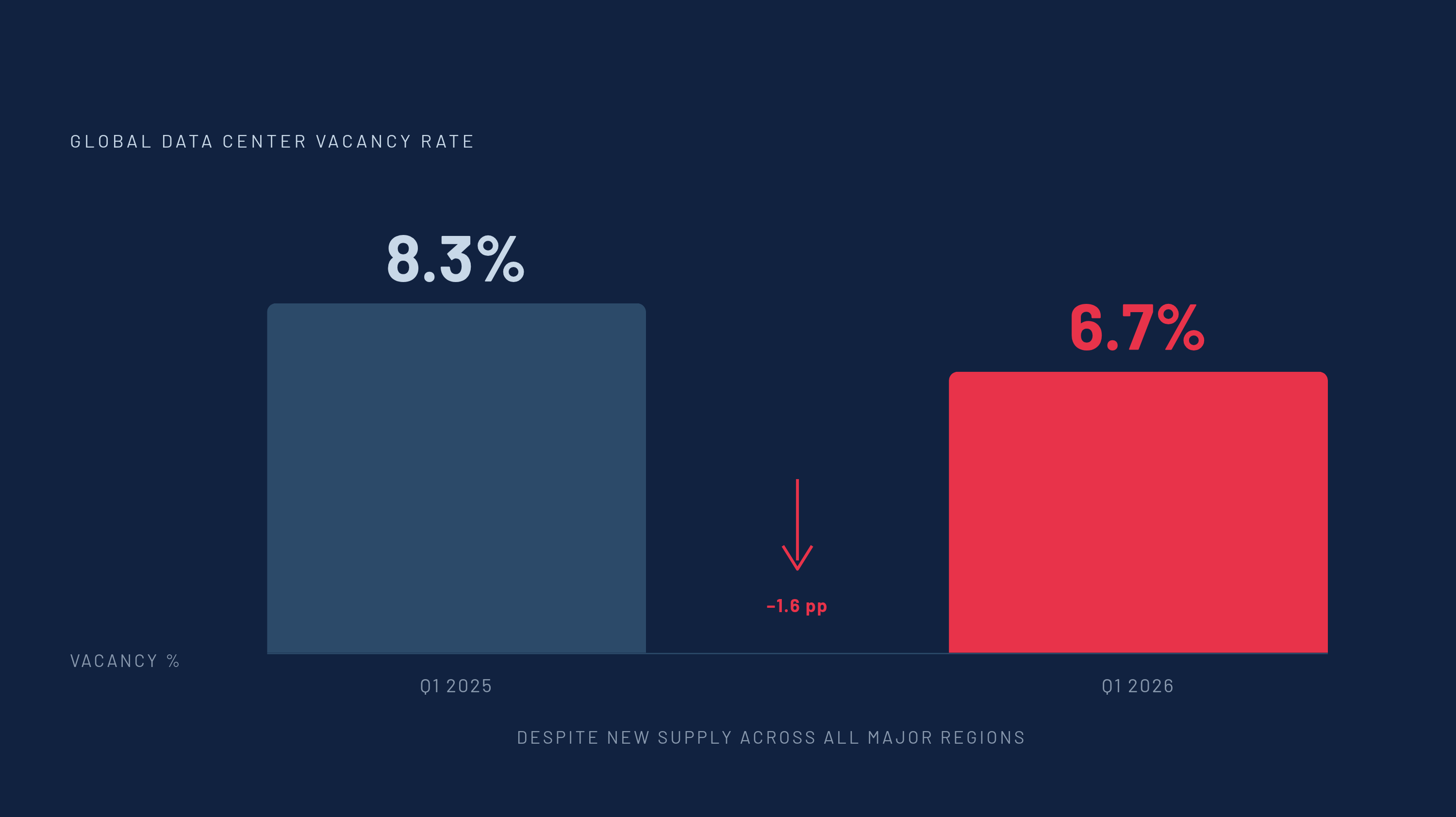
The colocation market isn't in a tight cycle that will loosen again on its own schedule. It has moved into a structural undersupply condition. Cycles end, but a structural condition needs a different planning posture. CBRE's Global Data Center Trends 2026 shows average global data center vacancy at 6.7% in the first quarter of 2026, down from 8.3% a year earlier, and supply grew across every major region. Vacancy falls even as construction continues, so demand is outrunning supply. The construction pipeline compounds the problem: most of what's being built is already spoken for before it delivers, so the headline pipeline number overstates what's actually available to a team that hasn't secured a position yet. Layer onto that a geography problem. Demand concentrates in a small number of core markets, while secondary and tertiary markets pick up a much smaller share of total absorption, so the national vacancy figure flatters conditions in exactly the places where most tenants want to be. If you build a capacity plan against today's available inventory, you're planning against a market that moved on months ago. The real starting point for planning is the precommitment date, not the vacancy figure.
Power availability, not floor space, as the binding constraint on absorption
Vacancy measured in square footage or rack count ignores power, the real constraint on whether space is usable. A site can show up as available capacity on a pipeline report and still be years away from delivering the power it was built to carry. Grid-connection timelines in primary markets now stretch well past a year in many cases, so a facility can look ready on paper and still have no confirmed energization date for a long stretch beyond its construction completion. That's an engineering problem before it's a real estate problem. If a project team plans to a nameplate capacity figure without checking substation status and energization dates, it has built a phasing assumption on a number that doesn't reflect what the grid can actually deliver on schedule.
AI workloads have made this worse by resetting what a rack even means in power terms. Training clusters draw far more power per rack than conventional server deployments, which shrinks the usable capacity of any facility designed around older density assumptions, even if the floor space and nameplate rating haven't changed. Older facilities built for lower, variable loads run into this directly: their power distribution systems, cooling infrastructure, and floor layouts weren't built for sustained AI-density loads, and retrofitting them is expensive enough that many effectively drop out of the usable supply pool. Supply figures need to be read against confirmed substation status and energization timelines, not against square footage or MW ratings sitting in a pipeline report. That's the only version of the number that tells a project team what it can actually build on the schedule it's working against.
How precommitment compresses planning horizons and redefines phased delivery
The traditional phased-delivery model assumed a buffer: build what's needed now, expand as demand confirms itself, and treat the gap between phases as a risk-management tool. That model depended on optionality that the current market has priced out. When most new supply gets committed before construction even starts, you have no slack left to wait and see. Enterprises that once locked in capacity six to twelve months ahead of deployment are now securing it eighteen to twenty-four months out, and that compression pushes major design decisions earlier in the project lifecycle, often before demand is fully understood.
That creates real tension for engineering teams. Power hall sizing, cooling system selection, and infrastructure phasing all have to get decided under more uncertainty than the old timelines ever required. Underbuild, and the facility has to go back to a market with no available capacity left to absorb the shortfall. If the facility is overbuilt, it carries stranded infrastructure costs against a schedule that was already tight. Modular and phased delivery architectures have gained ground because they try to compress the time between commitment and energization while preserving some flexibility, but that flexibility only exists if the design was built for incremental expansion from the start. Incremental expansion capability is a design brief requirement. It is not something a construction team can bolt on once ground has broken.
Demand concentration risk and facility sizing
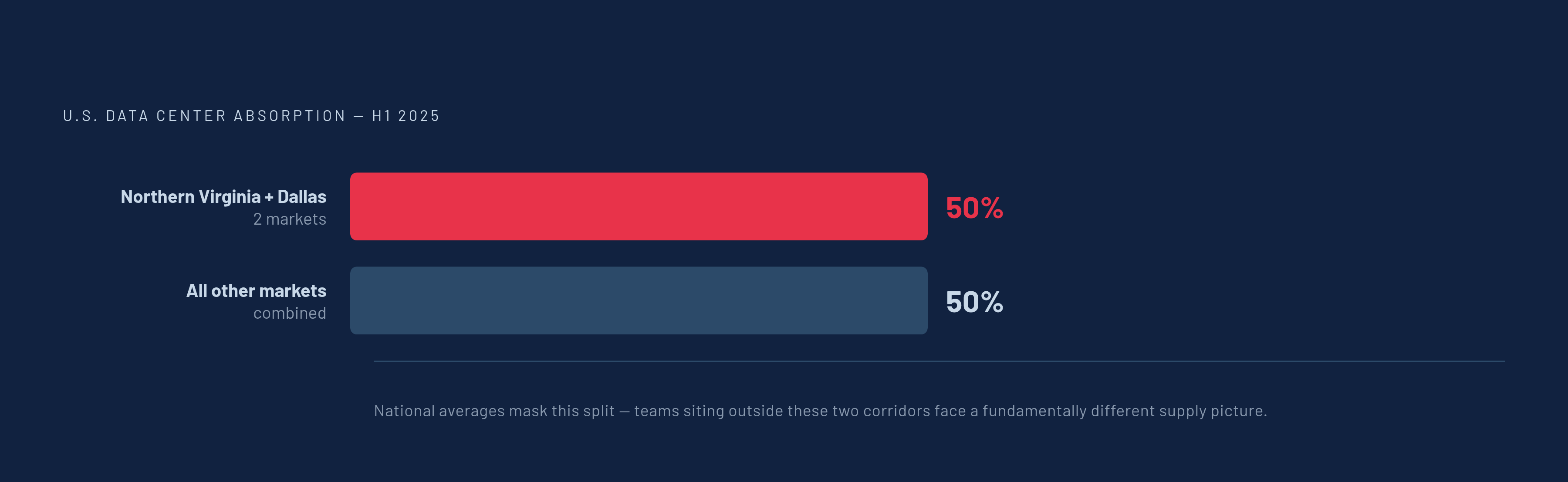
National absorption numbers hide a geography problem, and it matters enormously to the team sizing one specific facility. Half of all recorded absorption in the first half of 2025 went to just two markets, Northern Virginia and Dallas, leaving every other market to split a much smaller share. A capacity plan calibrated to the national average can be badly wrong for a facility sitting outside those two markets, because demand is so concentrated there that the utilization ramp and phasing risk look nothing alike.
Secondary and tertiary markets are growing their pipelines at a real pace, but that growth rests on thinner demand that depends more heavily on specific anchor tenants. A facility in one of those markets that loses a precommitment doesn't have the same depth of backup demand to draw on that a Northern Virginia or Dallas facility would. Capacity assumptions have to be built around the specific market a facility sits in, not derived from sector-wide absorption trends, and they need to account for how much of that facility's committed demand rides on a small number of anchor tenants. That concentration risk belongs in the design brief as explicitly as the power and cooling specifications do.
Utilization assumptions in power, cooling, and cable design
A utilization assumption doesn't just live quietly as a single line item in a spreadsheet. It's an input that runs through every major system in the building: power distribution sizing, cooling plant selection, cable and fiber routing density, and the load calculations that keep the facility running safely at partial load, full load, or beyond what was originally committed. Get that number wrong in either direction, and the consequences aren't the same size or shape. Underutilization assumptions produce oversized cooling plants, stranded power infrastructure, and cable trays built for density that never arrives. Overutilization assumptions produce power distribution systems that can't handle actual peak loads, cooling configurations that fail under sustained AI-density workloads, and cable routes that were never sized to carry the volume the facility eventually needs.
AI-density workloads force power and cooling to be designed together. Racks running at training-cluster densities need cooling specified as an integrated system from the start, not added after the fact, so the utilization assumption for AI-dense space has to be carried into mechanical and electrical design from the earliest layout decisions. Liquid cooling adds its own coordination demands on top of that: CDU telemetry, flow rate, temperature delta, pump status, and leak detection zones all need to be defined as integration requirements before the design is finalized, because none of that can be grafted onto a power and cooling architecture that's already locked.
When utilization assumptions live in a capacity plan that's disconnected from the power, cooling, and cable models, the fragmentation becomes expensive: one change in density target or phasing schedule forces you to manually rework every one of those systems separately. A rack move that triggers a cascade of manual updates across power, cooling, cable, schedules, and sheets is exactly the kind of rework that a connected design workflow is built to eliminate. That's not a theoretical efficiency gain. A phasing change can take an afternoon, or it can take weeks.
Capacity assumptions and the handoff to operational systems
A capacity plan can be fully sound at the design stage and still fail once the building is running, if the data that encodes those assumptions, meaning utilization targets, power caps, cooling thresholds, and asset configurations, doesn't survive the handoff from the design model into DCIM, EPMS, and BMS. That failure pattern is well understood: DCIM, EPMS, and BMS each serve a different operational audience, and unless the integration architecture spells out which system owns each data point, which system triggers which alarm, and how data moves between them, operational parameters get duplicated, dropped, or misaligned somewhere in the handoff.
Liquid cooling monitoring is a case where this often goes wrong. Assuming the BMS will handle CDU secondary loop performance is a structural mistake, because the BMS is built for facility mechanical systems and has no way to correlate CDU performance with IT workload. The handoff architecture has to define explicitly how liquid cooling telemetry reaches the operational monitoring layer, or that data simply has nowhere reliable to go. A DCIM-enabled digital twin is only as good as the data exchange architecture built into the facility during construction. Retrofitting that integration after handover is significantly more expensive and rarely complete, so capacity assumptions encoded in a design that never specified integration requirements are effectively lost the moment the building changes hands.
A facility can be technically at capacity on paper and operationally unable to prove it. That's the exact uncertainty the capacity plan was supposed to eliminate in the first place, reappearing at the one point in the project where it's hardest to fix. Structured handoff to DCIM, EPMS, and BMS isn't an IT project that starts once construction wraps. It has to be a design requirement specified before systems are sized, because that's the only point in the timeline where it's still cheap to get right.
Design process requirements for a capacity plan built for this market
A capacity plan built for current absorption conditions can't just be a more cautious version of a traditional plan. It asks the design process to do something structurally different from what it used to do. Utilization assumptions need to be market-specific and power-validated: build them from confirmed energization timelines and the density profile of expected tenants, not from aggregate vacancy figures that flatter conditions in markets where the facility doesn't sit. Phasing decisions need to be built into the design from the outset rather than added once construction is underway, with modular expansion capability, phased power delivery, and incremental cooling plant sizing designed in from day one, because the market will not hand back the optionality to retrofit any of that under pressure. Utilization assumptions need to connect directly to the systems models for power, cooling, cable, and fiber routing, so a change in density target or phasing schedule propagates automatically instead of requiring manual rework across models and documents that were never linked to begin with. And operational handoff requirements, covering DCIM integration architecture, EPMS data ownership, BMS boundary conditions, and liquid cooling telemetry definitions, need to be specified as design requirements before systems are sized, because working them out during commissioning costs far more.
All four of these requirements fail for the same reason: when the capacity plan, the systems models, the documentation, and the operational integration specifications sit in disconnected tools, nobody can trace, validate, or cascade the information that justified the original decisions once conditions change. ArchiLabs Studio is built for exactly that problem, connecting layout, critical-systems coordination, cable routing, documentation, and operations-ready handoff inside a single workflow, so the capacity assumptions written into the brief stay traceable and actionable all the way through construction handoff into DCIM, EPMS, and BMS. In a market with no vacancy buffer left to absorb a wrong assumption, precision in the design process is the only hedge a project team still has.