Utility Substation Capacity as a Site Gating Constraint
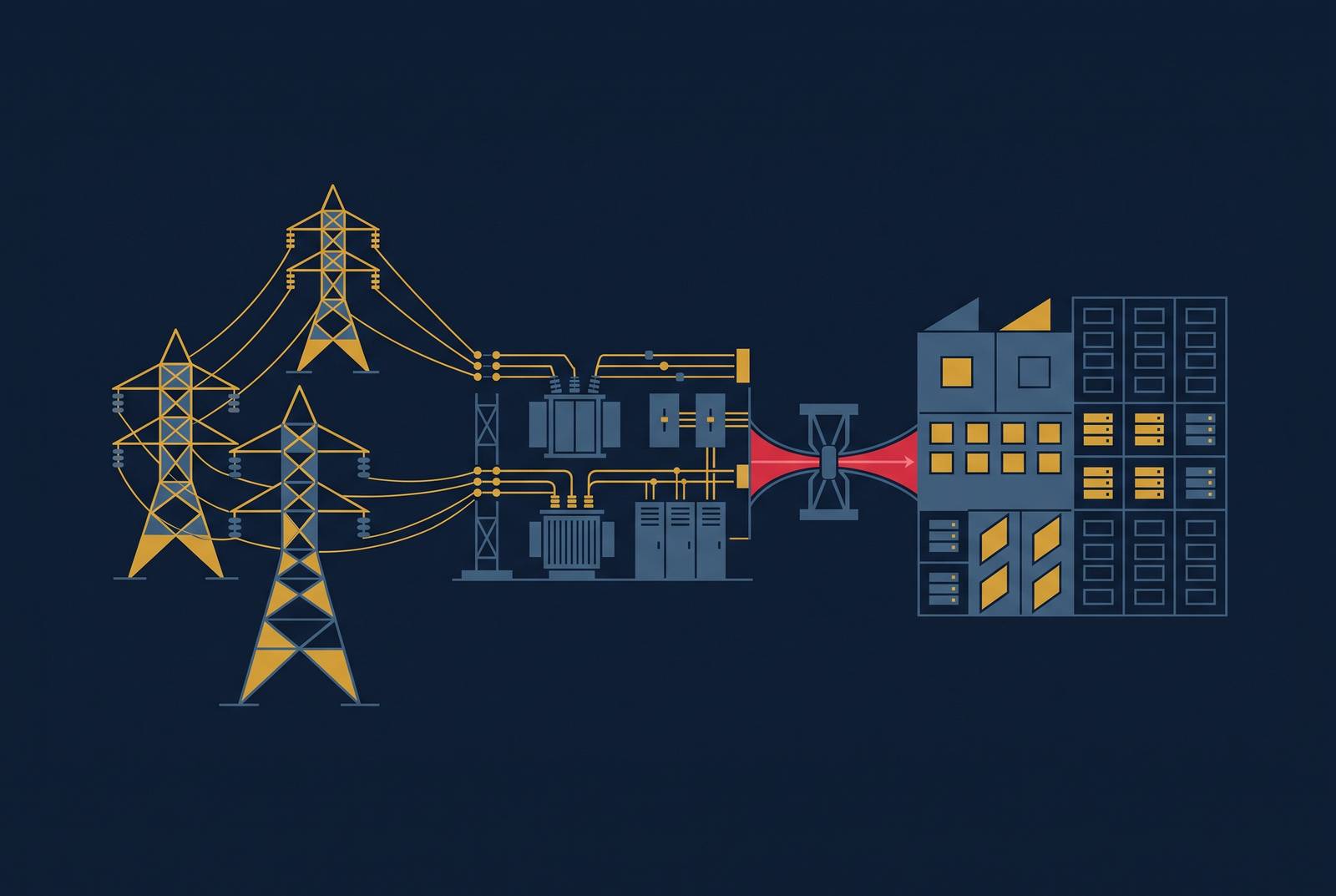
A finished data center building with no power running to it is a very expensive warehouse. Substation capacity has quietly become the constraint that delays a project's energizing for years after the concrete cures, even on schedules that assumed otherwise. A federal energy agency estimates 100 GW of additional peak generating capacity will be needed by 2030, with roughly half of that pull coming from data centers. Capital was never the bottleneck here. Power delivery is, and the industry has been slow to admit it.
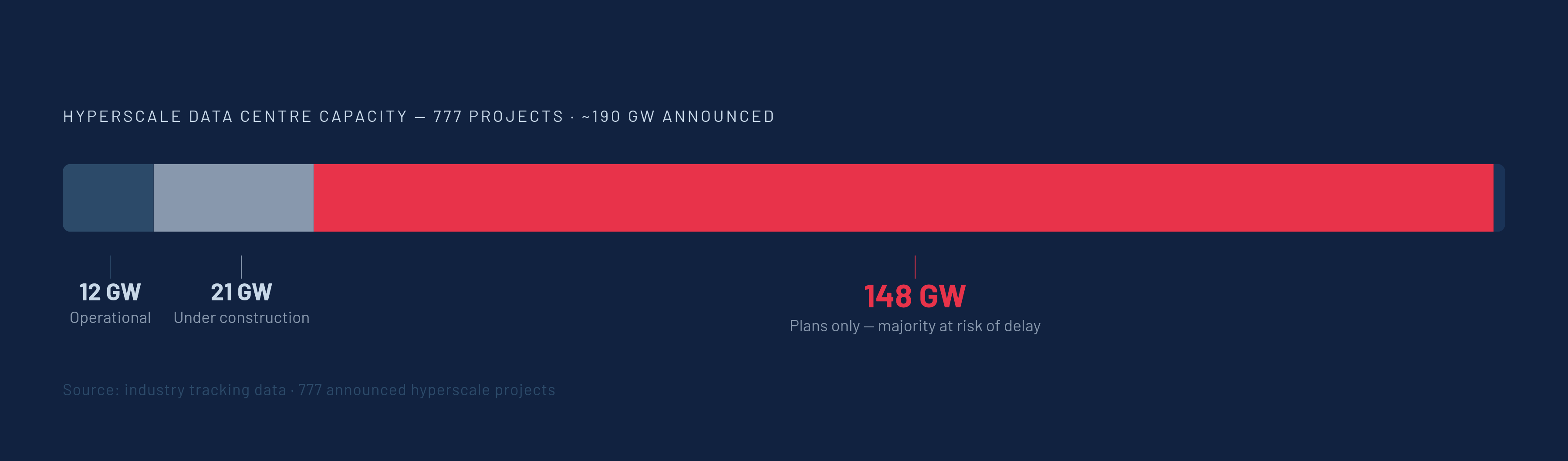
Across 777 announced hyperscale projects totaling roughly 190 GW, only about 12 GW is actually operational today, with another 21 GW under construction and the remaining 148 GW still sitting on paper. Industry tracking suggests a substantial share of scheduled capacity will be delayed, with the gap widening in the years that follow. A significant portion of projects, and potentially one out of two, will miss their date. The substation is usually why. Most site-selection teams still treat it like a formality, and that habit is the single biggest miscalculation in the industry right now.
What a data center substation does and why it is the longest pole in the schedule
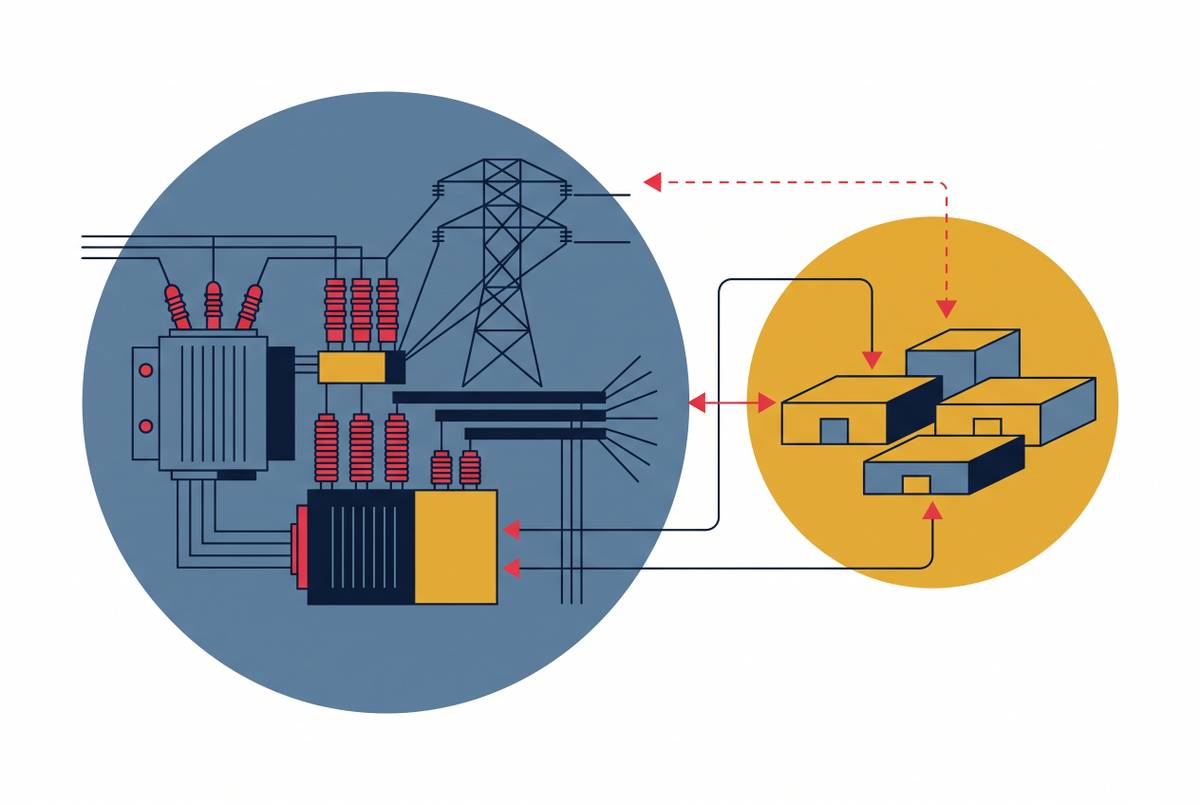
A substation is the electrical front door. It takes power off the utility's transmission or sub-transmission lines, at 69 kV, 115 kV, 138 kV, 230 kV or higher, and steps it down to a voltage the data center can use inside its own walls, typically 34.5 kV or 13.8 kV.
Four jobs have to work together or the site simply doesn't function. Voltage transformation runs through redundant power transformers, N+1 or 2N configurations, so a single failed unit doesn't take the whole campus down. Isolation and protection depend on circuit breakers, disconnect switches, and relaying coordinated to clear faults in cycles, not seconds. Revenue metering marks the legal and financial boundary between the utility and the customer. SCADA and control give both sides real-time visibility into load, power quality, and switching status.
A 250 MW campus, using figures from ATK Energy, typically needs two or three transformers rated around 150 MVA each, a ring-bus or breaker-and-a-half arrangement on the high-voltage side, and 34.5 kV switchgear feeding power across the site. Every one of those choices, the redundancy scheme, the voltage level, how much room gets left for future expansion, locks in the campus's reliability ceiling for the rest of its operating life. There's no cheap fix later if any of it gets sized wrong.
A building goes up in months, on skilled crews and standard materials and a process everyone already knows. A substation doesn't run on that clock. It runs on equipment lead times and interconnection paperwork, and neither one cares how fast the general contractor moves. Transformer lead times for 100+ MVA units now run 90 to 130 weeks, with some specialized units stretching past 160 weeks, based on tracking from ATK Energy. High-voltage breakers, gas-insulated switchgear, and protection relays carry their own waits on top of that.
The transformer order and the interconnection application belong in the same week the site closes, not after the architects finish the drawings.
The equipment supply crisis that is setting energization dates regardless of construction progress
A large power transformer is a custom-built machine, engineered to the exact voltage, impedance, and cooling spec of the site it's going to. Data centers, grid hardening projects, and electrification of transportation and heating are all pulling from the same small pool of manufacturers at the same time, and none of them can wait their turn gracefully.
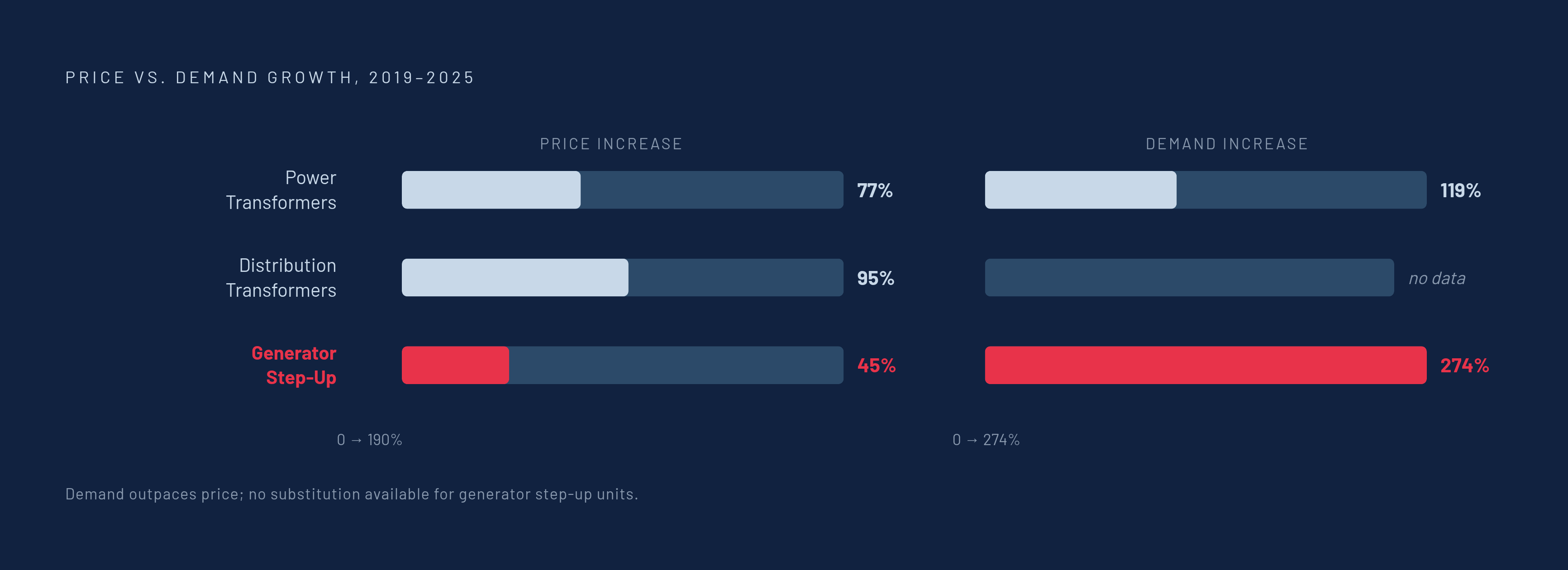
The price data makes the shortage plain. Since 2019, power transformer prices are up 77%, generator step-up transformer prices are up 45%, and some distribution transformers have jumped as much as 95%, according to Wood Mackenzie figures published in August 2025 via Global Data Center Hub. Demand climbed right alongside those prices: power transformer demand up 119% over the same stretch, generator step-up demand up 274%. Nobody substituted their way out of this, because there's no cheaper part to swap in when the one you need is engineered to spec.
The equipment delivery date sets the energization date. Not the construction crew, not the permit office. The transformer shop's production queue decides when the site goes live, and the diligence bar has to shift accordingly. Before anyone credits a delivery timeline in a site package, three things need documentation: an executed or secured interconnection position, transformer and switchgear order slots with a 24-to-48-month lead time assumed as the baseline, and allocated substation capacity that isn't just a verbal commitment.
A lot of site-selection packages carry a utility willingness letter and call it proof. A willingness letter is not a secured order slot, and treating it as proof leaves the actual commitment unverified. A willingness letter says the utility is open to talking. An order slot says a factory is building your transformer, on a specific date, against a specific spec. In a supply chain this tight, that gap separates a real date from a guess dressed up as one.
The workflow has to change too. Equipment parameters need to lock before the final drawings even get issued, with procurement running alongside engineering instead of waiting for it to finish. Call it the EPC overlap model. It's the only way to compress a schedule that the equipment market keeps trying to stretch in the other direction.
The interconnection queue turning a viable substation into a multi-year wait
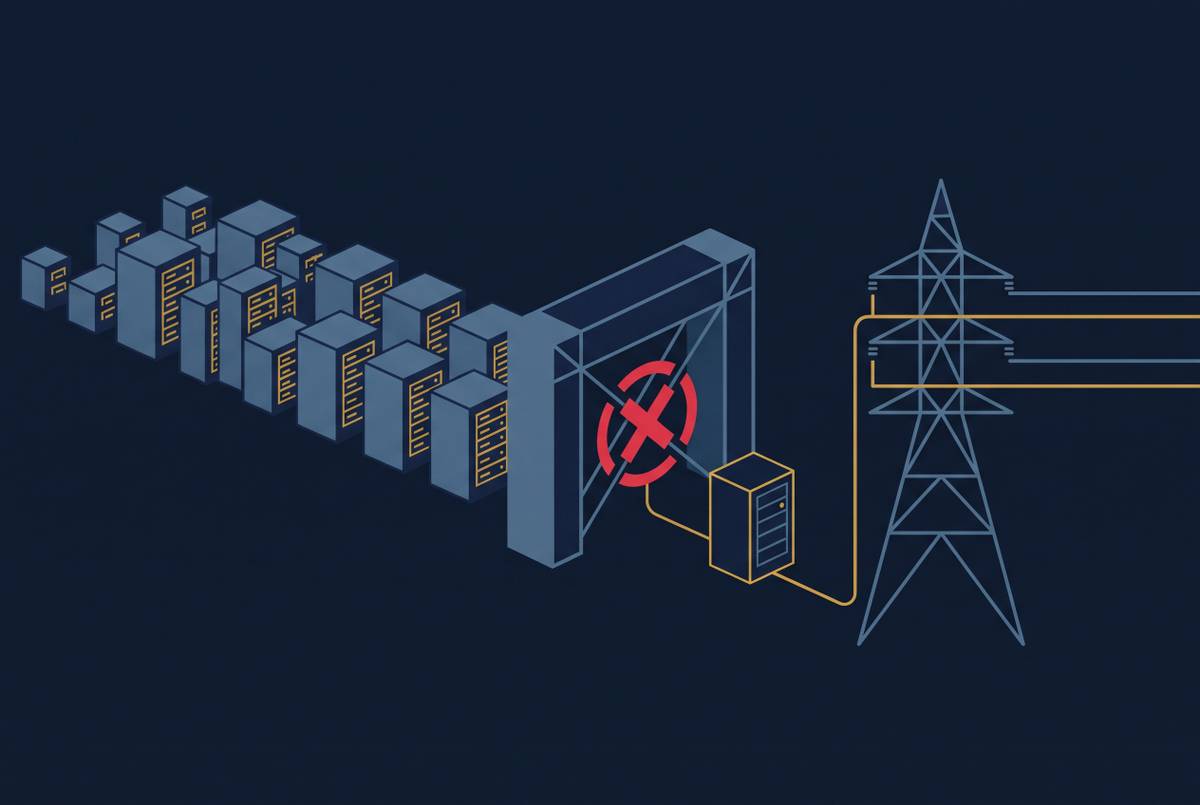
Even a substation with capacity to spare doesn't guarantee a fast connection. Queue-to-commercial-operation timelines have grown roughly 60% since 2017, and Enverus Intelligence Research shows projects targeting first power in 2025 now average over 2,100 days in the queue. Close to six years, waiting on paperwork and studies after the equipment question is already settled.
The mismatch is stark. A data center can be built in 12 to 18 months. Connecting it to the grid, in some of the busiest markets, takes 5 to 7 years. Over 2,000 GW of capacity is now in national interconnection queues, and Enverus estimates only about 10% of that will ever actually get built. Calling this a pipeline gives it too much credit. It's a backlog with a brutal drop-out rate.
ERCOT shows how bad this gets in a hot market. Its queue hit 474 GW, roughly 90% of it data centers. In June 2026, ERCOT rolled out a Batch Zero framework grouping large loads of 75 MW or more into coordinated study batches, covering roughly 205 GW of eligible capacity. Then on August 3, Governor Abbott halted all new data center grid connections pending an audit by the state's utility commission and grid operator. Projects now have to disclose ownership, financial backing, water use, and community impact before they can move forward, and ERCOT expects the verification process to run several months.
PJM tells a similarly rough story, with waits approaching 7 years. Its December 2025 capacity auction for the 2027/28 delivery year cleared at the FERC-approved price cap of $333.44 per MW-day, generating $16.4 billion in total capacity costs, of which data centers accounted for $6.5 billion, or 40%. Even at that price, the auction fell 6,623 MW short of PJM's reliability requirement. The 2024/25 auction cleared at just $28.92 per MW-day. Clearing prices rose more than tenfold in a single year, and that alone tells you how tight the margin has gotten.
Washington has noticed. On October 23, 2025, DOE Secretary Chris Wright invoked Section 403 of the DOE Organization Act, a rarely used authority, to direct FERC to act. FERC issued its Order Regarding Intent to Act on April 16, 2026, and by June 18, 2026, had sent tailored show-cause orders to all six regional grid operators under its jurisdiction, telling each to justify its current large-load tariffs or propose changes. Separately, FERC Order No. 1920, issued in May 2024, requires transmission providers to plan 20 years out on a regional basis. It's a sound long-term fix, but it won't move anyone's 2027 date, since transmission projects take many years from planning to energization regardless of how the tariffs get rewritten.
Cost allocation is where the political friction is visible, in rate cases and utility filings that residential customers actually read. In PJM, data center growth drove a $9.3 billion capacity cost increase for the 2025/26 delivery year, working out to roughly $16 to $18 more per month on residential bills in Ohio and Maryland. That kind of pass-through doesn't stay a technical issue for long. It turns into a regulatory fight, and it will keep shaping how utilities negotiate with large loads for years to come.
Transmission planning diligence before a site is committed
What actually matters is whether the transmission system will still have room when the project is ready to energize, years from now, after the equipment ships and the queue clears. It's whether the transmission system will still have room when the project is ready to energize, years from now, after the equipment ships and the queue clears. That distinction is why transmission planning has become one of the highest-risk variables in site development, arguably riskier at this point than zoning or water rights.
Traditional power diligence, checking local utility capacity, substation proximity, voltage class, available feeder headroom, still matters, since without it a project's viability cannot be settled on its own. Residential load growth adds up gradually, across thousands of small connections spread over years. A data center lands as one enormous block, large enough on its own to force a utility to redo its load forecast or trigger a full network upgrade study.
Four questions belong in every transmission diligence review before a site gets committed. Has the utility already folded this specific load into its system forecast? Are regional transmission upgrades funded and scheduled, and on what timeline? What network upgrades will the interconnection study likely require, and who pays for them? Does transmission congestion in the area make the nameplate capacity less reliable than it looks on paper?
Voltage screening looks different depending on the developer. Hyperscale operators generally target higher-voltage transmission lines with substantial hosting capacity headroom, filtered further by available transfer capacity and land that clears zoning and acreage thresholds. Colocation operators work with 69 kV to 115 kV lines carrying 10 to 50 MW of headroom. Edge deployments check whatever subtransmission line feeds the nearest distribution substation, then look at the substation's expansion potential given supply-side constraints.
Off-market siting adds more layers, according to Enverus: parcel buildability, substation withdrawal capacity, transmission congestion context, proximity to natural gas supply and pipeline infrastructure, and competitive load analysis. What separates a credible site from a speculative one comes down to one document. A real interconnection queue position means something concrete. A utility willingness letter means somebody was polite in a meeting, and that politeness can evaporate the moment network upgrade costs get calculated.
Power-first site selection and the market pricing that reflects power scarcity
Site selection logic has flipped, and anyone still running the old playbook is going to lose sites to people who aren't. It used to start with fiber routes and customer proximity. Now it starts with available generation capacity, full stop. Call it power-first development: a complete reversal of how real estate decisions used to get made in this industry.
The most sought-after sites right now are the ones that can deliver power within 18 to 24 months. That window has become the single biggest differentiator in the market, ahead of land price and tax incentives both. Some developers are locking in power purchase agreements before they've even finalized the land deal. The PPA comes first. The deed follows.
Pricing already reflects the scarcity. Colocation pricing data from the first half of 2025 shows Silicon Valley posting nearly 20% growth, driven by persistent power constraints, with other major markets showing similar upward pressure. Power scarcity isn't a background risk anymore. It raises the lease rate directly, in the same lease cycle, not two years down the road.
The largest hyperscalers have responded by hedging geographically, banking land across multiple sites in PJM and MISO on the bet that at least a few will clear the interconnection bottleneck on an accelerated track. It's a probabilistic play across a portfolio, spreading the bet rather than relying on any single site.
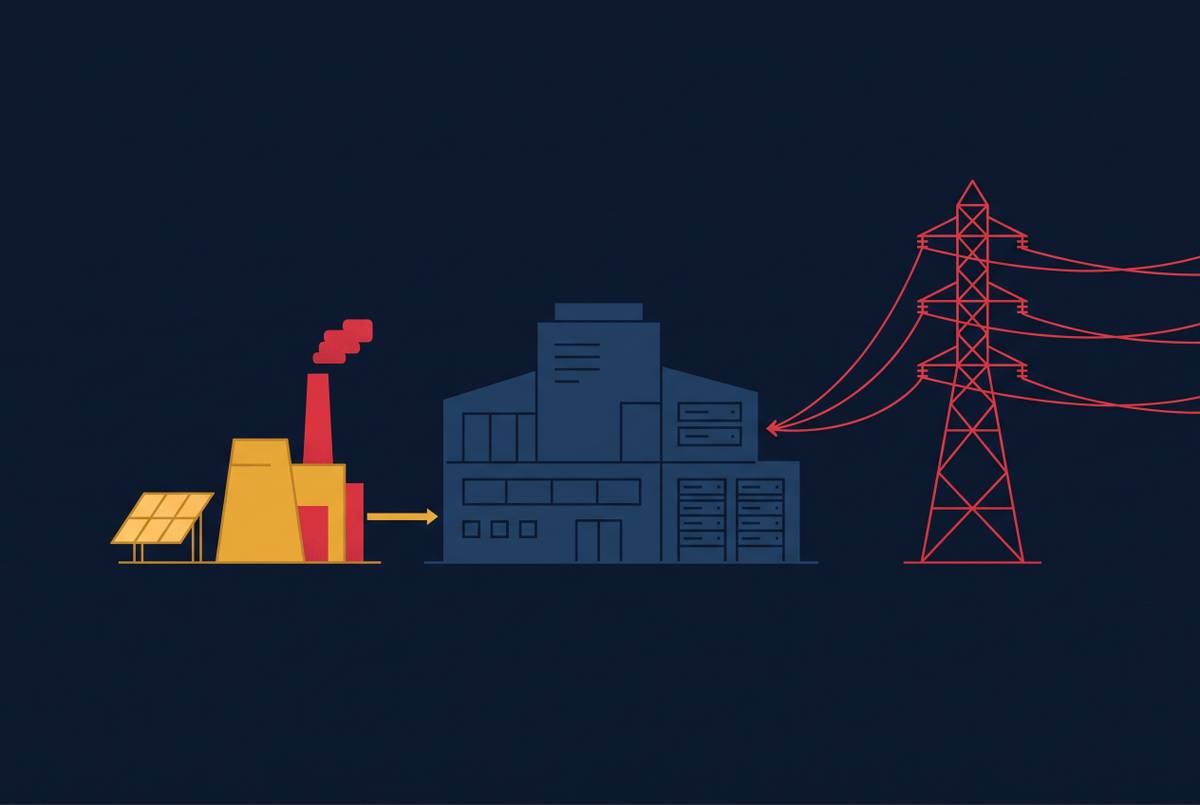
Bring Your Own Generation, or BYOG, has emerged as a bridge, not a fix. Enverus tracks more than 40 GW of announced behind-the-meter and co-located generation, with natural gas as the dominant fuel. For a project targeting service in the next 18 to 36 months, BYOG can compress a multi-year interconnection wait into a matter of months. The long-term interconnection position still has to get secured, though, and behind-the-meter generation brings its own permitting, fuel supply, and cost baggage that doesn't disappear just because the grid connection is delayed.
Industry analysis projects 14% compound annual growth through 2030, with close to 100 GW of new capacity coming online. Demand was never the question. The projects that capture that growth will be the ones that treat power as the first constraint checked, ahead of everything else, before anyone breaks ground.
The substation evaluation elements needed to function as a real go/no-go gate
A substation evaluation that actually works as a gate, instead of a formality everyone signs without reading, has to cover three layers in order before anyone signs off on a site.
Local substation capacity is layer one: allocated capacity, voltage class, available headroom, redundancy topology, room for future expansion, and alignment of the metering and protection approach with utility requirements. Layer two is equipment procurement position, meaning transformer and switchgear lead times assumed at a minimum of 24 to 48 months, order slots documented rather than assumed, and a preliminary one-line diagram finished before any procurement decision gets made. Layer three is transmission system context, covering interconnection queue position, the scope and cost allocation of required network upgrades, the utility's regional planning horizon, and confirmation that the load has actually been folded into the utility's system forecast.
The one-line diagram is where all three layers converge. Load definition, redundancy requirement, and ultimate buildout size need to get fixed before a single transformer gets ordered. Getting the sizing wrong is expensive on its own. Getting it wrong after placing an order on a 128-week lead time turns into a program-level failure, the kind discussed in board meetings, not fixed with a punch list.
Interconnection applications and substation engineering need to run side by side from day one. Finish the design, then file the application: treat that as two separate milestones instead of one continuous process, and the result is a stalled project sitting half-built with no power date in sight.
Design documentation that doesn't track equipment delivery status against the interconnection schedule isn't doing its job. The two timelines have to be managed as one, and most teams still manage them as two.
A substation evaluation throws off dozens of interdependent parameters: transformer sizing, switchgear configuration, voltage selection, protection philosophy, expansion provisions. Every one of those cascades into power distribution, cooling design, cable routing, and the documentation needed for operations handoff. Manage those parameters across disconnected spreadsheets and PDFs, and a single change to transformer specification triggers manual rework across every downstream document, on a schedule with no slack left to absorb it. A tool like ArchiLabs Studio earns its place here precisely because it ties critical-systems parameters directly to layouts, schedules, and handoff documentation, keeping the substation evaluation a living part of the project instead of a one-time exercise everyone quietly ignores the moment construction starts.
Sources
- U.S. Data Center Infrastructure: The Binding Constraint (Mid-2026)
- Time to Power: Fast-Track Data Center Energization
- Data Center Substation Construction in 2026: What Developers and Hyperscalers Need to Know - ATK Energy
- Siting Data Centers on the Subtransmission Grid
- hanwhadatacenters.com
- Power-First Data Centers in 2025: How Grid Constraints Are Repricing Land, Leases, and Revenue
- atkenergygroup.com
- electricchoice.com