Compute Retirement Cycles and Refresh Impact on Capacity Models
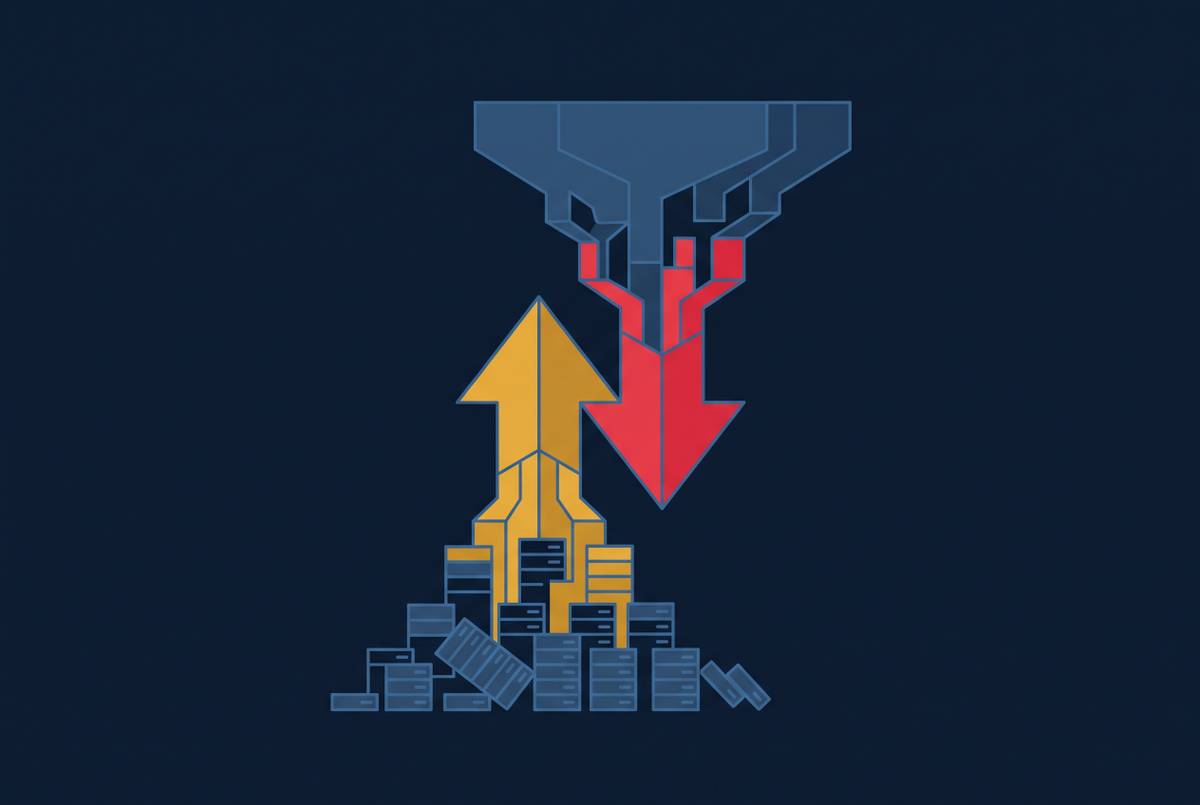
Faster GPU cycles force capacity models built for six-year timelines to fail.
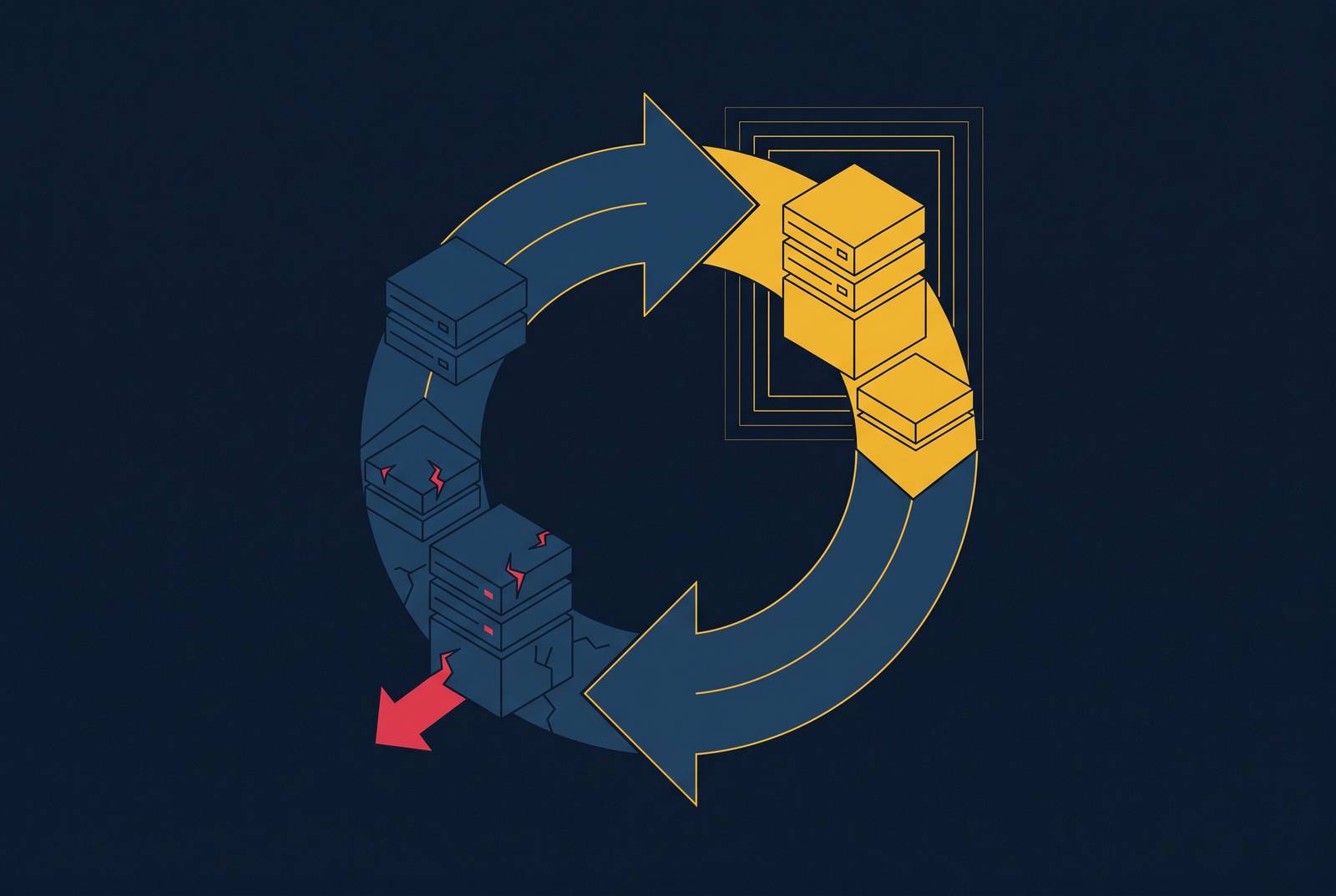
Capacity models used to be built around a simple fact: compute hardware lasted a long time. CPU-based servers depreciated over five to seven years, and between 2022 and 2024 hyperscalers settled on six-year useful-life assumptions as the industry standard (Amazon shortened that back to five years in early 2025). That timeline was slow enough to plan around and stable enough to trust. If a data center's assets turned over once per decade of the building's life, a capacity model built at design time could stay accurate for years with little upkeep.
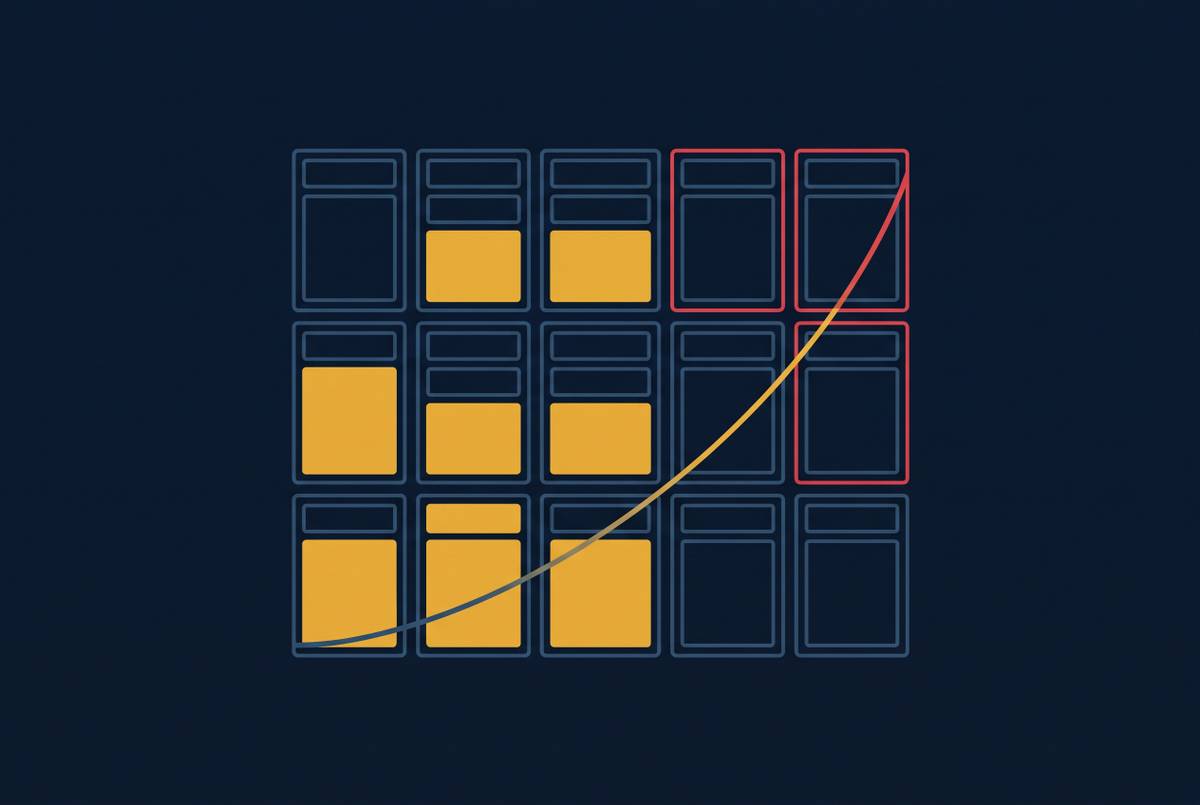
AI infrastructure has broken that arrangement. Refresh cycles that once ran five to seven years have compressed to 18 to 36 months because of architectural velocity: each new GPU generation makes the previous one economically suboptimal for large-scale inference within 18 to 24 months of enterprise deployment. NVIDIA's major architectures tell the story in their release dates alone: Ampere in 2020, Hopper in 2022, Blackwell in 2024, Rubin in 2026. A new generation every two years is a structural break from the six-year depreciation math that most capacity models were built on.
A model designed for six-year cycles does not just run a little behind when cycles compress to 18 to 36 months. It becomes wrong in a way that compounds. Every refresh wave that passes through a model built on the old assumption pushes the model further from the facility it is supposed to describe, and the gap does not close on its own.
Why AI has not accelerated the whole stack equally
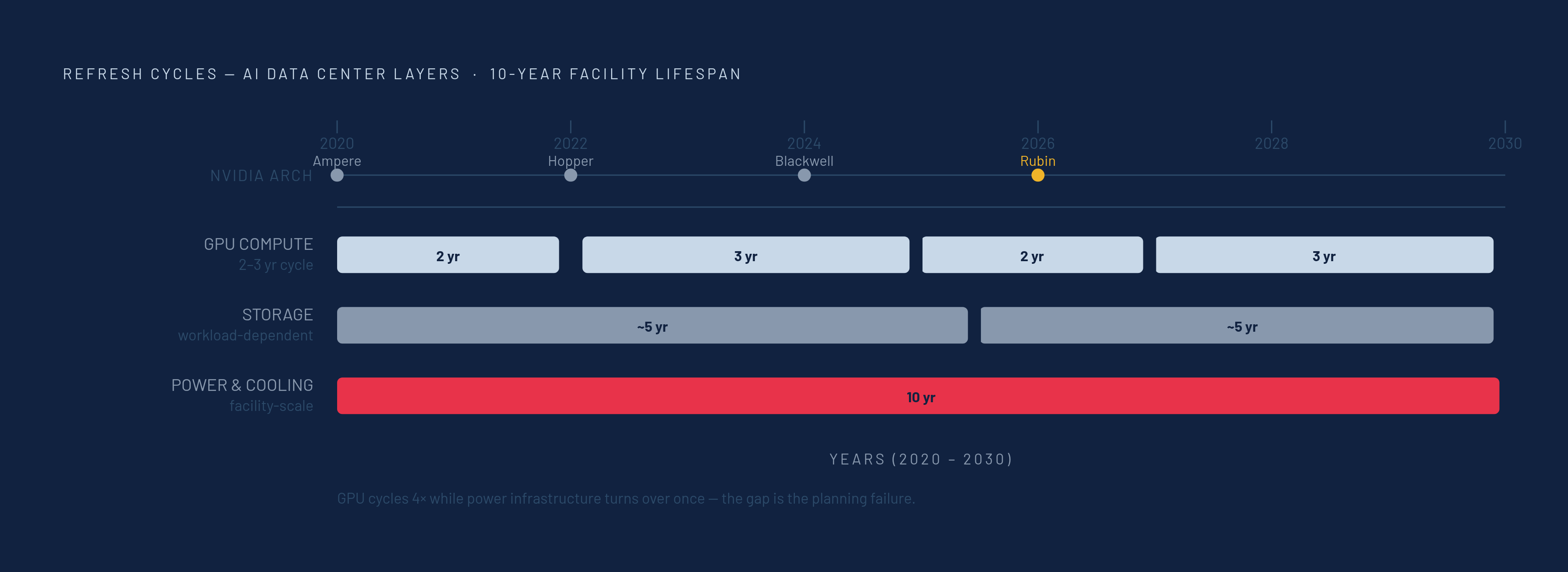
The common assumption is that AI simply sped everything up, and that a capacity model just needs a faster clock. That is not what happened. AI widened the gap between infrastructure layers instead of compressing them uniformly, producing a multi-speed asset base that no single timeline can describe.
Storage alone shows two different refresh logics running side by side. HDD refresh follows capacity economics and workload fit. SSD refresh follows endurance, write activity, and platform qualification constraints. Neither moves on the same clock as GPU compute, and GPU compute itself moves on a different clock than the facility infrastructure around it.
A modern facility runs at least three simultaneous refresh timelines inside one capacity envelope: GPU compute cycling every two to three years, storage systems on longer and workload-dependent schedules, and power and cooling infrastructure on a timeline of its own. A model that treats all of this as one cohort with one lifecycle gets the timing wrong across the board. Tracking each layer separately is a necessary fix, but not a sufficient one. A model can track compute, storage, and facility infrastructure as three distinct timelines and still fail, if it does not also capture how a change in one layer forces a change in another, such as a GPU refresh that forces a rebuild of the power and cooling system serving it.
Power density as the physical mechanism that forces facility redesign during a refresh
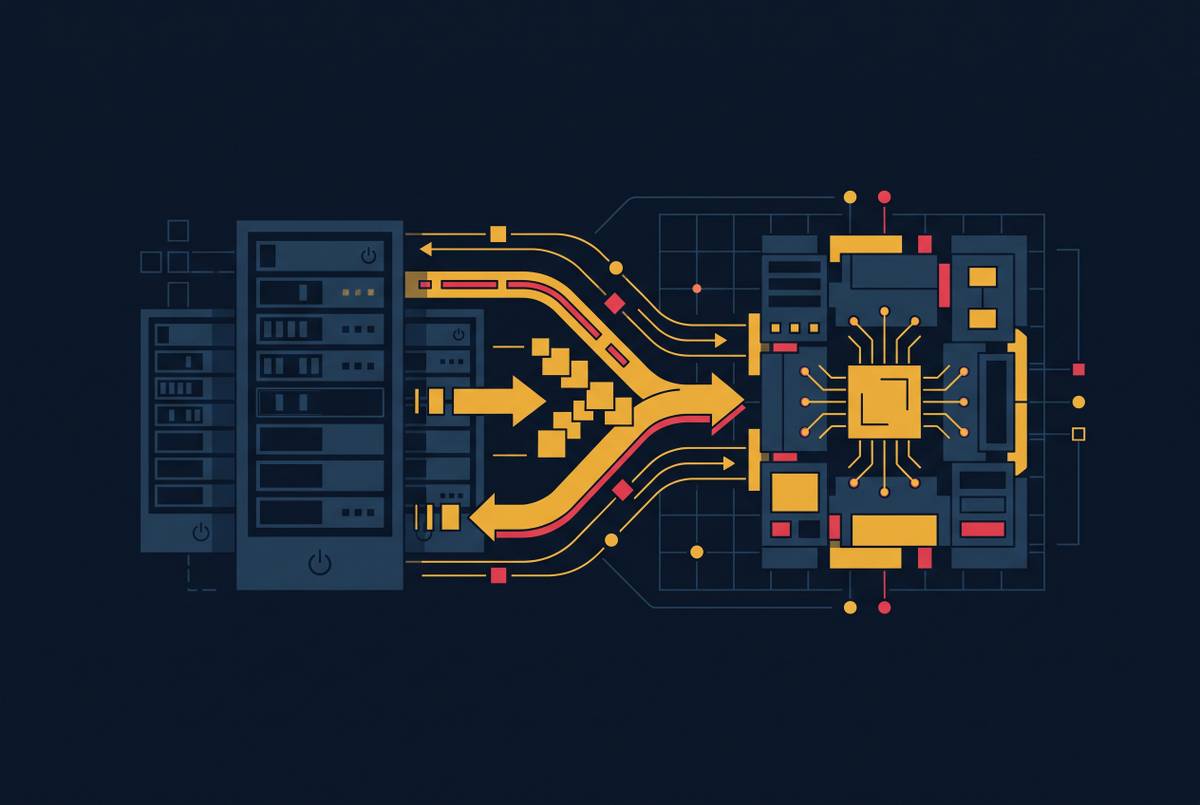
That cross-layer dependency is not theoretical. It shows up as power density, and power density is a physical problem long before it becomes a modeling problem. A GPU refresh is not a like-for-like swap of one box for a newer box in the same slot. The jump in power draw between generations is large enough to force a redesign of the electrical and cooling systems that support the rack. A capacity model has to account for facility constraints, not just how many units are installed.
Training AI models now requires 40 to 100-plus kilowatts per rack, and standard air conditioning cannot keep pace with that load. Liquid cooling is a planning requirement that has to be built into the model from the start, the same way rack counts and power budgets are.
The supply chain adds a timing constraint on top of the physical one. AI chips, specialized power transformers, and liquid cooling loops all carry long lead times, and organizations are pre-ordering this equipment 12 to 24 months in advance. A capacity model that waits until the compute refresh arrives to think about facility upgrades is already too late. The upgrade has to be triggered well ahead of the refresh, on its own separate schedule, or the facility will not be ready when the new hardware shows up.
What breaks in a capacity model under continuous refresh pressure
Traditional capacity models carry four assumptions baked in from the era of slow, predictable turnover. Asset cohorts are treated as homogeneous. Lifecycles are treated as known at design time. Retirements are expected to arrive in predictable waves. And facility infrastructure is assumed to outlast several generations of compute without redesign. Continuous refresh breaks every one of these assumptions, and it breaks them at the same time.
Predictable waves turn into continuous flow. At 18 to 36-month AI cycles, decommissioning becomes an ongoing operational program running at all times, not a periodic project. That means the inputs a capacity model depends on, what is installed, what is being retired, what is being procured, change faster than a static model gets updated. A model refreshed once a year is tracking a facility that has already moved through most of a hardware generation by the time the update happens.
The financial layer of the model breaks too, and for reasons that have nothing to do with refresh timing directly. Component cost volatility has hit server and workstation memory the hardest, with major OEMs including Dell, Lenovo, Cisco, and HP signaling component-driven price increases on enterprise gear. A refresh budget set when the model was built can be unreliable well before the refresh it was meant to fund ever arrives.
There is also a recovery problem that static models have no way to surface. High-value retired assets lose a substantial share of their recoverable worth within weeks of retirement. A capacity model that treats retirement as a single binary event, in service one day and gone the next, never accounts for that decay curve, and the organization loses value it never knew it was losing until the window has already closed.
The Design-to-Operations Handoff
All four of those failures become real at one specific moment: when a refreshed rack enters a facility that was modeled at an earlier point in time. A capacity model that gets updated carefully during planning but has no live connection to operational systems turns into a liability the instant the first refresh happens, because the facility's DCIM, EPMS, and BMS keep describing the building as it was designed while it is actually running differently.
This is a precise coordination failure, not a vague one. PDU and branch-circuit load belongs to the EPMS for power quality and events. The same load belongs to the DCIM for per-rack capacity planning. The BMS only needs the alarm. If all three systems poll the same PDU directly instead of working from a shared, structured data source, the PDU's network card can fail under the load, and all three systems lose visibility at once.
Power already causes more high-impact outages than any other single factor, the Uptime Institute's outage analysis shows. A refresh that changes rack power draw without updating the EPMS, DCIM, and BMS together creates precisely the blind spot that tends to precede those outages. The risk is not abstract. It sits exactly where power data is supposed to be shared across systems and instead gets siloed inside each one.
The construction handoff makes this worse before the facility even opens. Construction workflows are built around getting the fit-out finished, not around supporting decades of operational life afterward. When critical mechanical, electrical, and liquid cooling data ends up trapped in contractor spreadsheets that never make it into operational systems, the owner inherits a financial and operational liability the moment the keys change hands, well before the first refresh cycle even begins.
An integrated alternative exists, and a 2026 deployment shows what it looks like in practice. One operator ran Siemens Desigo CC and SENTRON Powermanager together to manage HV/MV, LV, and UPS systems inside a single platform, giving that facility visibility across mechanical and electrical infrastructure that a fragmented three-system setup cannot sustain once refresh events start stacking up. A capacity model is only as reliable as its connection to that kind of operational truth. Disconnected from DCIM, EPMS, and BMS data, the model describes a building that no longer exists.
What a capacity model designed for continuous refresh requires
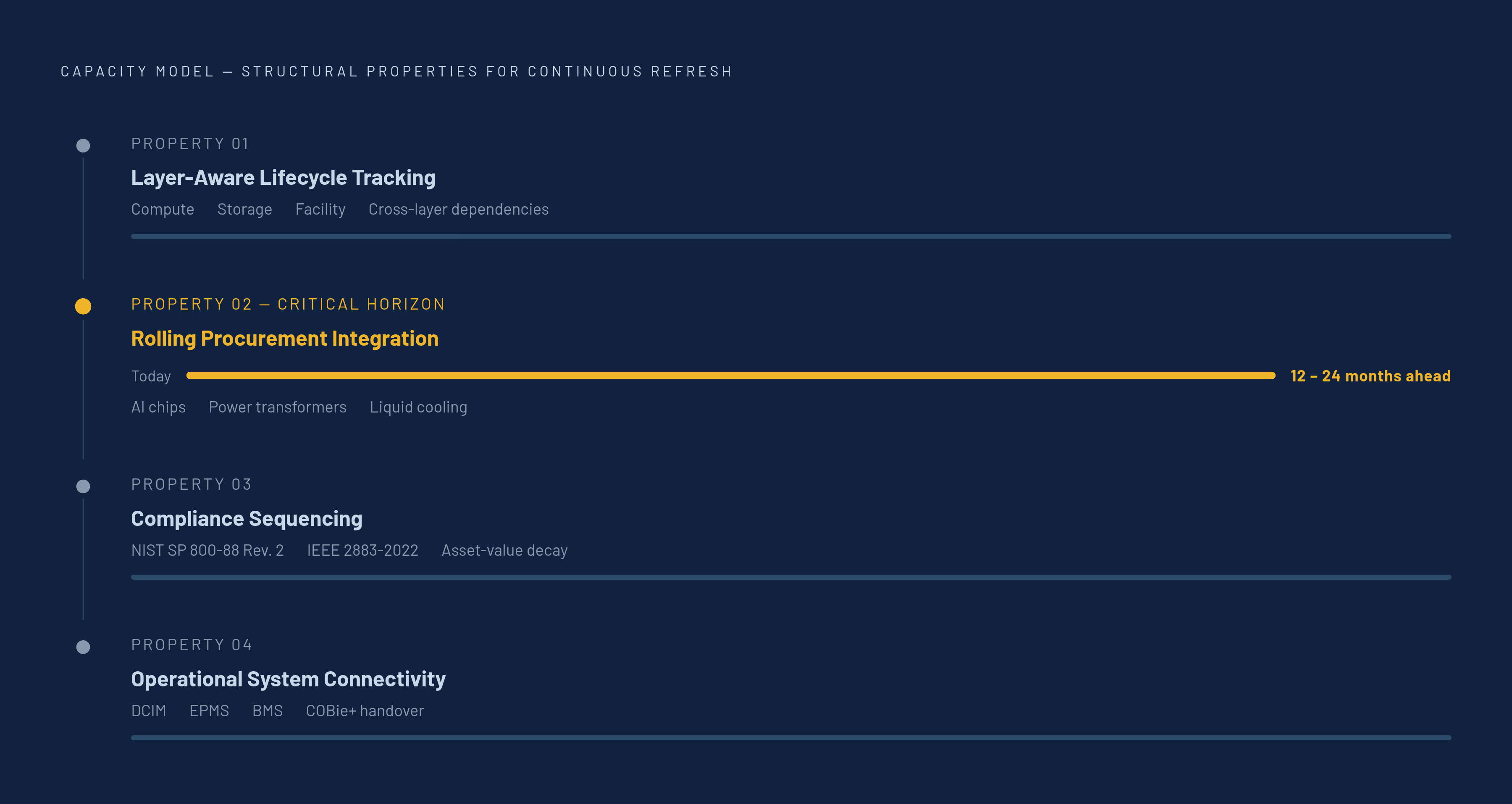
A capacity model built for continuous refresh is a different kind of artifact, one built to take refresh events in as regular inputs rather than treating each one as a disruption that knocks the model out of date.
Four structural properties separate a model that survives continuous refresh from one that does not.
Layer-aware lifecycle tracking comes first. The model has to track compute, storage, and facility infrastructure independently, each on its own refresh timeline, while also representing the dependencies that run between them. A GPU refresh that will force a power infrastructure upgrade needs to surface that dependency before procurement starts, not after the new hardware is already sitting in the rack waiting on power it does not have.
Rolling procurement integration comes second. Supply chains for AI chips, specialized power transformers, and liquid cooling loops now run 12 to 24 months of lead time. A capacity model has to trigger facility and procurement decisions at that horizon. Refresh timing needs to be modeled as a range of likely dates on a calendar.
Compliance sequencing belongs in the model as a first-class input, not an afterthought handled separately by a different team. NIST SP 800-88 Rev. 2 and IEEE 2883-2022 set hard requirements for data destruction on retired assets, turning retirement timelines into compliance sequences with real deadlines attached. Combined with the fact that recoverable asset value drops fast after retirement, the model has to optimize the recovery window with the same care it gives the installation window, not treat recovery as a cleanup task that happens after the real planning is done.
Operational system connectivity closes the list. A capacity model with no structured connection to the DCIM, EPMS, and BMS systems running the facility turns into a historical document the moment the first refresh happens. The mechanism that keeps a model current through the building's operational life is the moves-adds-changes workflow paired with a COBie+ handover schema, carrying structured data forward instead of letting it die in a one-time handoff document. A model that depends on deterministic, rule-based logic for things like power budgets and compliance sequencing, with judgment reserved for the genuinely novel parts of a refresh, holds up better than one that tries to predict everything probabilistically and trusts the prediction blindly.
Where fragmented toolchains fail
Most teams are not failing to build models like this because they lack the intent. Every refresh event forces the same information to be rebuilt by hand across design models, spreadsheets, PDFs, and separate operational systems because the tools underneath the model are not connected to each other.
The fragmentation runs deep in the toolchain itself. Design models, DCIM platforms, EPMS, BMS, and ITAD tracking systems each hold only a partial view of the asset base. A single refresh event changes power draw, cooling load, rack position, and retirement compliance status all at once. All of those systems need updating together. In a fragmented workflow, each system gets updated on its own, by different people, at different times, and the records drift out of sync with each other within a single refresh cycle.
At 18 to 36-month cycles, that manual rework is a tax paid on every generation, and it grows heavier as the hardware being refreshed gets denser and more complex to plan around.
A connected workflow changes the economics of that tax. When a rack change propagates automatically through power load calculations, cooling capacity checks, cable routing, compliance documentation, and operational records, the model gets updated once and the update holds everywhere it needs to. That is the only architecture built to survive continuous refresh pressure without absorbing the full rebuild cost every single cycle. This is the problem a platform like ArchiLabs Studio is built to solve: as a connected operating layer for data center projects, it ties layouts, critical-systems engineering, cable routing, documentation, and operations-ready handoff into one workflow, so a refresh event updates the model once and the change propagates correctly instead of triggering hours of manual rework spread across disconnected tools.
Any toolchain, connected or fragmented, can be measured against the same four questions at any point in a refresh cycle: what is installed right now, what is retiring next, what the current power and cooling envelope actually allows, and whether the next generation of hardware will fit inside it. A team that cannot answer all four from one source of truth is running a capacity model that is already behind the facility it claims to describe.