Stranded Capital Risk in Multi-Phase Data Center Commitments
Power delays and design misalignment trap billions in uncommitted data center capital.
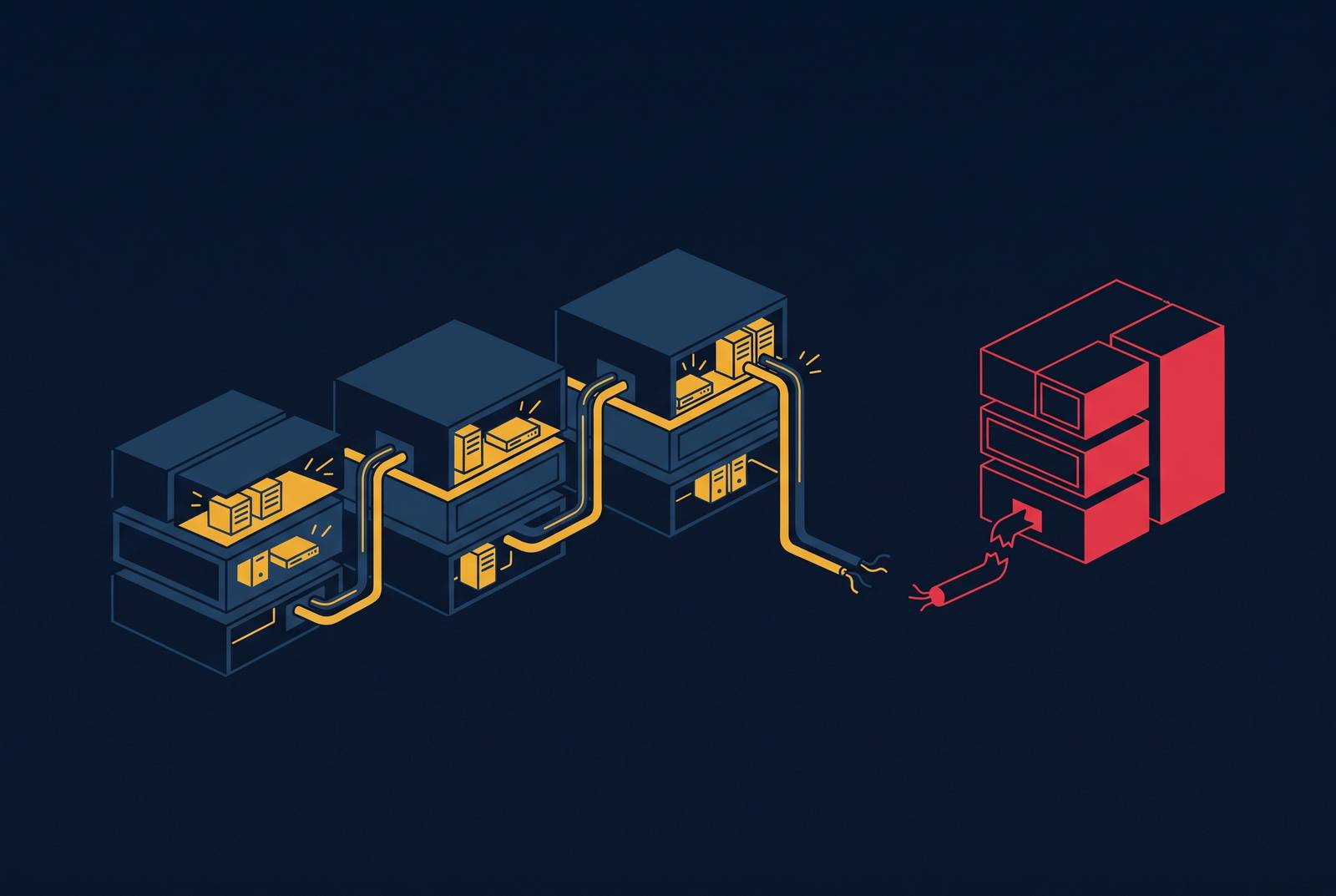
Stranded capital in multi-phase data center programs comes from a timeline mismatch built into the deal from day one. Capital gets committed against phase two and phase three before the conditions those phases depend on, power interconnection, permitting, tenant demand, are anywhere near settled. Grid interconnection now takes five to seven years in most markets, while the construction it is supposed to support takes 12 to 18 months. That gap, measured in years, is where committed capital sits exposed, because it is waiting on a grid timeline it cannot control or accelerate.
This exposure is not a temporary market condition that corrects itself. This exposure is structural, built into how these projects get financed and sequenced, and it appears in the offering documents themselves. DayOne Data Centers' F-1 filing states that government limitations or moratoriums on data center construction in a given market can prevent an operator from expanding as planned, or stop a project from completing at all, with stranded capital as the direct result. A regulatory pause in one jurisdiction does not just delay a phase. It can sever the capital committed to that phase from any realistic path to productive use.
The severity of that severance comes down to what else the asset can become. An AI-optimized data center is not easily converted to general-purpose computing use. The infrastructure built for GPU workloads, power density, liquid cooling, specific rack geometry, would need to be replaced with CPU-oriented systems to serve a different market, and that replacement is expensive and structurally complicated enough that it rarely pencils out. Limited alternative use suppresses liquidation value. When a phase stalls, the capital behind it cannot easily be redeployed into something else, making this kind of stranding close to permanent.
Financing structures that amplify phase-level risk
The capital structures built to fund AI data center buildouts exist to scale deployment, not to absorb shocks at the phase level. These structures are engineered for speed and volume, moving large amounts of capital into construction fast, and that same engineering spreads risk across lenders, investors, and institutional intermediaries rather than containing it inside any one party's balance sheet. CoreWeave closed its own GPU-backed loan facilities, including a $3.1 billion facility, so it could expand access to public markets for GPU-backed financing, and that shows how far asset-backed structures have already pushed into this space.
Scale on that level separates economic risk from operational control. The party bearing the financial consequence of a phase failure is often several steps removed from the party making the day-to-day decisions that caused it, and true leverage gets obscured across the chain. When something goes wrong at the phase level, the financial distress does not stay on a balance sheet. It becomes a legal dispute, often several at once, running across the different parties holding pieces of the structure.
Take-or-pay contracts are where this plays out most directly. Multi-phase campuses are frequently built so that phases two and three depend on revenue certainty from phase one tenants, so the entire capital stack for later phases rests on anchor customer commitments signed years earlier. If those commitments become unstable, whether from a tenant's own financial trouble or a dispute over delivered capacity, you get contract litigation layered on top of the construction risk. The financing was built to move capital fast across phases. It was not built to absorb what happens when one phase's assumptions stop holding. Anything that makes phase-level failure more likely becomes a multiplier on capital risk, not just a local project problem.
Where MEP cost concentration makes phase-scope misalignment most destructive
Mechanical, electrical, and plumbing systems, not the building envelope, are where the money in a data center project actually sits. MEP costs run to roughly three-quarters of total project value on data center builds, and electrical systems alone account for the dominant share of the guaranteed maximum price on recent bids. Walls, slabs, and roofing are a minor line item by comparison. Any phase-scope misalignment that touches power, cooling, or cable routing lands directly on the part of the budget carrying the most weight, so the same kind of planning error costs far more here than it would on a conventional commercial build.
Density assumptions compound the problem because they do not stay fixed between when a phase is planned and when it is executed. AI racks now routinely exceed 50 to 100 kW per rack, and hyperscale clusters reach multi-megawatt deployments inside a single data hall. A density figure used to plan phase two's power and cooling systems during phase one design can be outdated by the time phase two reaches execution, forcing MEP redesign work at the point in the project where redesign is most expensive.
Long-lead equipment turns that expense into something close to permanent. Utility transformers carry lead times of more than a year. Transformer prices have risen materially since 2019, according to Wood Mackenzie, making a redesign driven by a density change a procurement cost event, often locked in at a price point set well after the original budget was built.
Fragmented delivery workflows and early detection of phase-scope misalignment
The design and delivery workflows running on most multi-phase data center programs cannot surface a phase-scope misalignment at the point where fixing it is still cheap. The same core information, equipment parameters, load assumptions, space allocations, phasing logic, gets rebuilt by hand in every tool that touches it. Models, spreadsheets, PDFs, and procurement logs each hold their own version of what the design intends, updated on their own schedule, with no shared record tying them together.
A rack density assumption changed in the layout tool does not automatically flow into the power model, the cooling sizing, the cable routing, or the procurement schedule. Each of those downstream updates is a separate manual action, and whether it happens at all, let alone in the right order, depends on someone remembering to do it. Data center MEP coordination is already heavier than almost any other project type, because cooling systems, power distribution, and cable management all compete for the same physical space. Getting that coordination wrong inside the model does not stay inside the model. It turns into field coordination meetings, RFIs, and last-minute redesigns that show up later as schedule slippage and cost overruns.
Critical-systems coordination, power, cooling, cable, and fiber, is where these failures concentrate. Managing large volumes of conduits, cable trays, and bus ducts through confined routes demands precision that fragmented tools are not built to enforce, and the errors that slip through can mean overheating, safety hazards, or voltage drops once the system is live. A misalignment that a connected model would catch as a constraint violation on day one instead becomes visible as an RFI during procurement, a clash during installation, or an energization failure during commissioning, and the cost of fixing it climbs at every one of those later stages.
Teams already running BIM might assume this kind of coordination gets caught automatically. BIM objects are organized around construction disciplines and drawing sets, not around the cross-system logic that should govern how a rack density change cascades through power, cooling, and cable. A model can be geometrically complete, with every object placed correctly in three-dimensional space, and still be informationally fragmented, with no system tying the logic of one discipline to the consequences in another.
Connected data requirements for re-sequencing infrastructure across phases
Recognizing a phase-scope problem is only half the task. Fixing it means re-sequencing infrastructure decisions across phases, and fragmented workflows make that re-sequencing slow enough to turn into its own source of delay. A substituted transformer specification in phase one creates ripple constraints for phases two and three that may not surface until those later phases reach energization. In a workflow where every system is manually reconciled, that kind of substitution has to be tracked down and re-checked against every downstream dependency by hand, one tool and one spreadsheet at a time.
If layout generation cannot be reconfigured quickly as density assumptions shift, and they shift in nearly every phase, it locks risk into the project. Parametric discipline in data hall layout, the ability to change one input and have the geometry update correctly around it, is a risk management capability, not a drafting convenience.
Two different tools matter here, and they do different jobs. AI can evaluate re-sequencing options well, because it weighs trade-offs across dozens of possible configurations faster than you could work through them manually. Deterministic rules are what enforce the hard constraints, load calculations, clearance envelopes, busway ratings, containment geometry, that cannot be left to probabilistic judgment. Neither substitutes for the other, and fragmented workflows make it hard to apply either one correctly, since the data each needs is scattered across disconnected systems. McKinsey's analysis estimates that smarter design approaches, meaning integration and standardization rather than simply faster drafting, could cut projected global data center spend through 2030 by a material margin. The lever is connected information, not more labor applied to the same fragmented process.
ArchiLabs Studio is built around that exact principle. A rack move inside the platform cascades automatically through power, cooling, cable, and documentation, rather than generating a queue of manual updates that have to be carried across disconnected tools by hand. If you have that kind of connected automation, re-sequencing can move fast enough to actually reduce capital exposure. Without it, re-sequencing itself becomes another source of delay, stacked on top of the problem it was meant to solve.
RFIs and submittals as stranded-capital accelerants in multi-phase programs
RFI and submittal management is often treated as paperwork, something to clear out of the way, when in fact it is what catches a phase-scope misalignment before it gets built in permanently. In a multi-phase program, an unmanaged RFI or submittal process is the mechanism by which a misalignment turns into a locked-in cost and schedule commitment.
Current best practice calls for scoring RFIs across schedule, procurement, cost, commissioning, and coordination risk, not just by dollar value, and for keeping a human approval gate in place before any AI-generated response can change project direction or become part of the contract record. Most programs running today do neither of these systematically. Before an equipment purchase order goes out, comparing the vendor submittal against the approved basis-of-design, specifications, drawings, and contract requirements should produce a cited, requirement-by-requirement exception list. The useful output at that stage is a structured list of exceptions that lets the right person resolve the gaps before the wrong unit gets ordered and delivered at full cost.
On a multi-phase campus, a submittal exception that slips through before the purchase order, a transformer specification that deviates from the basis of design, creates ripple constraints for the phases that follow, constraints that may not become visible until those later phases reach energization. By then the capital behind those phases is already deployed, and the fix is structural.
Fragmented RFI management, items tracked across email, spreadsheets, and disconnected project management tools, keeps teams from telling which open items carry real procurement or commissioning risk and which are purely administrative. Aging items pile up invisibly until one of them lands on the critical path. ArchiLabs Studio addresses this by embedding RFI and submittal management inside the same connected workflow as layout, power, cooling, and cable routing. An open RFI against a switchgear submittal appears in the same context as that equipment's role in the phase-one power distribution design, instead of sitting isolated in a separate inbox disconnected from the system it affects.
Structured asset data and phase-level exposure assessment for lenders and operators
Lenders, rating agencies, and operators need to assess exposure across the phases of a multi-phase data center program, so they need asset data that reflects what is actually built and planned, not a static snapshot filed away after the fact. When that data is locked inside PDFs, disconnected BIM models, and spreadsheets that stop getting updated once a phase moves past design, the people pricing and managing risk on that program are working from a record that no longer matches operational reality.
Rating frameworks already built around cash flow metrics, debt service coverage and loan-to-value triggers, and tenant credit depend on power security as a central factor in how a data center asset gets evaluated. Power security, in a multi-phase program, is downstream of exactly the kind of phase-scope misalignment this piece has traced from grid timelines through financing structures, MEP cost concentration, fragmented workflows, re-sequencing failures, and unmanaged RFIs. A lender cannot price that risk accurately from a document that was accurate the day it was filed and has drifted from the truth ever since. Structured, connected asset data lets the capital side of these deals see the same reality the design and delivery side is working from, at the same time.