Land Assemblage Strategies for Campus-Scale Data Center Development
Power access, not acreage, unlocks campus-scale data center development.
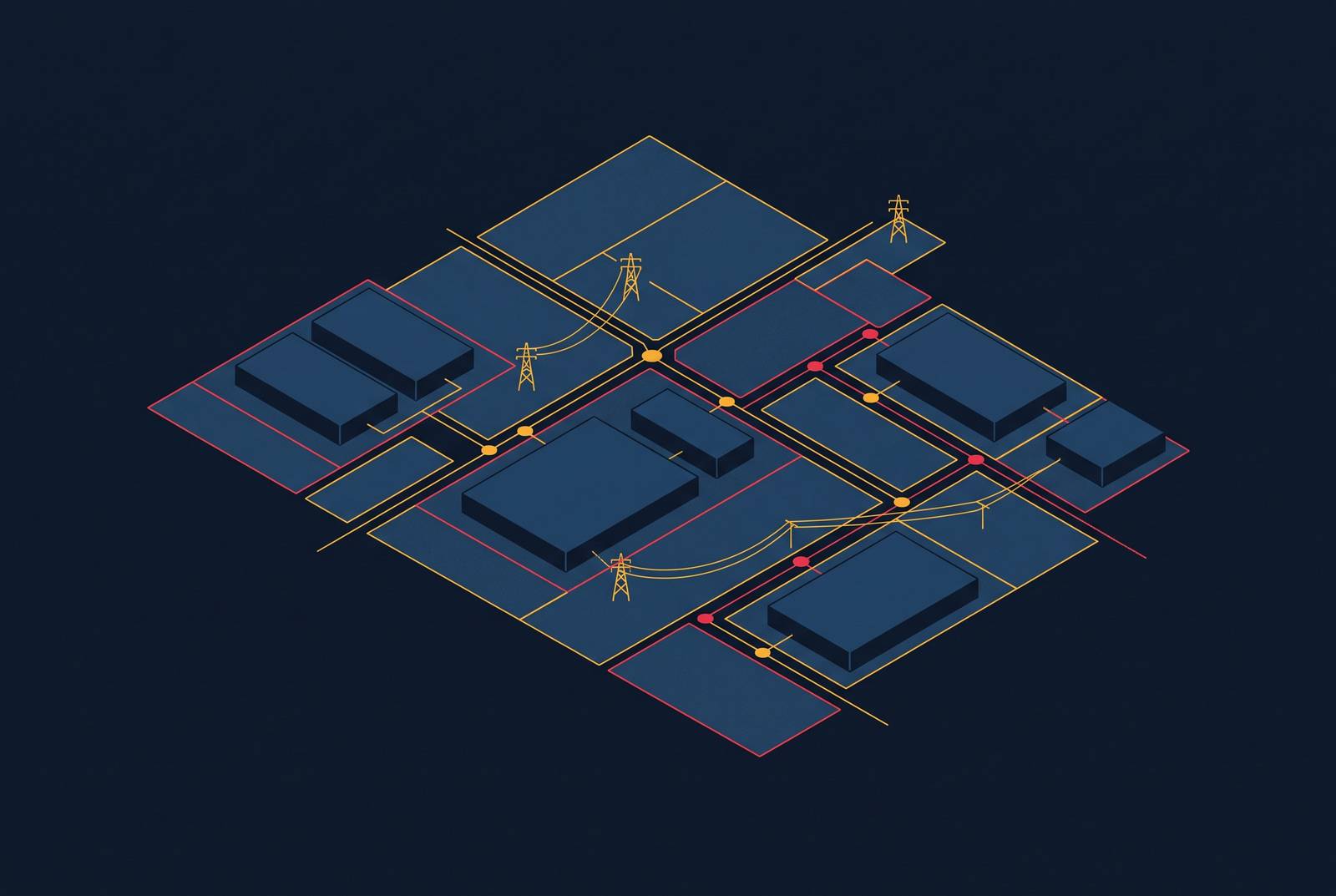
A campus announcement looks simple from the outside: a headline, a groundbreaking photo, a number in megawatts. What that moment hides is years of work that had to happen first, in a specific order, before anyone could stand at a podium. Land assemblage for a hyperscale campus is an infrastructure sequencing problem: the order of commitments must be right for the project to be viable.
The old model was simple enough to fit in a paragraph. That model worked when power densities were modest and network paths were everywhere. It does not work now. A single building no longer justifies the capital required for utility upgrades, transmission interconnects, or long-haul fiber routes, so the campus model has replaced the single-building mindset (Datacenters.com, Jan 2026).
Land itself is no longer the scarce input. Power position, utility queue placement, and regulatory runway are the scarce inputs, and a parcel without them is just acreage, not a data center site. By the time a billion-dollar campus gets announced, site identification, land acquisition, environmental studies, utility coordination, transmission planning, entitlement work, and infrastructure design have largely already happened (Data Center Real Estate). The announcement sits near the end of the pre-construction sequence, not the start of it.
That sequence has a built-in constraint: infrastructure commitments take 18 to 24 months or longer to mature. If a developer locks down land before locking down power, they are already behind schedule, because the clock on power access starts ticking independently of when the deed transfers. So the order that works runs power and regulatory work first, land second, or runs both at once. Every section that follows in this piece traces one piece of that sequence: power, parcels, optionality, community risk, fiber, and the design coordination needed to hold it all together across a multi-year build.
Power position as the first gate: why grid access is secured before parcels are sized
Power availability now decides where a campus can rise, how fast it can grow, and whether a speculative land play makes sense. Land without enough reliable electricity behind it is not viable for AI-era deployment, no matter how well located or how cheap.
In some markets, utilities make developers pay for substations, transmission upgrades, and even new generation assets before they will reserve any capacity. Parcels near transmission corridors and existing substations cost more, but land in otherwise established markets can become stranded when the local grid can't take on more load (Datacenters.com, Jan 2026). That has turned substation adjacency into a site-selection filter as firm as zoning. Operators now source parcels by how close they sit to existing high-voltage infrastructure before they look at anything else.
Interconnection queues compound the problem. Power access has a lead time that cannot be shortened after the fact. It has to be first in the sequence rather than something negotiated once land is already in hand.
A handful of recent projects show what that looks like in practice:
- Rowan Digital Infrastructure's Project Temple in Central Texas began construction in January 2026, a 300 MW campus on roughly 700 acres, targeting initial operations in 2027. Power came through a partnership with Oncor representing a minimum $700 million investment, part of roughly $3 billion in total financing secured by May 2026. The utility partnership came before the construction commitment, not after it.
- Vantage's Lighthouse campus in Port Washington, Wisconsin, is working with WEC Energy Group's We Energies on a dedicated rate structure, under which Vantage underwrites 100% of the power infrastructure investment, specifically to shield existing ratepayers from any increase. The campus will hold four hyperscale data centers delivering nearly 902 MW of IT load across roughly 672 acres, with construction running through 2028 (Data Center Frontier).
- The PORTS Technology Campus in Piketon, Ohio, developed by SB Energy and SoftBank, targets up to 10 GW of engineered capacity on about 2,700 acres of leased land next to the DOE's former Portsmouth Gaseous Diffusion Plant. SB Energy is committing $4.2 billion through AEP Ohio to build new 765-kilovolt transmission lines and grid infrastructure, alongside a plan for roughly 10 GW of new generation. The transmission build is a condition baked into the project from the start, not something added downstream.
Parcel aggregation under entitlement pressure: how developers assemble the acreage
Once power position is secured, the land itself still has to be assembled, and that process is rarely as simple as buying one large tract from one owner. Campus sites are typically stitched together from many smaller, separately owned parcels, and each one comes with its own negotiation and its own zoning history. In August 2024, Tract acquired 2,069 acres in Buckeye, Arizona, made up of 22 separate parcels that ranged from 40 to 242 acres each. Every one of those parcels required its own agreement and coordinated zoning before any single piece of the site could move forward.
Zoning and permitting timelines, not negotiation, set the pace of this work. An 18-month runway for permits and zoning is now the standard planning assumption for a project like this, not an outlier to be hoped against.
Existing by-right permissions change that math considerably. Tract's broader portfolio reflects the same logic at scale: the company controls more than 25,000 acres, roughly 40 square miles, and plans to support over 25 GW of workload capacity by delivering sites that are pre-entitled, zoned, and infrastructure-ready, so hyperscale clients never have to carry that entitlement risk themselves (Data Center Frontier).
Federal land is starting to enter this pipeline as a new category of pre-positioned site. In 2025, the administration directed federal agencies to identify up to ten sites for fast-tracked data center development. Brownfield federal land, much of it carrying legacy transmission infrastructure already in place, is becoming a meaningful new source of sites that skip some of the usual entitlement grind.
The scale of time this all takes shows clearly in AWS's Homer City, Pennsylvania project. Construction could start in December 2026, with the final phase in 2032 and overall completion targeted for 2036, a ten-year build window that reflects how phased entitlement and infrastructure permitting actually pace a campus of that size.
Why developers land-bank far beyond immediate need
Developers routinely acquire far more land than a first phase requires, which is the rational answer to a market where restarting site selection mid-program costs more than carrying idle acreage ever will. If you don't need the land today, you get flexibility that only grows more valuable as the program matures (Data Center Real Estate).
That optionality has become something investors actively underwrite. Institutional capital increasingly evaluates what a site could become over its full development life, not just what sits on it today, so future development rights, infrastructure scalability, and land reserves now factor directly into investment decisions.
Three current projects each show a different side of this logic:
- Applied Digital's Delta Forge 1 is sized for approximately 430 MW overall, with an initial phase of 150 MW facilities on more than 500 acres and first operations targeted for 2027. The acreage and power headroom were secured for the full multi-stage growth curve that large AI deployments require, not just for phase one.
- Crow Holdings and CleanArc's Central Dallas project is a 245 MW multi-building campus on urban infill land Crow Holdings has held for decades, with a first 70 MW building targeted for late 2027. The project shows that holding land for years before its highest use arrives can be just as strategic as acquiring greenfield acreage fresh.
- Sites built to support phased expansion, able to add substations, accommodate future buildings, and scale utility infrastructure over time, are becoming some of the most sought-after assets in the market. Land value is increasingly measured by what a site can support across its full development life, not by what can be built on it right now (Data Center Real Estate).
Community opposition and moratorium risk as sequencing variables, not political noise
Carrying large land positions and the infrastructure demands that come with them generates resistance, and that resistance has become a sequencing risk a developer has to manage with the same rigor applied to power lead times and entitlement timelines. A project years into infrastructure commitments can still freeze if local opposition or a moratorium lands at the wrong moment.
Transportation departments are now treating large campuses as quasi-municipal infrastructure in their own right. Transportation departments now treat road network planning as a factor in whether the asset holds up over its long-term life.
Developers are responding by changing how they approach communities before opposition can calcify. Many builders entering 2026 are recalibrating how they engage with communities instead of racing to lock in approvals ahead of possible policy shifts. The emerging playbook pairs fully integrated infrastructure planning, land, power, water, and construction all coordinated together, with upfront commitments around transparency and local investment (Data Center Frontier).
Amazon's approach in Louisiana illustrates the template this is becoming. Vantage's Lighthouse campus in Port Washington shows the same logic applied to jobs and local investment: the project is expected to generate more than 4,000 primarily union construction jobs, and Vantage has pledged at least $175 million toward regional infrastructure upgrades. Community investment at that scale functions as political capital. It makes a project harder to oppose and faster to permit, which is the entire point.
Fiber and connectivity infrastructure as the third rail of campus siting
Fiber connectivity does not arrive after a campus gets built. It has to be planned and, in many cases, co-built alongside land and power, because a campus cannot run at the density AI workloads demand without it already in place.
Buyers now expect proximity to dark fiber routes, long-haul backbones, and metro ring networks, and some developers are partnering directly with telecom providers to build that fiber infrastructure in step with land development. Fiber is now something you co-develop, not something you add once tenants move in. Tract's integrated model reflects this directly: its approach pre-builds energy, cooling, and transportation infrastructure, with fiber connectivity delivered as part of the shovel-ready package before a hyperscale client ever sets foot on site (Data Center Frontier). Not every pre-built site clears the finish line. Tract's Mooresville Tech Park in North Carolina is a planned 400-acre campus that is expected to support 1.5 million square feet of data centers, with initial power delivery anticipated in 2029, but Tract withdrew its rezoning application in August 2025 after community opposition. It is a reminder that even a fully packaged infrastructure plan still depends on the community sequencing covered above.
Utility corridors, fiber conduit included, are planned before a single building rises. The comparison to municipal infrastructure fits directly here: just as a city lays water and sewer lines ahead of development, a campus developer has to lay fiber conduit routes as part of the initial site infrastructure plan (Datacenters.com, Jan 2026).
The internal network matters as much as the external routes. East-west network fabric is the performance backbone for AI clusters, and the internal connectivity architecture of a campus affects workload performance as much as the physical building layout does. Power, land, fiber, and community commitments all have to move together, and holding that many moving pieces in sync across a multi-year build is fundamentally a design and data coordination problem.
Design automation and the feasibility of managing a phased campus program
Everything covered so far, power, parcels, optionality, community commitments, and fiber, has to be managed as interlocking pieces across a build that can run a decade or more. That coordination burden breaks down fast when teams have to re-enter the same information into disconnected spreadsheets, models, and operational systems at every phase boundary. The coordination overhead itself becomes a source of project risk.
Modular and prefabricated construction is now standard in data center delivery, and it raises the stakes on coordination. Factory-built modules get manufactured in parallel with site work and grid permitting. Design data has to be accurate and synchronized across civil, structural, mechanical, and electrical disciplines before those modules ever leave the factory floor, not after they show up on site.
Phase boundaries are where fragmentation gets expensive. Every new building on a multi-phase campus inherits decisions made in the previous phase: rack layouts, power distribution paths, cooling architecture, cable routing. If those decisions live in disconnected tools, each new phase restarts the same coordination problem.
Cable tray routing is a clear case of how this failure appears in practice. On a campus where multiple buildings share routing corridors, that single failure multiplies across the whole site.
Operations handoff carries the same risk across phases, not just at the point a building is finished. Outages happen in the gaps between these systems, and those gaps widen whenever a campus phase gets handed off with data that is incomplete or disconnected.
Connected design workflows close that gap directly. When layouts, critical-systems engineering, cable routing, documentation, and RFI resolution all run inside one connected workflow, a rack move or a phase-boundary change cascades automatically across power, cooling, cable, and sheets, instead of triggering hours of manual rework across every downstream system. ArchiLabs Studio is built for exactly this problem: it is the operating system running underneath data center projects, connecting the disciplines that otherwise fragment on campus-scale programs, from early layout generation through critical-systems coordination to structured handoff into DCIM, EPMS, and BMS, so each phase inherits accurate, traceable data.
That traceability is not a nicety on a program like this. Every RFI answer, design decision, and equipment parameter has to be traceable back to the information that supports it. On a build running 10 to 15 years, like Tract's Buckeye site or AWS's Homer City campus, that traceability is an operational necessity for whichever team inherits the next phase.