Greenfield Versus Brownfield Site Trade-Offs for Data Center Development
Choosing between greenfield and brownfield sites is really a choice about delivery risk.
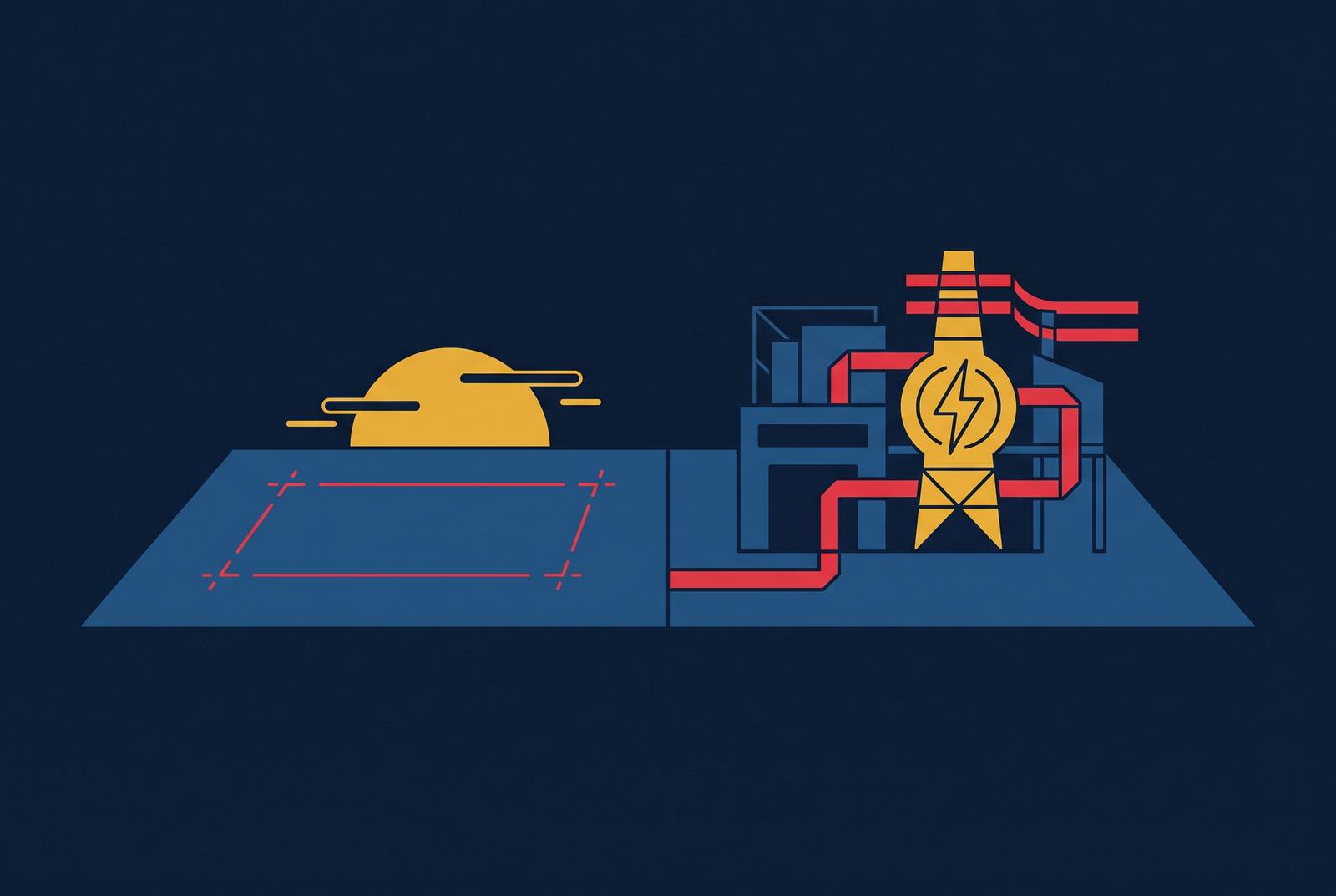
Greenfield versus brownfield data center development is a choice about delivery risk as well as land and capital. The better site is the one a team can turn into an operating facility with power, cooling, documentation, and handoff kept in step. Connected workflows such as Archil Labs belong in that evaluation because the site decision sets the coordination burden for everything that follows.
Why the greenfield/brownfield question is really a delivery-risk question
A project team starts routing power and discovers that the utility tie-in has already narrowed its choices for equipment placement, cable paths, and cooling. Those looked like open design questions, but the site decision answered part of them at acquisition. Land cost and capital outlay still matter, but they do not describe the work the engineering team has inherited. RSP Engineers calls utility availability “the primary driver of site viability”.
The two paths differ in what already stands on the land, what the team must establish first, what depends on that answer, and which decisions sit outside its control. A change in utility tie-in location can cascade through layouts, cable routing, sheets, and operational documentation. Archil Labs connects those dependencies so that a change across power and cooling does not require disconnected updates throughout the project. That addresses the workflow burden, but it cannot remove the physical or utility constraints that created it.
What demand growth has done to the definition of a viable site
Traditional racks ran at 7–15 kW, while AI training clusters require 40–100+ kW per rack. That difference changes more than the size of the utility feed. It changes the distribution chain inside the facility and the cooling systems that chain must support. Power access has therefore become the first filter for either site path, ahead of acreage or price.
A greenfield parcel without a utility-backed path to power is not viable simply because it offers room to grow. An existing industrial connection also does not prove that a brownfield site can support the planned workload. Its capacity and condition still need assessment. As power scarcity pushes teams toward imperfect sites under time pressure, those distinctions become harder to ignore. The practical comparison is between two ways of securing usable capacity, each with a different burden of proof and a different sequence of work.
What greenfield actually gives a project team — and what it costs them in time
Greenfield gives the team control over site layout, security, expansion, cooling strategy, and power distribution without inherited routing to work around. That freedom lets engineers design for the workload instead of fitting it into a building that is already there. Yet every part of that design still has to work through entitlement, utilities, and procurement. RSP Engineers describes entitlement as “lengthy and unpredictable”. Rezoning or a special use permit can bring public hearings and scrutiny from adjacent landowners.
Utility extension adds another set of dependencies. Easements across multiple providers, high-voltage transmission extensions, water mains, and redundant fiber each have their own lead times. In power-constrained markets, interconnection waitlists can extend years, beyond the project team’s control. These risks to the schedule are built into the process and go beyond what better drawing production alone can fix.
Engineers must keep the design open to change while they wait for those outside decisions. Connected automation, including Archil Labs, can keep layouts, distribution, and cooling aligned when an easement or interconnection plan forces a redesign. Verified power pathways, phased delivery, strong utility alignment, and tenant pre-commitments help keep that schedule exposure from being mispriced. Without them, blank-slate freedom can amount to a detailed design waiting on permission to proceed.
What brownfield actually gives a project team — and where its costs hide
Brownfield can give a project a head start with grid ties, water access, and other infrastructure left by the site's former industrial use. Where those assets are suitable for reuse, the project can skip years of extension work. That advantage is not proof of a lower total cost. Forecasting what must happen before the inherited infrastructure becomes usable is harder.
RSP Engineers identifies risks including soil and groundwater contamination, old foundations, buried tanks, and infrastructure with uncertain age, condition, and remaining capacity. A professional engineer must assess whether that infrastructure can be reused, upgraded, or replaced. Surface inspection alone cannot settle the question. A site can also have useful power access and still lack the space a modern data center needs.
Brownfield due diligence must therefore bound both the physical unknowns and the reuse assumptions. For inherited routing and cooling constraints, structured documentation and rules-based validation in workflows such as Archil Labs help catch conflicts earlier. They do not resolve contamination or concealed obstructions. If those conditions come to light late, remediation and redesign can wipe out the early lead in the schedule, though brownfield does not cost more by its nature.
How the site type shapes critical-systems engineering before a single cable is run
Once power access is established, the next question is how much of the internal distribution chain the team controls. High-density workloads affect feeders, busways, transformer layout, redundancy strategy, cooling support loads, and voltage-drop tolerance. On greenfield, engineers can design these relationships around the intended rack density. The price of that control is having to specify, procure, and coordinate every component, including those with long lead times.
On brownfield, the team starts with a partial distribution chain whose compatibility is not yet established. Deciding what to retain is itself an engineering task. Cooling makes the distinction especially clear. Greenfield allows rear-door chillers and liquid-to-chip solutions to be designed in from the start, while brownfield structures can constrain the geometry those systems need.
Those constraints matter financially because electrical distribution accounts for a significant share of the guaranteed maximum price on 2026 bids. Liquid cooling for high-density GPU racks also raises mechanical costs above the usual range for commercial projects. When these costly systems must share space with inherited cable routes and structures, teams have more relationships to work out. Unsettled relationships then become requests for information, or RFIs, during delivery.
How site complexity drives RFI volume and where coordination breaks down in practice
Power equipment, cooling systems, cable trays, fire protection, and structural elements compete for limited space. If the drawings leave their relationships unresolved, field teams discover the conflict after installation begins. A single coordination error in a data center can cost days. The site path influences both where that error begins and when it becomes visible.
Greenfield conflicts often start with choices made in the design, including routing choices, clearance assumptions, and gaps in how the work is sequenced. In principle, a complete model can expose them before construction. Brownfield has those same risks along with physical conditions the team does not know about. An undocumented structural element or a legacy conduit that cannot be relocated can invalidate a route that appeared workable in the model.
Even careful pre-construction coordination cannot resolve a condition that has not been captured accurately. Meanwhile, on either path, a model prepared to meet architectural deliverables may omit relationships that field teams need resolved. The cost turns on timing because a design change during construction is far more expensive than a correction during coordination. Brownfield’s concealed conditions add to the risk of that late discovery, so its timing alone says little about how well the design team did its work.
What MEP coordination and BIM can and cannot resolve across each site path
Mechanical, electrical, and plumbing coordination carries unusual weight in data centers because cooling, power distribution, and cable management all demand substantial space. Building information modeling, or BIM, helps teams work out how to meet those competing needs before installation. Its limit is the quality of the information it receives. A coordinated model is not proof that the site beneath it is fully understood.
Greenfield gives the design team control over the inputs, but completeness still requires discipline from kickoff. Asset tags, data schemas, and exchange processes must stay aligned as information moves between authoring, coordination, document management, and scanning tools. Brownfield adds incomplete or inaccurate as-built records, sometimes in formats that do not translate cleanly into current tools. Scanning and survey work can improve that record, but they add time and cost and cannot capture every buried or concealed condition.
There is also a separate test of model quality at handover. A construction model may be useful to the contractor yet require substantial rework before the operator can use it. Operational model formats, asset tags, and DCIM/CMMS data requirements therefore need definition at kickoff. A shared asset identifier strategy must precede construction, with brownfield teams also reconciling any legacy identifiers that conflict with the new schema.
How site type affects operations-ready handoff to DCIM, EPMS, and BMS
The operational data layer depends on design decisions just as much as the physical installation does. Teams need to plan how data center infrastructure management, electrical power monitoring, and building management systems will connect before commissioning begins. Without that planning, information from the BMS may not reach DCIM in a workable form.
Greenfield lets the team set alarm logic, threshold rationale, and trend baselines and decide who is responsible for what before equipment is ordered. Brownfield may already contain BMS configurations, alarm setpoints, and naming conventions that conflict with the new systems. Undocumented settings leave the incoming operator with a costly choice between trusting inherited configurations and establishing new baselines. For liquid cooling, a handoff that operators can use needs alarms that have been validated and clear operating responsibilities as well as as-built drawings.
Siemens describes Greenergy Data Centers using an integrated BMS–EPMS platform to monitor power quality across HV/MV, LV, UPS, and third-party devices. Even with those connections in place, the platform still needs the right project data. When the handoff specification arrives after construction has started, the team may discover that its model serves architectural deliverables and lacks the information operators need. Retrofitting that information after handover is significantly more expensive and rarely complete.
How automation changes the delivery calculus on each site path
Connected automation addresses a different problem from entitlement, remediation, or utility availability. It reduces the coordination work that those conditions trigger across design and documentation. ArchiLabs Studio links layouts, critical-systems engineering, cable routing, documentation, RFIs, and DCIM-ready handoff within a single workflow.
Conventional BIM coordination still helps teams work out how systems will fit in the space, while scanning helps them see what is already there. Rules-based validation checks the constraints the team knows about, and AI-assisted tools can help come up with options or work with information that is mostly text. These approaches serve different jobs. Connecting them matters because manual retyping between models, spreadsheets, and PDFs breaks the traceability of equipment parameters, design decisions, and RFI answers.
On greenfield, the main opportunity is keeping rack layouts, power distribution, cooling zones, and cable routes synchronized as the design changes. On brownfield, the priority is checking new work against verified existing constraints. AI can generate layout options, draft RFI responses, and extract equipment data from manufacturer PDFs. Deterministic rules belong on precision-critical checks, including density limits, upstream capacity assumptions, A/B power path diversity, cable tray fill, and required DCIM fields. Neither approach can validate an unknown site condition, so automation still depends on a sound information base.
A framework for matching site path to delivery capability, not just to site conditions
A practical evaluation begins by separating site readiness from team readiness. Greenfield needs a utility-backed power pathway and a schedule that can absorb entitlement and extension work. It also needs a team able to coordinate a design-from-scratch program without repeated manual updates across disciplines. Operations-ready handoff architecture belongs in that evaluation before design begins.
Brownfield needs a professional engineer to assess existing interconnection and utility capacity, a clear scope for remediation, and records accurate enough to model inherited conditions. The building must also accommodate the intended rack density and cooling geometry. These conditions must be established before claiming a schedule advantage. Where they remain uncertain, the delivery plan must recognize that uncertainty rather than treat existing infrastructure as ready capacity.
The team needs to establish whether a rack layout change flows through power, cooling, cable routing, and documentation automatically. It also needs a defined DCIM/EPMS/BMS integration architecture at kickoff and shared asset identifiers between BIM and operational systems. A team without those foundations will pay fragmentation costs on either site, although at different points in the schedule. Teams should therefore choose the site and the delivery workflow together, and commit to land based on their ability to deliver what it demands.