Substation Ownership Models for Large Data Center Campuses
Three ownership models solve different timing and control tradeoffs for powering massive campuses.
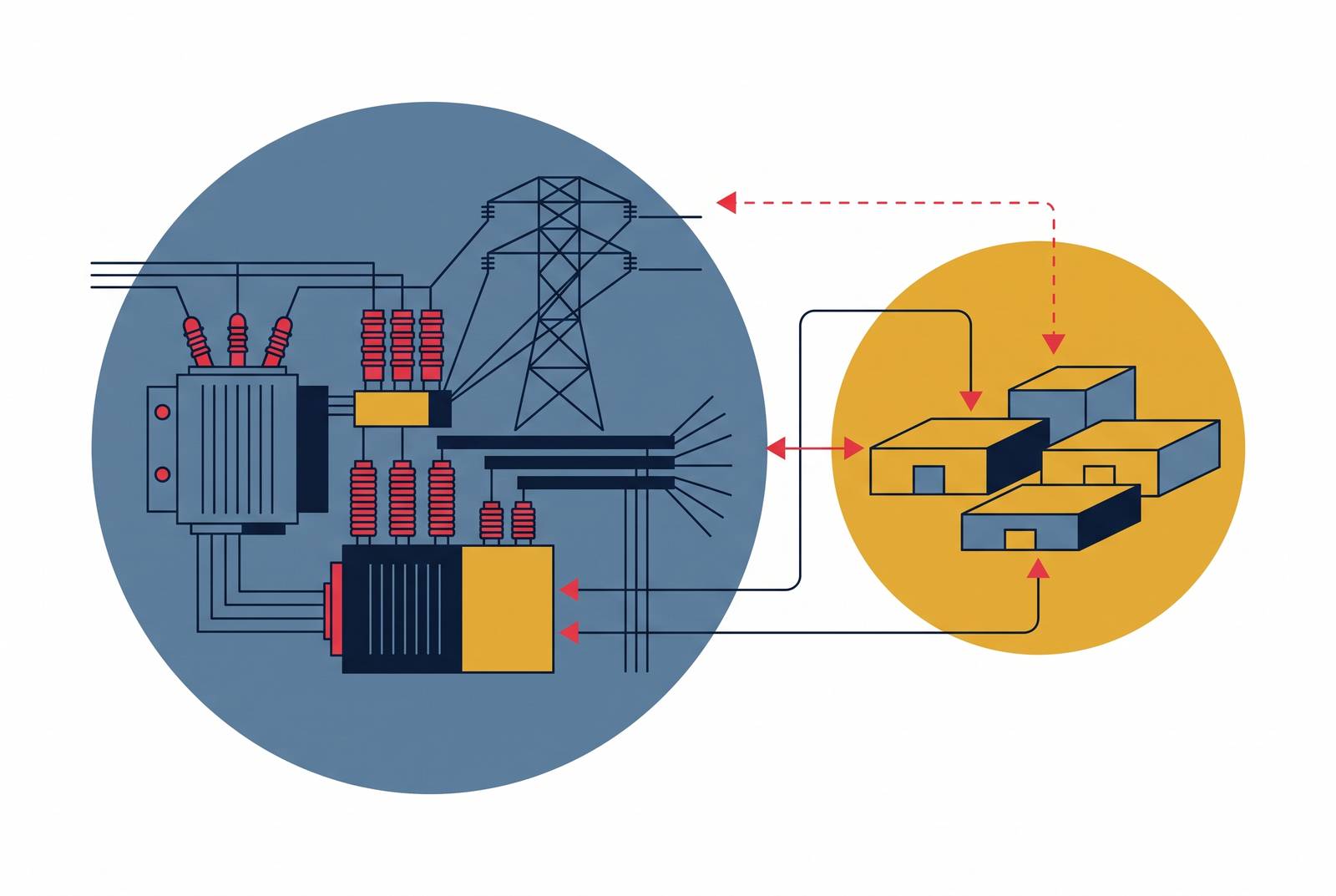
The three ownership structures and what each one means operationally
Substation ownership for a large data center campus isn't a bookkeeping choice about capex versus opex. It decides whether the project hits its power-on date or slips behind it by years, because the substation, not the building, sets the schedule for the whole campus now.
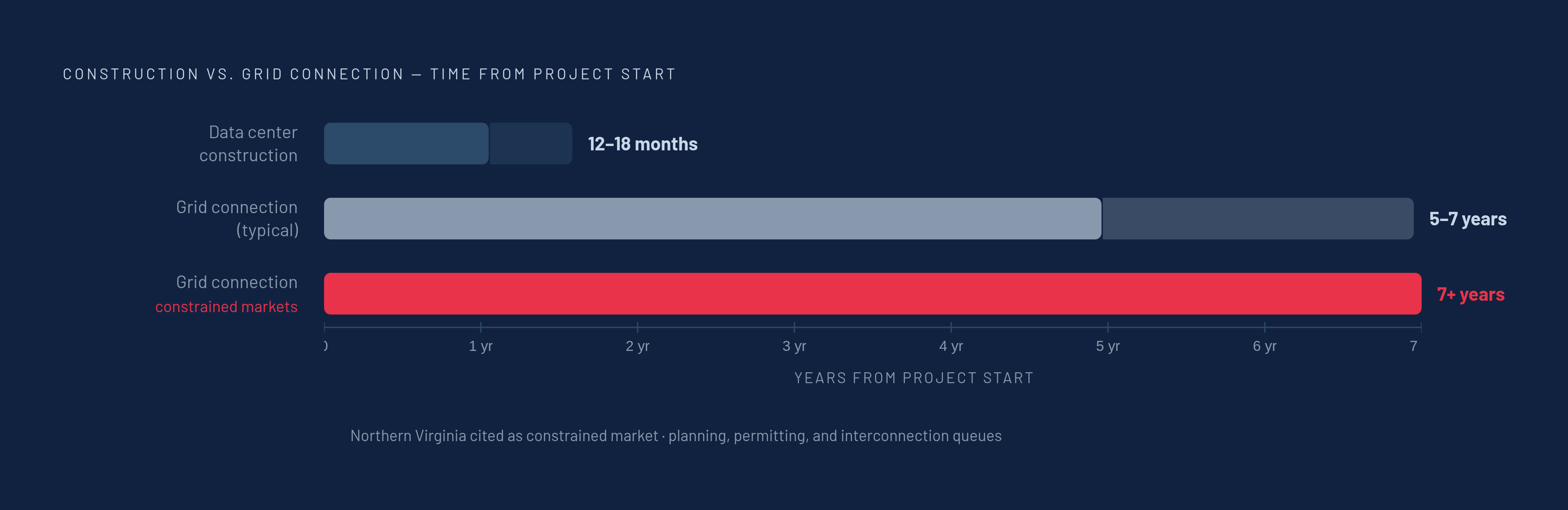
Buildings go up in 12 to 18 months. Getting them connected to the grid takes 5 to 7 years. That gap between the two clocks is the real problem, and the ownership model an operator picks for the substation either closes it or leaves it wide open.
Three models exist, and they aren't points on a spectrum from simple to complicated. Each one solves a different problem, and the right one depends entirely on scale, market, and what's already sitting on the land.
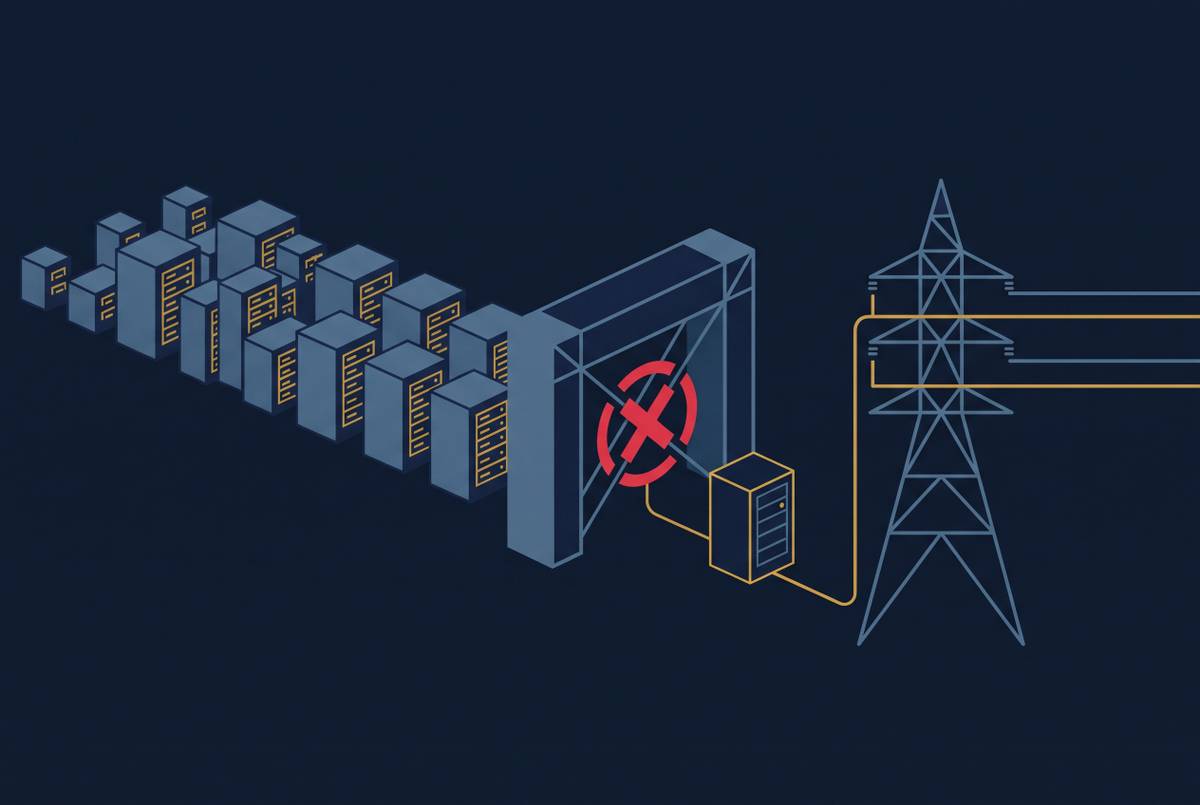
Utility-owned, off-site is the traditional path. The data center ties into a utility substation, sometimes miles away, sharing capacity with homes, retail, and factories on the same circuit. The cost appears as opex, spread across the electricity rate over years, instead of a lump of capex up front. In exchange, the operator gives up any say over what equipment goes in, when it gets serviced, or how fast the interconnection moves. Utilities routinely tell prospective campuses to expect 5 years or more before a proper circuit and substation exist, and that quote is the whole reason operators start looking elsewhere.
Operator-owned, on-site flips that arrangement. The operator builds and owns the substation, and the utility just runs transmission lines to it. That buys control over equipment choices, redundancy design, power conditioning, and maintenance schedules, but it also means the operator now carries the capital cost, the maintenance obligation, and the equipment risk that utility ownership used to absorb. Black & Veatch built substations at six sites for one of the world's largest colocation companies under exactly this arrangement, specifically so the operator could tie straight into transmission without waiting on a utility-run interconnection process.
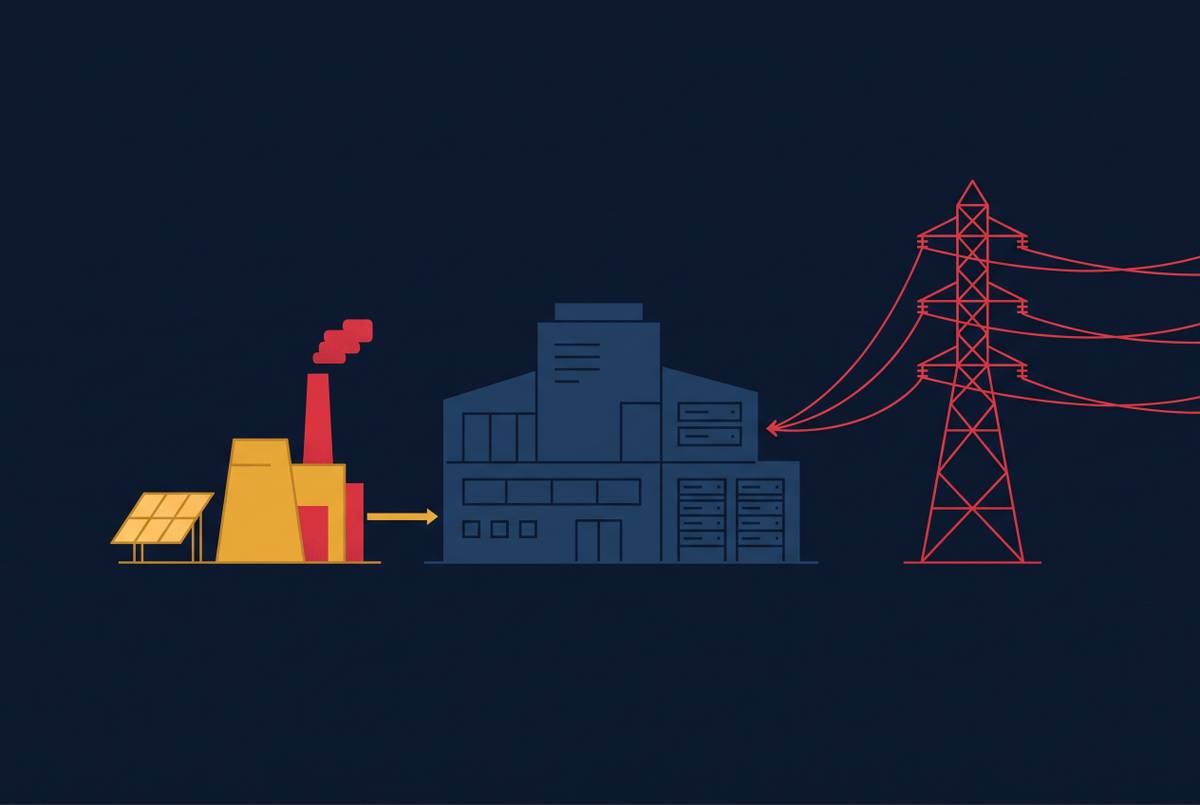
Brownfield, or inherited substation ownership, is the third path, and it's opportunistic by nature. An operator buys a site that already has a working switchyard, a transmission tie, and an existing interconnection: often a retired coal plant, a shuttered steel mill, or an old paper mill. These sites can come with high-voltage transmission already in place, water rights, rail access, and hundreds of contiguous acres, which saves years and tens of millions of dollars compared to building from nothing, and sometimes skips a chunk of the interconnection queue. The ownership question here gets answered by whatever's already sitting on the property, and rehabilitating aging infrastructure carries its own risks that a clean greenfield build never has to deal with.
Where utility ownership breaks down for large campuses
The math doesn't work at scale, and that's a structural fact, not a matter of opinion. A data center goes up in 12 to 18 months. Getting a data center properly connected to the grid can take 5 to 7 years to plan, permit, and complete. Those two timelines were never designed to run together, and above a certain campus size, sticking with utility ownership stops being the cautious choice. It becomes the riskiest one.
Before any utility approves a new substation or transmission tap, it runs a system impact study. That's standard practice, not bureaucratic overreach, but every study adds months the operator has no way to get back. Then comes equipment: substation and switchgear lead times run 26 to 52 weeks or more, and that clock doesn't even start until after interconnection gets approved. In tight markets like Northern Virginia, interconnection alone can now stretch past 7 years, longer than designing, permitting, and building the data center itself.
Shared circuits carry a second problem that has nothing to do with timing. An operator on a utility-served circuit doesn't control voltage regulation, power conditioning, or harmonic filtering, and high-density AI racks are sensitive to all three. Redundancy is also capped at whatever the utility is willing to provision on that circuit, not whatever the operator is willing to pay for.
That's why hyperscale and colocation teams now file interconnection requests before the building design is even finalized. The substation has become the longer pole in the tent, and the schedule risk compounds at every phase from there. Waiting on the utility is now the riskier move. It's the one most likely to blow the whole timeline.
What operator ownership of the substation delivers (and what it costs)
Owning the substation buys speed, mostly, and that speed comes from parallel work rather than any single shortcut. The operator can negotiate a direct interconnection agreement, order equipment, and start building the substation at the same time as the rest of the campus, instead of sitting in a utility's project queue waiting for a turn. Black & Veatch's published case data shows the operator-owned model cutting campus construction timelines in half or better.
Redundancy gets better too, in a way a shared circuit can't match. A dedicated substation can pull from multiple utility feeds off separate transmission lines, building in real redundancy at the point of delivery. Operators also gain direct control over power conditioning, voltage regulation, and harmonic filtering, which matters more with every generation of denser AI hardware. Every mile of transmission between source and load bleeds some power to resistance, too, so an on-site substation shortens that distance, and at hyperscale, small efficiency gains compound over the life of the campus.
None of this comes cheap. Core substation equipment runs $3 million to $7 million. Full utility interconnection, including transmission lines, easements, and utility contribution charges, can land anywhere from $20 million to over $100 million depending on distance and voltage class. In a constrained market like Northern Virginia, interconnection and power availability alone can run $40 million to $60 million or more.
The obligations don't stop once construction wraps. Owning the substation means owning its upkeep: continuous monitoring, scheduled maintenance, anomaly response around the clock. The Black & Veatch colocation project built in round-the-clock remote monitoring and real-time diagnostics as a requirement, not an option, and the operator had to contract that out. Moving redundancy up a tier, from Tier III to full 2N+1 Tier IV, adds real money to the electrical budget too, with industry estimates putting the increase anywhere from roughly 25% to double, depending on scope and what's already built.
Operators are choosing this path anyway. Dedicated data center substations made up 44% of the data center substation market in 2025, and that segment is projected to grow faster than any other through 2035. Capital is voting for control over convenience, and the vote isn't close.
The brownfield path: when inherited infrastructure changes the ownership calculus
A brownfield site rewrites who owns the substation before the operator even gets to ask. If the switchyard is already there, the operator becomes a substation owner by default, regardless of whether that was the plan going in.
The legacy infrastructure on these sites is often what a greenfield developer would pay a premium to build from scratch: switchyards, transmission ties at 230 kV or 500 kV, water rights, rail spurs, hundreds of contiguous acres. Inheriting a working substation and interconnection this way saves years and tens of millions of dollars, and it can skip a meaningful part of the interconnection queue that a greenfield project has to stand in line for.
The value math shifts accordingly. A former coal plant that would otherwise sell for scrap-and-salvage industrial value can command a far higher price once it's positioned as a data center campus with near-term, deliverable power.
Construction risk gets traded for a different kind of risk, not eliminated. Old switchgear may need replacing. Voltage levels may need reconfiguring. Environmental remediation might be sitting underneath the acreage. Before any of this pencils out, the diligence has to answer a specific set of questions. How old is the existing switchgear, and what condition is it actually in? Do the current interconnection agreements transfer to a new owner? Is the transmission voltage compatible with the campus load being planned? Can the existing substation expand to support future phases?
Brownfield ownership is, functionally, forced operator ownership, since the "whether to own it" question is already decided by the land itself. The inherited infrastructure may or may not be truly shovel-ready, and any hidden rehab bill it carries can quietly eat away the schedule advantage that made the site attractive. A brownfield site with bad switchgear underneath it is a slower, pricier greenfield project wearing a disguise. It's a slower, pricier greenfield project wearing a disguise.
How new large-load tariff structures are reshaping the economics of every ownership model
Regulators are, for the first time, building a commercial rate structure for a customer class that draws power like heavy industry but signs contracts and scales like a software company. The shift is moving away from socialized cost recovery, where every ratepayer helps fund grid upgrades, toward cost causation, where the large load pays for the infrastructure its own demand requires. None of this existed five years ago, and it's rewriting itself faster than most operators can track.
The specifics vary by state, but the shape is consistent. Virginia's Dominion GS-5 tariff, approved in November 2025 and taking effect January 1, 2027, charges a 100 MW customer using just 30 MW in year one as if it were drawing 60% of that 100 MW for generation and 85% for transmission and distribution. Large customers fund their own site-specific substations and interconnection equipment rather than spreading the cost across general rates. A coalition of operators has already filed a counterproposal to lower those minimums to 50% of generation and 75% of new T&D costs, arguing the current structure loads too much risk onto new entrants.
AEP Ohio requires data centers to pay 85% of their requested demand in minimum monthly charges no matter what they actually use, closing off the scenario where a developer locks up grid capacity and never builds the load out. Oregon's PGE Schedule 96, effective July 2026, creates a dedicated rate class for large loads at or above 20 megawatts. Customers there cover 100% of the distribution upgrades their project needs, minimum demand charges are 90% of contracted capacity, and contracts run 10 to 30 years for loads of 220 megawatts or more.
Florida's FPL got two large-load classes approved, effective January 1, 2026, folded into a four-year rate plan through 2029. LLCS-1 covers up to 3 GW of combined load across three zones near existing 500 kV transmission; LLCS-2 handles anything outside those zones. Either way, the customer pays incremental generation and transmission costs through a formula-based charge under a long-term minimum contract. On the federal side, the Department of Energy directed FERC in October 2025 to start a rulemaking aimed at speeding up interconnection for large loads above 20 MW, standardizing the process the way generator interconnection already works.
None of this lets an operator-owned substation off the hook. The tariff applies to every kilowatt delivered no matter who owns the transformer, so it reshapes the opex side of the ledger even after capex ownership gets settled. And the minimum-charge structures now appearing everywhere (AEP Ohio's 85%, Virginia's 60% and 85%, Oregon's 90%) create a new cost for exactly the kind of phased buildout most large campuses use. A campus ramping load up gradually over several years ends up paying for capacity it hasn't plugged in yet.
How the ownership decision interacts with phased expansion and long-term capacity planning
Large campuses don't turn on all at once. A large campus, which can demand 100 MW to over 1 GW, typically ramps up power over several years, phase by phase, and the substation ownership model changes what that ramp actually costs.
Under utility ownership, every phase means going back to the utility, re-entering the queue, and re-triggering study processes. Expansion isn't a formality under this model, it's a repeated negotiation, and each round resets the clock. Under operator ownership, the substation gets engineered up front for the campus's full target load, with each phase energized as buildings come online. The interconnection fight happens once instead of every time a new building gets added, which is the entire point of paying for it up front.
Tariff structures compound this gap. Under Virginia's GS-5, that same 100 MW customer using only 30 MW in year one still pays charges calculated against 60% of the full contracted generation capacity. Phased operators end up paying for headroom they haven't grown into yet, and that's before factoring in the redundancy tier chosen at day one.
Whatever redundancy level gets picked at initial design (N, N+1, 2N, or 2N+1) cascades through every electrical budget decision that follows, and upgrading it after construction is expensive and disruptive to a live campus. The 132 kV to 220 kV voltage segment led the substation market with a 48% share in 2025, the dominant configuration for large colocation and hyperscale campuses, which tells you where most expansion planning is happening right now.
Brownfield sites add one more wrinkle. Inherited substations were sized for a prior industrial use, not necessarily for a hyperscale campus ramping toward a gigawatt. That gap between inherited capacity and target load is a real design and procurement problem, and it has to get solved before phase two or three can move forward. Across every model, the same lesson holds: the ownership decision needs to account for the full campus program from the start. Re-engineering the power strategy midway through costs far more than getting the architecture right the first time.
Matching the ownership model to the project profile: a framework for the decision
None of the three models is universally correct, and pretending otherwise is how operators end up locked into the wrong one. Each matches a different project profile, and the fit depends on scale, market, timeline, and what's already sitting on the site.
A smaller campus, well under 100 MW, in a market where the utility isn't overloaded, still has a reasonable case for utility ownership. The capex stays off the balance sheet, and if the local grid has headroom, the 5-year-plus timeline might not even bind the project.
Above that threshold, especially in constrained markets like Northern Virginia, operator ownership is close to a requirement because the alternative can't meet the timeline and control demands of a dense AI campus. The alternative simply can't meet the timeline and control demands of a dense AI campus. The $20 million to $100 million-plus interconnection cost is real money, but it buys a schedule the utility path can't offer, plus control over redundancy and power quality that dense AI racks increasingly need to run.
Brownfield sites deserve a hard look whenever one is available at the right location. The years and tens of millions saved on inherited transmission and switchyard infrastructure are hard to replicate any other way, but that upside only holds if the diligence on switchgear condition, interconnection transferability, and voltage compatibility actually checks out. Skipping that diligence turns the brownfield "shortcut" into the most expensive path of the three.
Layered on top of all three paths now is the large-load tariff, and it isn't optional. Whichever ownership model gets chosen, the tariff in that state, such as Virginia's GS-5, Ohio's 85% minimum, or Oregon's Schedule 96, sets the real cost of every megawatt during ramp-up. Getting the ownership model right and getting the tariff exposure wrong still leaves an operator with a plan that doesn't add up financially.
The throughline across all four paths is the same. The substation decision has to get made in view of the entire campus program, every phase. Fixing this choice after the fact costs far more than getting it right before ground breaks.
Sources
- Data Center Substation Design: What Every Builder Needs to Know
- Data Centers and Large-Scale Electric Growth: The Virginia and Texas Experiences
- Leading Data Center Provider Turns to Substations to Solve Fast Expansion Needs | Black & Veatch
- Data Center Substation Market to Reach $22.32 Billion by 2035 as AI and Hyperscale Data Center Power Demand Surges | Research by SNS Insider
- The benefits of implementing substations for data centers
- eta-publications.lbl.gov