MISO and PJM Interconnection Queue Delays for Data Centers
Seven-year grid queues are now the biggest constraint on AI data center timelines.
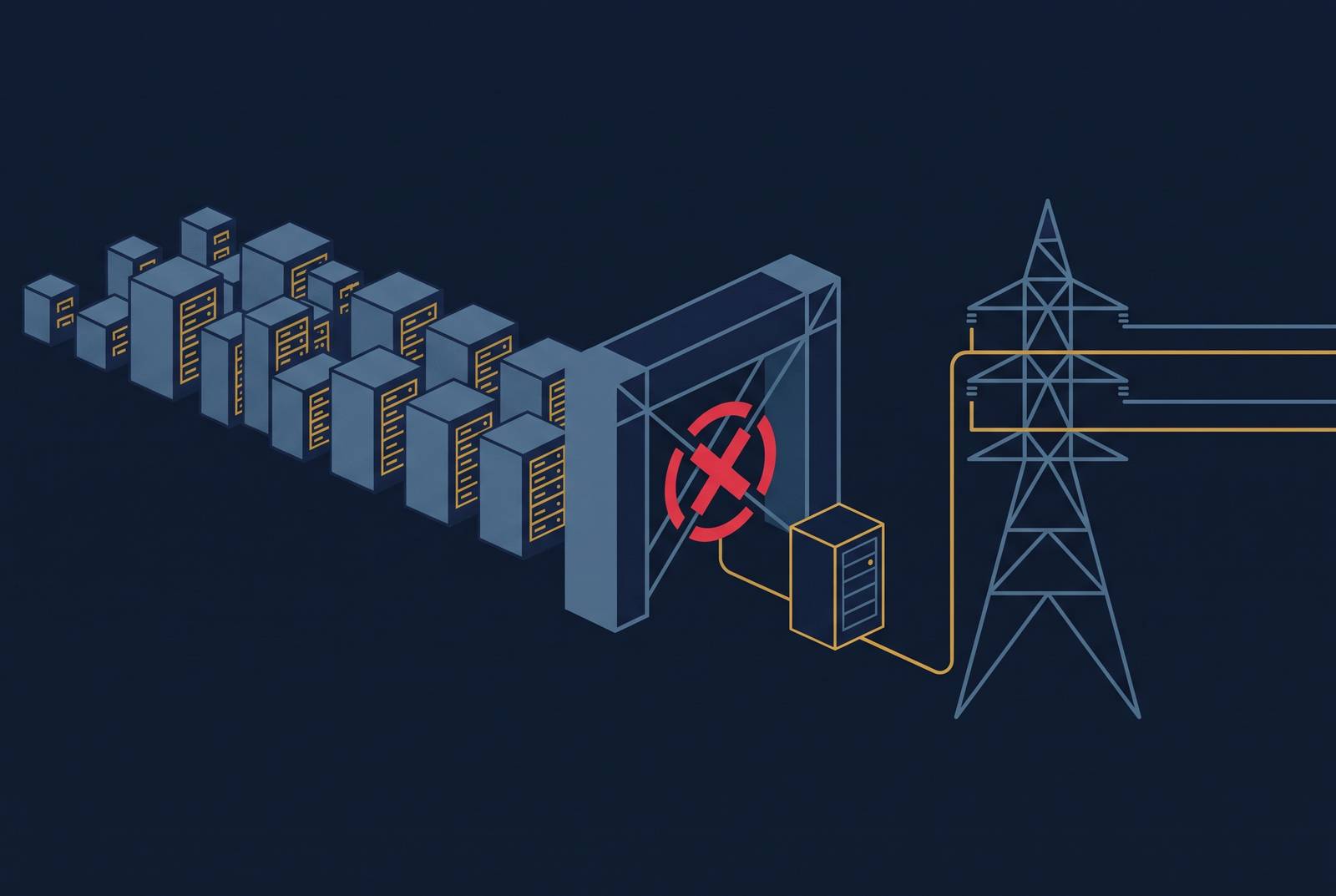
Interconnection has quietly become the single biggest constraint on when an AI data center actually turns on, ahead of chip supply, capital, and construction schedules. In PJM and MISO, the two grid operators covering the densest concentration of new data center demand in the country, the wait between filing an interconnection request and flipping the switch now runs seven years or more on average. That's a structural mismatch between how fast demand is growing and how fast the grid can physically absorb it. It's a structural mismatch between how fast demand is growing and how fast the grid can physically absorb it.
The scale is hard to overstate. RMI puts the national interconnection queue at more than 2.2 terawatts of generation and storage waiting to connect, a figure that dwarfs what most grid planners anticipated even a few years ago. None of that clears itself once a few staffers catch up on paperwork. It's what happens when demand growth outruns the physical and administrative capacity of the grid to say yes, and pretending otherwise just wastes another planning cycle.
PJM's queue as a seven-year gauntlet for large loads
PJM serves more than 65 million people across 13 states and a federal capital region, and it holds the densest concentration of hyperscale and colocation load in the country. It's also where the wait has gotten worst. As of 2025, the average timeline from interconnection application to commercial operation in PJM has stretched past eight years.
PJM's own numbers break that down: better than three years, on average, just to land an interconnection service agreement, then another four years from that approval to actually coming online. The queue itself carries more than 260 gigawatts of requests, against a grid that was never built to process that kind of volume. Developers feel the squeeze and act on it. PJM logged 95 large-load adjustment requests totaling around 54 gigawatts through November 2025, all attempts by data center developers to jockey for a better spot in line.
The eight-year figure deserves a second look before anyone treats it as gospel. Jeff Shields, a senior manager at PJM, has pointed out that published eight-year numbers often bundle in construction time and post-approval work that sits outside PJM's control. The queue process itself isn't the whole story. Something else eats the clock, and it happens after approval, not during it.
Where the delay lives: transmission, substations, and supply chain after approval
PJM's own data backs that up. The biggest delays aren't happening inside the interconnection queue anymore. They've moved downstream, into transmission buildouts, substation capacity, and supply chains stretched thin by demand nobody fully priced in a few years ago.
PJM presented a breakdown in January 2026 of milestone change requests for projects under construction or in development. Permitting accounted for 29% of those requests. A catch-all "other" category, covering EPC procurement, equipment availability, construction delays, and land ownership issues, made up 28%. Supply chain delays alone were 23%. Add those up and the message is blunt: a project team that signs an interconnection service agreement and then waits for the clock to run out just makes its own delay worse. That three-to-four-year window after approval is working time, not downtime. Permitting has to get resubmitted. Equipment substitutions have to get made. The supply chain throws curveballs that need answers, not silence.
The pressure isn't letting up, either. New large-load demand in PJM is forecast to grow by roughly 70 gigawatts through 2038, against a grid that has already retired around 15 gigawatts of generation since 2022. That gap keeps the post-approval window tight. The real job for project teams is making productive use of every year that follows approval, not just surviving the queue.
MISO's structural backlog and why a fast-track attempt failed
MISO covers a wide stretch of the Midwest and South, a region pulling in growing data center investment as developers look for alternatives to an oversaturated Northern Virginia market. The queue there tells a similar story to PJM's, with its own particular flavor of gridlock layered on top.
As of October 2024, MISO's Definitive Planning Phase Study Schedule still showed projects dating back to 2018 and 2019 stuck at the "GIA In Progress" stage. Some projects have been waiting five, six, seven years just to get a signed agreement in place. The current scale is staggering: 1,127 projects totaling 215 gigawatts sitting in MISO's queue right now. Between November 2024 and August 2025, MISO managed to process 100 GIAs totaling 17 gigawatts, a fraction of what's waiting behind them.
Getting a signed agreement doesn't even mean the wait is over. Of the projects with signed GIAs, 57,478 megawatts are still waiting for construction, and 31,512 megawatts of that is actively delayed. Clearing the queue guarantees nothing about a clean path to energization, and that's the part project teams underestimate most.
MISO tried to get ahead of the backlog with a fast-track proposal called the Expedited Resource Addition Study, or ERAS, which would have accepted applications quarterly until December 2028 or the completion of the 2027 study cycle, whichever came first. FERC rejected it in a 2-1 decision on May 16, 2025. The rejection came without prejudice, so MISO can refile a modified version, but for now the fast lane simply doesn't exist. Any project team banking on ERAS as a near-term escape hatch is planning around a door that's currently shut.
Internal reform is underway regardless. MISO has rolled out software called SUGAR to automate steps in the study process, stood up a new application portal, and capped new requests at 50% of each planning region's noncoincident peak, effective for the DPP-2025 cycle. None of that has gotten MISO down to its tariff-required 373-day processing timeline. That target is still out ahead of where the process actually stands.
The regulatory moves underway and what they offer project teams
Regulators know the queue is a problem, and there's real motion at the federal level. Whether that motion translates into relief for a given project depends entirely on the fine print, and most projects currently in line will find the fine print doesn't cover them.
FERC issued show cause orders to all six regional grid operators in June 2026, giving each 60 days to justify their current tariffs or file reforms. The reform categories on the table cover transmission service processes, cost shifting, co-location rules, flexible large-load service, and studies of generation that sits electrically close to a proposed load. On October 23, 2025, DOE directed FERC to start a rulemaking aimed at speeding up interconnection for large loads, including a path for co-located load and generation projects to file joint interconnection requests directly with FERC instead of going through the regional queue at all.
PJM's most concrete near-term offering is its Expedited Interconnection Track, or EIT. FERC has approved it, and it takes effect July 31, 2026, running through the end of 2027. The relief is narrow by design: only up to 10 interconnection requests get reviewed under this track each calendar year. To even qualify, a project needs a minimum of 250 megawatts of unforced capacity, full site control, and a commitment from the relevant state's primary siting authority. Ten projects a year, against a queue carrying 260 gigawatts of requests, means most data center developments simply won't fit through this door. That math alone should end any hope that EIT is a general fix rather than a pressure valve for a handful of projects.
Co-location is the other major front. FERC ordered PJM on December 18, 2025, to build out rules allowing data centers to co-locate at power plants, a reversal of sorts from FERC's November 1, 2024, rejection of a co-location interconnection agreement for up to 480 megawatts of data center load at an existing nuclear plant in Pennsylvania. PJM's compliance filing now proposes several new service types designed to accommodate co-located loads under varying generation and reliability arrangements. Separately, PJM's Critical Issue Fast Path process on large load additions, kicked off in August 2025, produced a Board decisional letter in January 2026 laying out six guiding principles, including an expedited "Bring Your Own Generation" track and a reliability backstop procurement mechanism.
That backstop sets a mandatory registry of large-load facilities in motion. Starting in September 2026, PJM plans a Reliability Backstop Procurement auction meant to address a capacity shortfall of roughly 60 gigawatts. The PJM Board also plans a mandatory registry of large-load customers, data centers included, that would face curtailment during periods of system stress. Faster interconnection paths are showing up, but they arrive bundled with new curtailment obligations that didn't exist a year ago, and any developer treating the fast path as a free lunch is missing the other half of the deal.
MISO's ERAS fast-track remains dead for now, with a refiled version only a possibility somewhere down the road. Project teams sitting in MISO's queue should treat expedited relief as speculative, not something to build a schedule around. Across both grids, reform is happening on a timeline measured in years, with qualification bars set high enough that most projects currently in line won't clear them anytime soon.
The capacity cost explosion's implications for data center economics and site selection
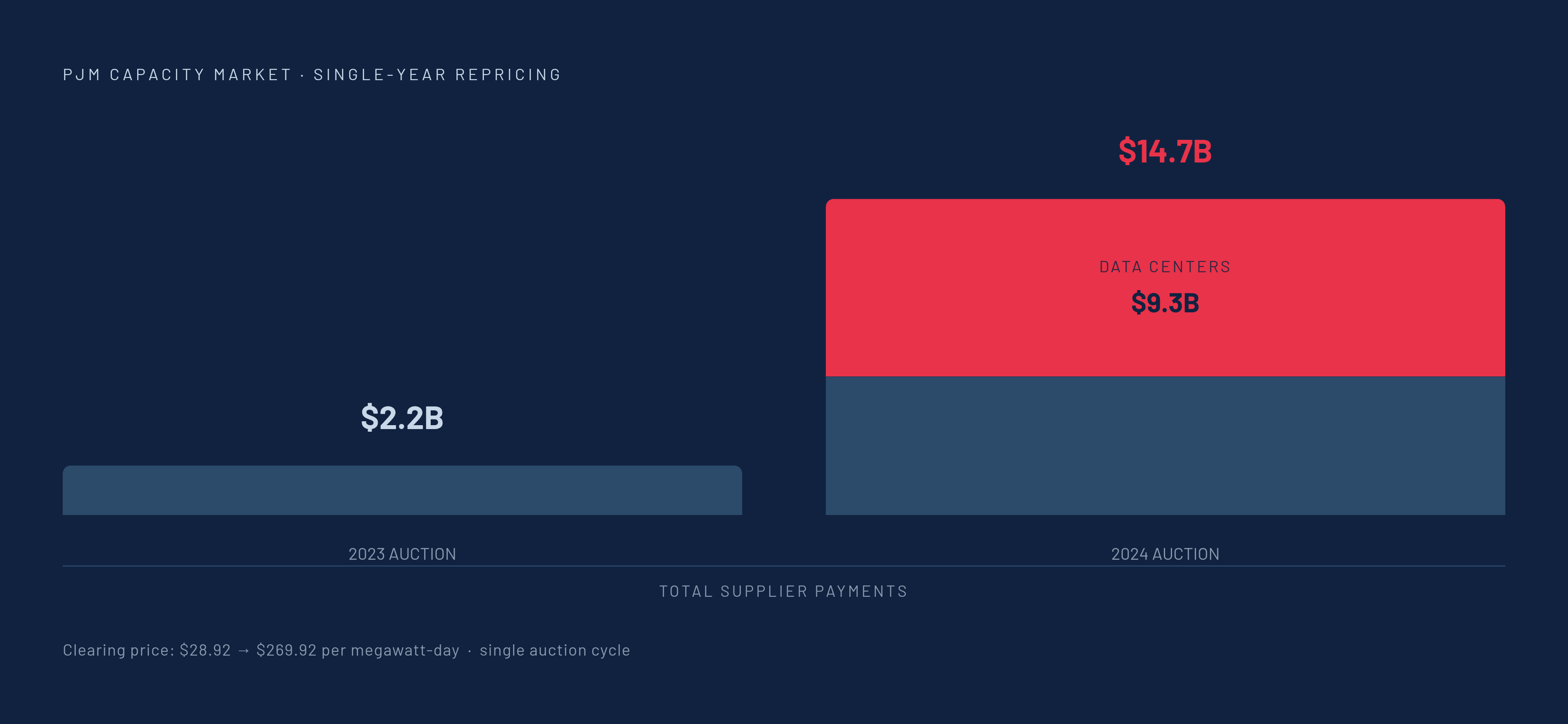
The tightening of the PJM market is most clearly visible in the capacity auction price. It jumped from $28.92 per megawatt-day to $269.92 per megawatt-day in a single year, a repricing of risk almost overnight rather than a gradual climb. Anyone still modeling PJM capacity costs off last year's numbers is working from a stale map.
The dollar figures that produced that jump are large enough to change political conversations and spreadsheets alike. In 2025, PJM's electricity suppliers paid $14.7 billion at auction to secure supply adequacy, up from $2.2 billion the year before. Data centers alone drove a $9.3 billion increase in capacity costs for the 2025-26 PJM delivery year. Households feel it too, with residential customers in Ohio and Maryland seeing added charges on monthly bills, small individually but enough to generate real political pressure once multiplied across millions of accounts.
One analysis ran the counterfactual: if just 30% of the renewable projects stuck in the queue for five years or more had actually gotten interconnected, the 2025 auction cost would have come in 63% lower. That's about as clean a measurement as exists of what queue congestion costs everyone on the grid, data centers and households alike, in dollars already showing up on a bill.
Site selection changes because of this, and not just on timeline risk. A developer choosing PJM territory now isn't just accepting a multi-year wait to get online. That developer is locking in materially higher capacity costs that stay attached to the project for its entire operating life, and treating PJM as the default safe choice ignores what that auction number already proved.
PJM isn't some cautionary outlier sitting next to otherwise smooth-running markets. Other major grid operators are facing their own versions of the same pressure, with queue volumes and connection timelines climbing in markets that were once considered more accessible. Reports indicate that ERCOT's queue has swelled with data center load requests, and state authorities have moved to impose new oversight on incoming connections. No geography is insulated from this, and betting a site-selection strategy on finding some unclogged market is a bet against the numbers above.
The four-to-seven year gap between approval and energization and its reshaping of project sequencing
The traditional data center delivery playbook assumes a fairly tight window between locking in a design and flipping the switch. Queue delays break that assumption completely, and the break ripples through every part of a project's plan, not just the schedule line marked "interconnection."
Equipment lead times for transformers, switchgear, UPS units, and generators now stretch well past historic norms, so procurement decisions made the day a project enters the queue can be obsolete by the time it's ready to energize. Permitting, which already accounts for 29% of PJM's milestone change requests, gets timed to an energization date that then slips, kicking off resubmission cycles that eat even more time. Technology moves too: a layout frozen in year one of a seven-year window may not match the rack density or cooling requirements of the equipment actually available when energization finally arrives. Staffing continuity suffers on top of all that, since teams assembled around a known energization date can't realistically stay locked in place across a multi-year gap without churn.
That creates a documentation problem that's easy to underestimate. Every rack move, every load revision, every equipment substitution, every layout change made during that gap needs to trace back cleanly, RFI to design decision to equipment parameter. Without that thread, a project arrives at energization with records that don't match the facility actually being handed over.
It creates a handoff problem, too. DCIM, EPMS, and BMS systems that come online at commissioning need structured, current asset data. A model frozen the moment the project entered the queue, then patched by hand across several years of change orders, won't cut it.
None of that gap is dead time. It's the exact stretch where fragmented, manual workflows are most likely to introduce errors, and those errors compound the longer the project sits.
Connected design workflows made possible across an extended pre-energization window
The gap exposes a workflow problem that's been simmering for years. Design data lives scattered across disconnected models, spreadsheets, and PDFs, so a single equipment substitution or load revision forces manual rework across power, cooling, cable routing, schedules, and documentation, all separately, all prone to drift. Stretch that across four to seven years and the manual rework stops being an inconvenience. It becomes unmanageable, and it's the single biggest reason projects arrive at commissioning with records nobody trusts.
A connected project workflow changes what's possible during that window. Layout and critical-systems coordination can cascade automatically, so a rack move updates power, cooling, and cable routing without someone re-entering the same change across five different tools. Equipment data pulled straight from manufacturer specifications can flow directly into models and validation rules, so when a transformer's lead time forces a substitution, that substitution propagates through the design instead of getting scribbled into a separate change log nobody checks again. RFI and submittal records stay attached to the design decisions they actually document, so a team arriving at commissioning three years after an RFI got resolved can still trace what was decided and why. Structured asset data gets maintained in a form ready to hand off to DCIM, EPMS, and BMS at energization, rather than reconstructed at the last minute from documentation that's gone stale.
ArchiLabs Studio is built for exactly this kind of work: layouts, critical-systems engineering, cable routing, documentation, RFIs, and operations-ready handoff, connected inside one workflow, so design changes made across a long pre-energization window stay consistent across the whole project record instead of piling up as manual debt someone has to untangle later.
The distinction that matters here is which tool handles which job, and getting this backwards is where most connected-workflow efforts quietly fail. Deterministic rules should handle the coordination work where precision can't slip, things like power capacity, cooling load, and cable routing compliance. AI is better suited to the responsive, language-heavy work, like drafting RFIs or pulling structured data out of a manufacturer's spec sheet. These aren't interchangeable tools, and treating them as if they were creates a mismatch nobody can explain years later, once the model and the paperwork have quietly drifted apart.
A project team that reaches a seven-year energization date with a fragmented, manually patched design record runs into the same handoff failure as a team on a two-year timeline. The only difference is how much divergence has piled up between the model, the paperwork, and the building that actually got constructed.