Cooling Water Rights and Municipal Supply Agreements for Data Centers
Data centers face new legal battles over municipal water supply in drought-stressed regions.
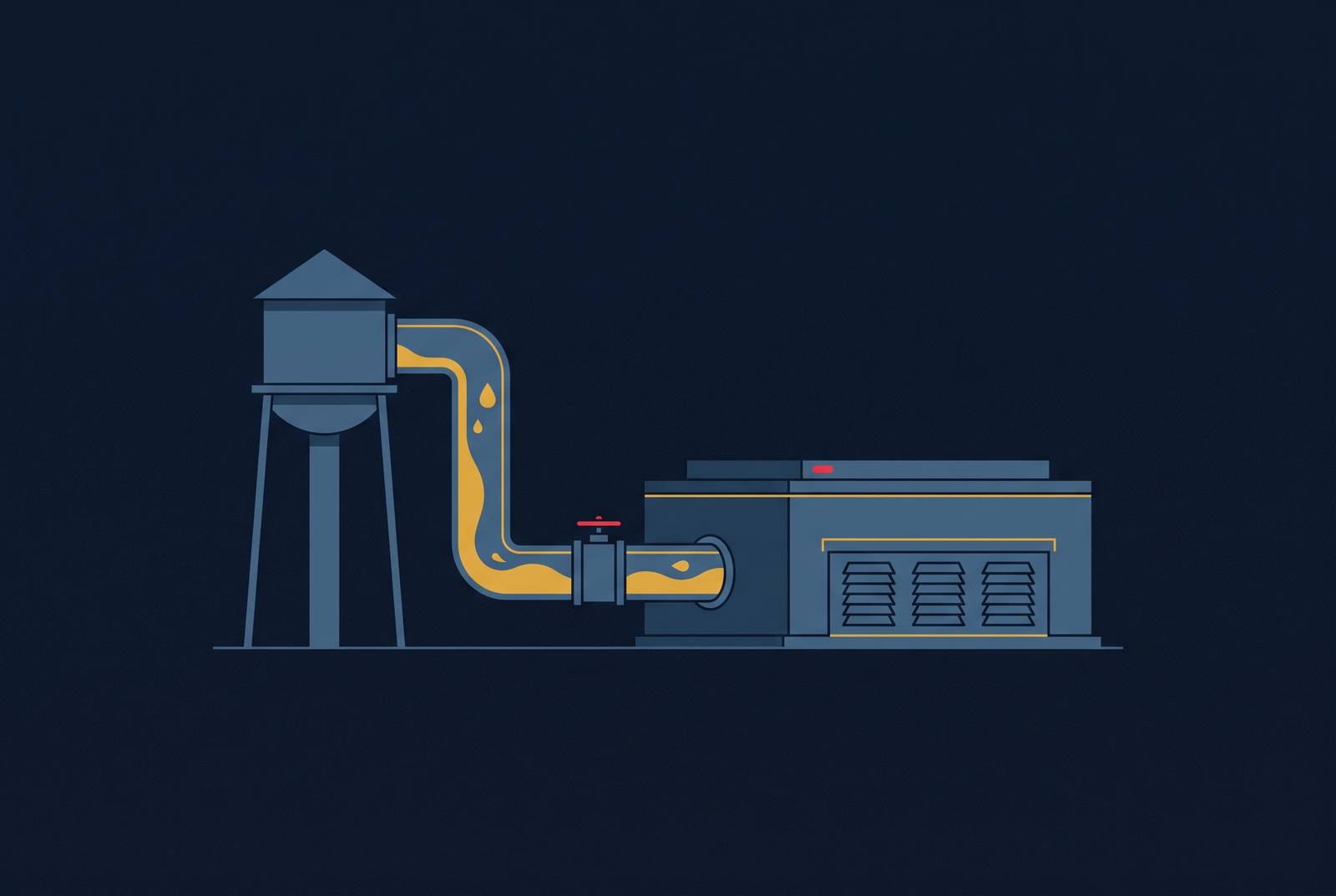
Water used to be the easy utility connection on a data center project, the line item nobody argued about. Securing a firm, reliable water supply for cooling now carries the same legal complexity and the same power to make or break a project timeline as electrical interconnection. The Congressional Research Service's report confirms that most data center operators get their water from public water systems, with municipal supply covering an estimated 97% of on-site water needs.
How U.S. water law determines a project's exposure
Nothing in water law is uniform across jurisdictions. In the West, states like Colorado, Nevada, and Arizona follow prior appropriation: "first in time, first in right." Water rights are ranked by seniority, and when shortages hit, junior users get cut first. A data center acquiring rights in an already over-appropriated basin starts as a junior user by definition, meaning its supply sits first in line for curtailment during a drought call.
The East and Midwest generally follow riparian or reasonable-use doctrine, where rights attach to land ownership and use must be "reasonable." Project Turbo, a data center near Gainesville, Georgia, shows what that looks like in practice: its water plan depended on the City of Gainesville's withdrawal rights from Lake Lanier, a reservoir managed by the U.S. Army Corps of Engineers. A federal reservoir relationship stands behind what looks on paper like a routine municipal hookup.
Most projects connect through a municipal utility rather than sourcing water directly, and that choice comes with a built-in shield and a built-in inheritance. The utility generally carries legal responsibility for complying with the state's water-right requirements, so the data center itself doesn't hold the right. But the facility still inherits the utility's exposure: drought restrictions, curtailment orders, and whatever supply planning constraints the utility is operating under become the data center's problem the moment conditions tighten.
Direct sourcing, by contrast, exposes a company to state and local permitting requirements with no intermediary to absorb the risk. Imperial County, California, shows how fast that door can close. The Imperial Irrigation District denied it, and litigation followed.
A federal layer runs underneath much of this, and project teams often miss it. Many municipal water systems draw from reservoirs built and managed by the Bureau of Reclamation or the Army Corps of Engineers, so a data center connected to municipal supply may be indirectly dependent on federal infrastructure it never directly contracted with. Arizona's Central Arizona Project is the clearest case: a 2026 study identified dozens of data centers completed or under construction in Central Arizona, every one of them served by municipalities drawing Colorado River water through CAP.
Municipal supply agreements: contents and risk
Municipal supply agreements for large data centers have moved well past the standard utility contract now. They're now negotiated frameworks that allocate real risk around drought, curtailment, and future expansion, and the clauses that get the least scrutiny at signing are frequently the ones that cause the most trouble once the facility is operating.
Cost-sharing arrangements settle who pays for new pipelines, pump stations, or reclaimed water distribution infrastructure, a question the Imperial Irrigation District's Resolution No. 37-2025, adopted in December 2025, answered directly by requiring developers to fund infrastructure upgrades triggered by their own projects, keeping those costs off ratepayers.
None of this means the data center holds the stronger hand. Utilities in constrained markets have real leverage, and some simply decline to negotiate. Utilities that decline to negotiate, and negotiations that collapse into litigation instead of a signed agreement, appear clearly in the cases that follow.
Negotiation breakdowns in Arizona, California, and Georgia
Three cases make the risks concrete, and each one represents a different way a water strategy can fail.
Marana, Arizona, is a case of outright municipal refusal. In December 2024, the Town of Marana adopted an ordinance stating that "the Marana water department will not provide potable water to a data center (principal or accessory use) for its cooling system, humidity control, and other similar operations. Marana isn't an outlier. A 2026 study counted 66 data centers completed or under construction in Central Arizona, and municipalities in that same supply-constrained position serve all of them. That makes the corridor a concentrated zone of water-access risk even for facilities that are already built and running.
Imperial County, California, is a case of regulatory denial followed by litigation. The fallout extended past the courtroom: in December 2025, the IID Board unanimously adopted Resolution No. 37-2025, a "ratepayer first" framework requiring developers to fund any infrastructure upgrades their projects trigger. A failed, creative water strategy produced litigation, and that litigation produced a formal policy that closes the door more firmly on the next developer who tries something similar.
Gainesville, Georgia, is a case of federal reservoir dependency inside a riparian state. Project Turbo, paused as of December 2025, planned to meet its water needs through the City of Gainesville's system, which can withdraw up to 8 million gallons per day from Lake Lanier. Even in the East, where the legal doctrine looks less restrictive on paper, a large industrial water user can end up depending on a federal reservoir allocation and a municipal intermediary at the same time, two separate constraints that can each independently cut off supply.
A fourth case belongs here mainly as a preview of what comes later in this piece. The legislative consequence is not, and it sets up the disclosure landscape covered later.
Community opposition as a project-approval variable
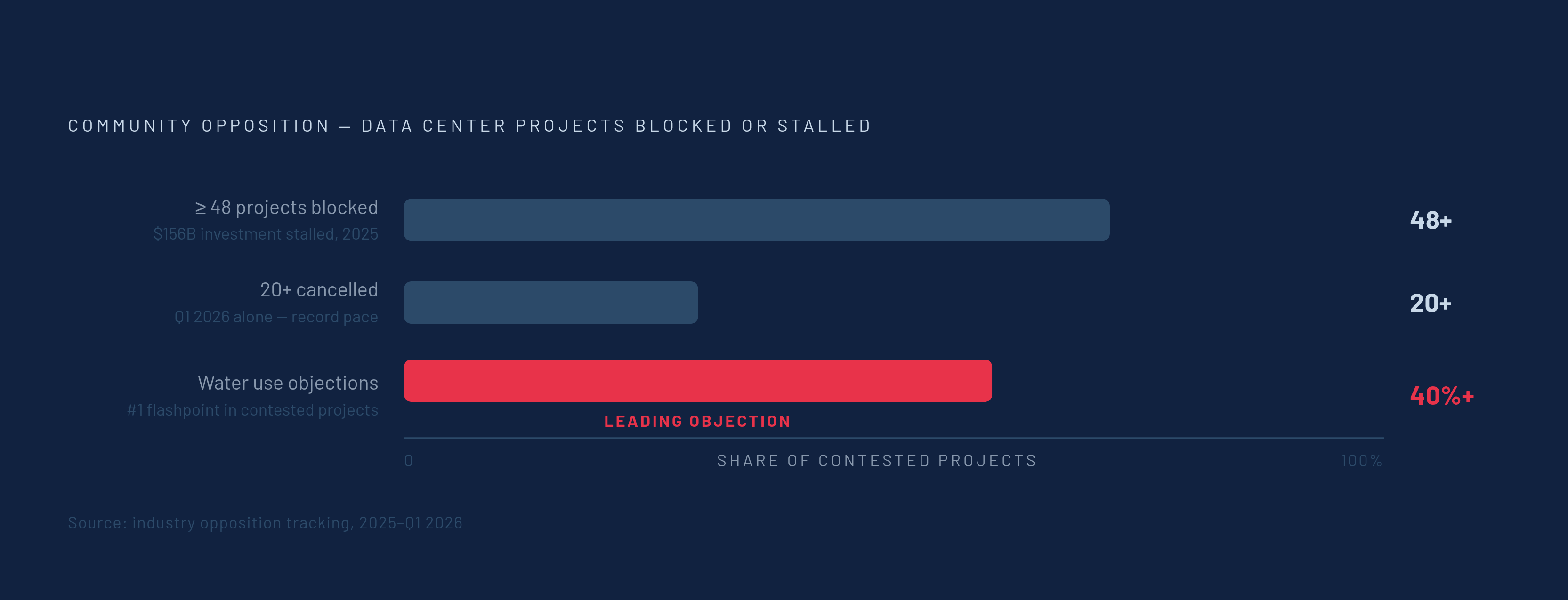
Community opposition to data center water use is no longer just a public relations issue now. It's organized enough and consequential enough that it now shapes how deals get structured, not just how they get discussed at town meetings. A Fortune analysis found that at least 48 data center projects, representing $156 billion in investment, were blocked or stalled by local opposition in 2025 alone. Cancellations rose sharply from 2024 to 2025, and more than 20 additional projects were cancelled in the first quarter of 2026, a record quarterly pace. Water use appears in more than 40% of contested projects, making it the single most common point of community objection.
That pressure has produced a new category of contract provision that Climate Solutions Law calls "social license" structuring. Water-use caps now get negotiated as conditions of local approval. Tiered conservation triggers automatically reduce a facility's water draw when drought thresholds are crossed. Community advisory mechanisms give local stakeholders ongoing visibility into consumption data. Community benefit commitments fund local infrastructure or conservation programs directly.
The opposition is tracking a real structural inequity, not just discomfort with new industry moving in. If facilities are proposed near disadvantaged communities, that imbalance compounds into added stakeholder management work and real litigation risk, and a standard permitting review won't catch it on its own.
Reclaimed water agreements: offerings and requirements
Reclaimed water is the most viable near-term alternative to potable municipal supply for cooling, but it isn't a simple substitute. Most state legal frameworks governing water reuse were built for irrigation and agriculture, and adapting them to the continuous, high-volume demand of an industrial cooling system takes real negotiation.
Reclaimed water is treated wastewater made available for non-potable use, which works well for evaporative cooling systems that don't need drinking-water quality. It eases pressure on potable supplies and, in some states, qualifies a project for permitting advantages or incentive eligibility. Treatment risk needs explicit allocation: the agreement has to say who bears the cost and liability if reclaimed water quality falls outside what the cooling system needs. And water right transferability isn't automatic in every state: a utility's right to use reclaimed water can be constrained by the terms of its original water right, so the shift from potable to reclaimed use requires its own legal clearance.
The EPA's Water Reuse Action Plan 2.0, released in April 2026, addresses industrial-scale reuse more directly than prior federal guidance. But primary permitting and allocation authority stays with the states, so reclaimed water deals still get assembled one jurisdiction at a time, with no federal shortcut available.
The energy-water trade-off that cooling technology choices create
Choosing a cooling system is a resource allocation decision, not an engineering preference, and it sets whether a project's binding constraint ends up being water access or grid capacity. Evaporative cooling is the most water-intensive option but also the most energy-efficient: it moves heat by evaporating water, which works thermodynamically but sends that water out of the system as vapor with no recovery. Liquid cooling, whether direct-to-chip or immersion, can reduce water consumption by 90% or more compared to traditional evaporative systems, and it's becoming standard in AI-optimized facilities, though it introduces its own equipment procurement, maintenance, and performance guarantee requirements that teams need to negotiate separately.
Hybrid configurations are emerging as a practical middle path. Some facilities now shift between evaporative and dry cooling depending on the season, ambient temperature, real-time water availability, or utility curtailment signals. That flexibility makes the supply agreement more adaptable, but it also makes it harder to specify contractually, since the agreement needs to account for multiple operating modes.
A technology company's infrastructure investment in Louisiana shows what a well-managed version of this trade-off looks like. The company pledged up to $400 million to upgrade local public water infrastructure, so evaporative cooling now gets used less than 13% of the year during peak heat. The water investment converted directly into grid relief, benefiting the operator and the utility at the same time.
State disclosure requirements and cooling mandates in project due diligence
State legislatures are building a fast-moving layer of rules on top of all of this, turning water use from a privately negotiated matter into something publicly reported and, in a growing number of states, technically mandated. States vary so much that due diligence on a multi-site portfolio now has to track live legislative sessions, not just settled law.
Several states have moved on disclosure. Iowa's HF 2447 requires the state's Department of Natural Resources to get quarterly reports on water usage. Georgia is working on legislation to bar local governments from signing nondisclosure agreements with data center operators that would conceal energy and water usage from the public.
Other states are moving on cooling technology directly. South Carolina's HB 4583 would mandate closed-loop cooling systems with zero net water withdrawal and zero wastewater discharge, prohibiting the extraction of groundwater or the use of municipal water for cooling, and the bill has picked up bipartisan co-sponsors. Virginia has taken an incentive-based approach instead: SB 417 conditions eligibility for the Cloud Computing Cluster Infrastructure Grant Fund on using treated wastewater, and the legislature will reconsider it in 2027. Virginia's HB 30 budget amendments tie the state's data center tax credit to investment in environmental management and energy efficiency, but the Senate version, SB 30, would eliminate the sales tax exemption for data centers. Iowa's HF 2261 would create a separate utility customer class for water utilities serving energy facilities that need at least 20 MW of power, and it applies to water utilities a customer-class framework that already appears in electricity legislation.
The trend isn't moving in one direction without resistance. A site permitted today under one state's framework can face new disclosure requirements or cooling mandates within the next legislative cycle, so project teams and their financiers need to track each state's legislative trajectory, not just its current statute book.
A rigorous water strategy at project inception
Everything above points to one practical conclusion: teams that treat water supply analysis with the same rigor and the same timing as power procurement catch fatal constraints early, negotiate stronger agreements, and avoid the cancellations and litigation that follow from treating water as a late-stage detail.
That starts before site selection is final. Identify which water law regime applies, prior appropriation, riparian, or some hybrid, and what that means for a new industrial user's position in the priority system. Check whether the target municipality's own water supply is constrained: what its source is, whether it depends on federal infrastructure, and whether it has adopted any ordinance restricting industrial cooling supply, the kind of Marana-type risk that can eliminate a site. Map the state's legislative posture too, because pending disclosure bills or cooling mandates can change the economics of a project before it's even built.
On the contract side, insist on explicit priority-of-service terms and drought interruptibility triggers, and don't accept boilerplate language that defers everything to the utility's discretion. Where reclaimed water is available, treat it as a serious primary supply pathway, with treatment risk, quality parameters, and drought interruptibility negotiated with the same precision as a potable water agreement, not less.
Cooling technology choice belongs in this strategy, not off to the side as an engineering decision. In grid-constrained markets, evaporative cooling may ease electricity demand at the cost of water, and that trade-off needs to be modeled explicitly and reflected in both the supply agreement and the interconnection application.
Community engagement works best as a permitting instrument, not an afterthought. Water-use caps, tiered conservation triggers, and community benefit commitments are now contract provisions that belong on the table early, before opposition organizes against the project. Structuring them up front, the way Lancaster, Pennsylvania did with its water-use cap, emissions controls, and $20 million community benefit commitment, produces more favorable terms and faster approval timelines than responding to opposition after it has already formed.
None of these pieces, the water supply agreement, the cooling system design, the power supply arrangement, the permitting process, operate independently. Managing those dependencies through connected, structured workflows rather than scattered spreadsheets and PDFs is what makes a water strategy executable, and it's increasingly the kind of traceability that financiers, regulators, and community stakeholders expect as a condition of supporting a project.