24/7 Carbon-Free Energy Matching for Data Center Operators
Hourly carbon-free matching demands new procurement and operational strategies.
Annual renewable matching can balance a data center’s energy books without covering its dirty-power hours. This article explains why 24/7 carbon-free energy matching is a different commitment, and what operators need to close the gap. Closing the gap requires a coordinated change in power procurement, workload scheduling, and facility data, built around matching consumption where and when it happens.
Why 24/7 CFE is a categorically harder problem than annual renewable matching
A “100% renewable” claim sounds like clean power at every hour, but it need not mean that. An operator can draw coal power at 2 a.m. and buy certificates from solar generation at noon. Under annual matching, the account balances when renewable energy certificates cover as much energy as the data center uses over the whole year. Actual grid emissions continue during the hours those certificates do not cover.
24/7 carbon-free energy matching, or CFE, removes that freedom to move claims across time and place. Every kilowatt-hour consumed must be matched with carbon-free electricity generated in the same grid region at the same clock hour. A surplus in another hour or region cannot make up the difference. Annual matching and hourly matching need different technical systems and accounting rules as well as different amounts of certificates. Solar and wind power purchase agreements, or PPAs, can cover an annual total, but the hourly commitment also needs clean generation for the hours they leave empty.
Why the AI demand surge makes the 24/7 gap impossible to ignore any longer
Data centers around the world needed roughly twelve percent more electricity in 2025 because of AI. The IEA projects consumption reaching 945 TWh annually by 2030, up from roughly 415 TWh in 2024. At that scale, the gap between annual-matched electricity and genuinely clean power is measured in megatons of actual emissions. An annual balance says little about the emissions attached to that growing load hour by hour.
The difficulty is that data centers need continuous, uninterrupted power. Unlike manufacturing facilities that can shed load, they cannot simply defer their whole electricity requirement when renewable output falls. Nighttime and low-renewable hours must still be covered, even if some computing jobs can move. As demand grows, so does the amount of power needed during those difficult hours. That makes the distinction commercially and reputationally consequential now, rather than a distant question about reporting standards.
The firmness problem: what solar and wind cannot cover and why
The generation profile poses an obstacle alongside the amount of renewable capacity purchased. Solar capacity factor is around twenty-five percent, and output falls to zero at night. Wind is at thirty-five to forty-five percent and changes from season to season and day to day. Buying more solar cannot fill a nighttime gap, and more wind capacity does not ensure that power will be there during a wind lull.
Short-duration batteries help, but even a mix of solar, wind, and short-duration batteries leaves long gaps in supply. These include overnight low-wind periods, seasonal lulls, and multi-day weather events. The need for dependable clean supply through periods when variable generation cannot meet demand connects energy procurement to storage, electrical architecture, operational flexibility, and resilience. A contract that covers total consumption does not settle whether the facility has clean power through those periods.
Proving the match adds another layer of difficulty. Credible hourly accounting requires granular consumption data, advanced forecasting, and rules that tie clean-energy claims to both time and location without double-counting them. Time-based energy attribute certificates, or T-EACs, support hourly tracking and verification, complementing PPAs. However, their standards and verification infrastructure are not fully resolved across all grid regions.
Procurement strategies that address firm, around-the-clock carbon-free supply
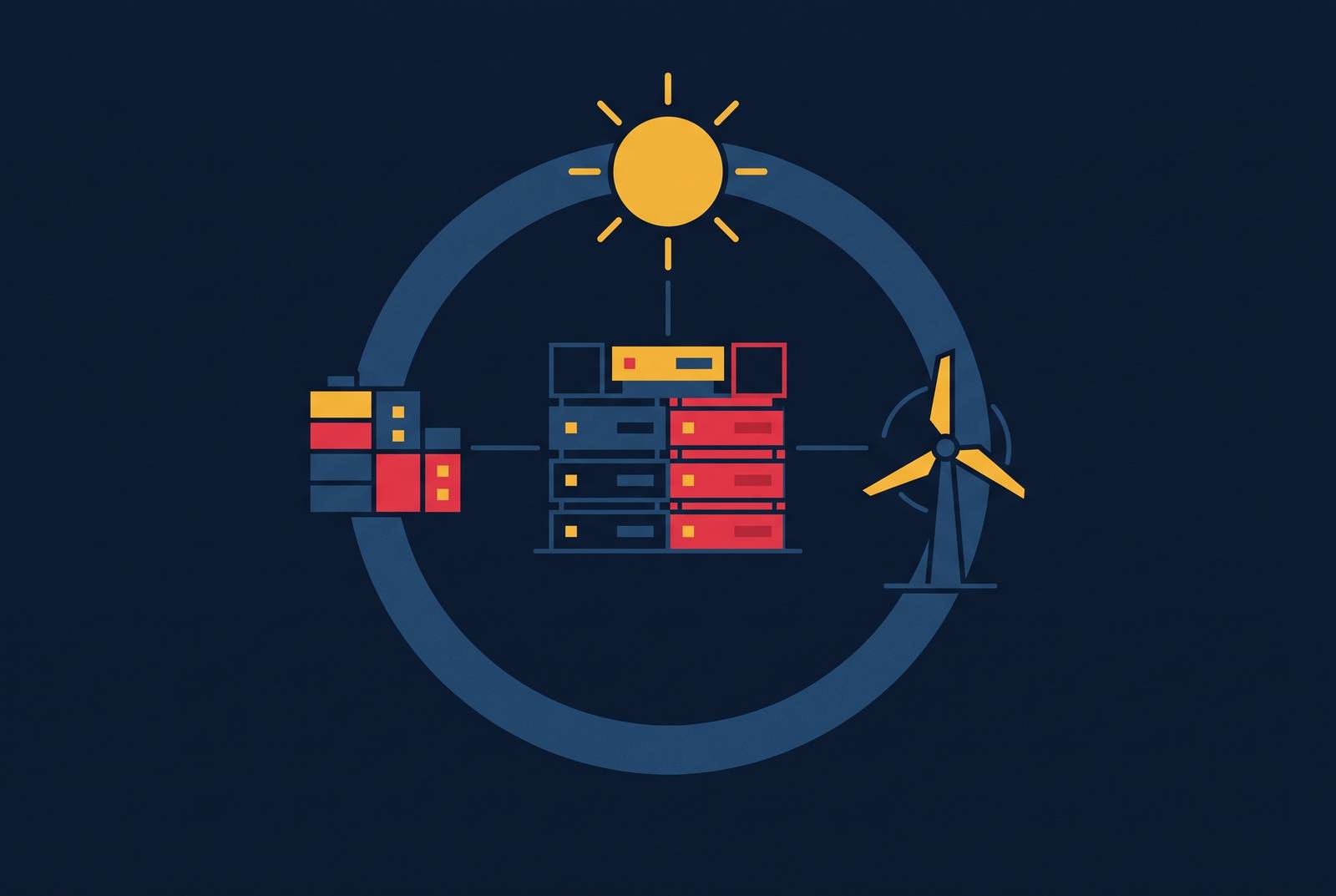
The supply-side response is a portfolio whose parts cover different hours. Solar and wind provide renewable volume, but firm generation and storage must address the gaps. Geothermal provides twenty-four-hour-a-day dispatchable carbon-free baseload, which is the steady supply profile hourly matching needs. Google has contracted enhanced geothermal with Fervo Energy and NV Energy, while Meta has contracted with Sage Geosystems. Suitable geology limits where geothermal can work, so it remains a partial solution.
Nuclear provides firm, dispatchable, carbon-free baseload with broader geographic applicability, but much longer lead times. Hyperscalers are paying for restarts and work to develop small modular reactors that would not go ahead based on what utilities alone could earn. Long-duration storage addresses a different need by bridging extended supply gaps. Options such as vanadium flow batteries for eight-to-twenty-four-plus-hour uses and compressed hydrogen for very long duration are still at an earlier stage and cost more. They belong in the developing supply picture, at a lower level of readiness than established renewable procurement.
Gas with carbon capture is also being contracted as an interim firmness solution. Google signed a 400 MW power agreement with Broadwing for natural gas with CCS, expected online in early 2030, with power generation potentially beginning by end of 2029. The agreement shows demand for a bridge while nuclear and long-duration storage reach commercial scale. It does not remove the need to distinguish near-term contracts from future supply.
Grid access is another constraint that contracts alone cannot clear. Google’s planned acquisition of Intersect Power is framed around “Energy Parks” and “Speed to Power” that bypass grid interconnection queues. Across these arrangements, hourly procurement instruments still matter because generating clean electricity and attributing it to the right consumption hour are separate tasks.
Operational strategies that reduce the clean-power gap from the demand side
While new supply develops, operators can also change when and where flexible computing runs. Batch AI training jobs, model evaluation, and data preprocessing have genuine scheduling flexibility, unlike latency-sensitive inference serving. Running those jobs in cleaner hours and regions can shrink the supply gap. This complements procurement, while continuous power remains necessary. The useful distinction is between loads that can move and services that must remain available.
The Oracle, NVIDIA, Emerald AI, and Salt River Project coalition showed that workload tiering could cut power use by twenty-five percent during peak demand hours while keeping AI quality-of-service guarantees. The demonstration also showed that systematic reductions during roughly the top one percent of peak hours could unlock a large volume of constrained grid capacity. That establishes a practical role for flexibility, but peak reduction and carbon reduction are not identical goals.
Knittel, Senga, and Wang’s 2025 research at the National Bureau of Economic Research demonstrates the risk of confusing them. In regions with carbon-intensive baseload generation, shifting loads to off-peak hours can increase emissions even as costs fall. Carbon-aware scheduling therefore needs grid-region specificity and actual grid-mix awareness.
Operators earn much less from offering flexibility to the grid than from compute, and a break in service puts far more valuable customer relationships at risk. Operators may thus be unwilling to take part even when their systems can do so. The practical approach is careful, region-specific shifting that respects service requirements, rather than treating all flexible compute as available for grid use.
What real 24/7 CFE programs look like in practice — and where they fall short
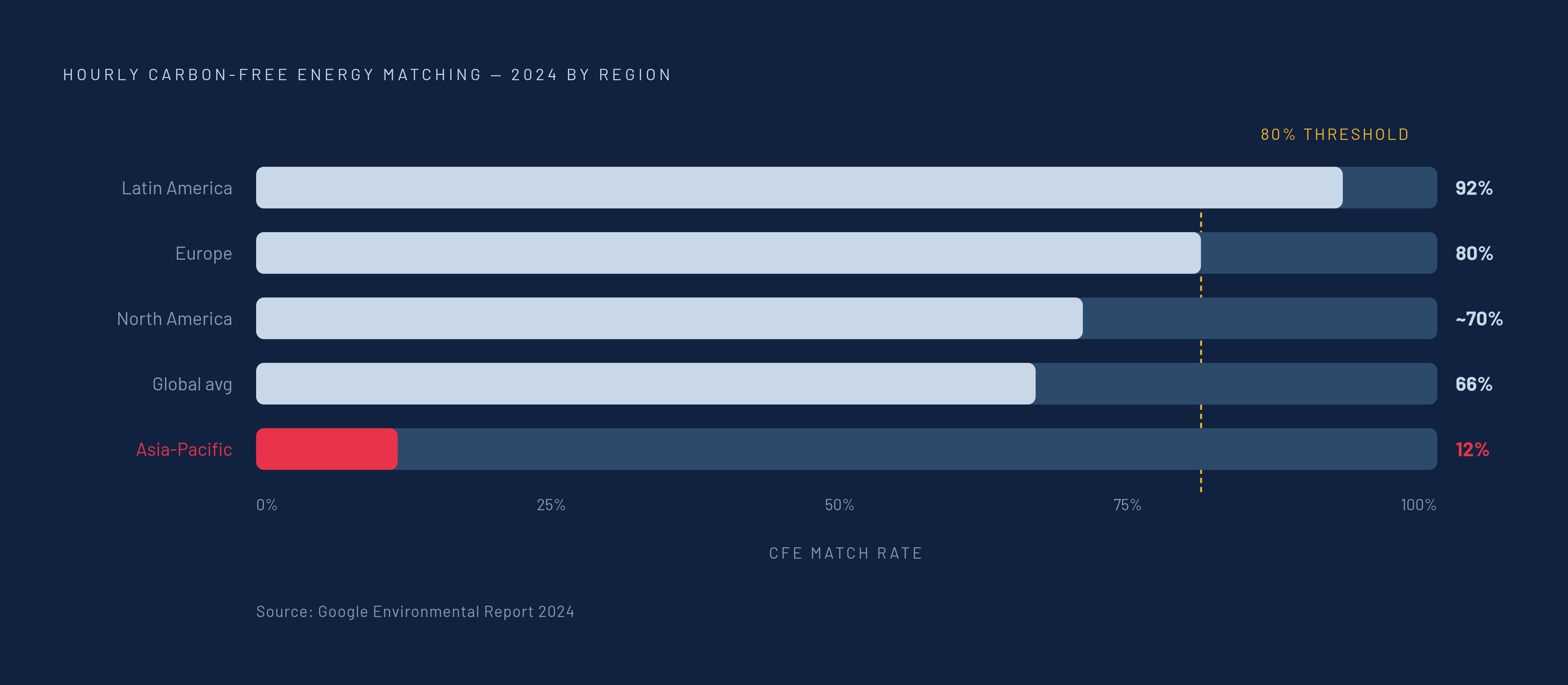
Google’s results show why hourly CFE is better understood as a range of regional outcomes than a single corporate condition. Google’s 2025 Environmental Report gives a global average of sixty-six percent hourly CFE for 2024, with nine of its twenty grid regions reaching at least eighty percent. Latin America leads at approximately ninety-two percent, Europe is in the eighty percent range, and North America is around seventy percent. Asia-Pacific averages just twelve percent. That last figure shows how far a global commitment can remain from execution in particular regions.
Google identifies eighty percent hourly matching as a meaningful threshold at which system-level grid decarbonization effects begin to materialize. Most of its own regions had not reached that threshold in 2024. Google also signed a long-term PPA for nearly seventy megawatts of baseload hydropower with Current Hydro in September 2025, directly supporting hourly matching goals.
Digital Realty’s plan to build a gas-fired power plant in Dublin shows another part of the execution gap. The operator is pursuing 24/7 CFE while also addressing the need to guarantee one hundred percent reliability. Meta’s one hundred percent annual matching uses accounting across its portfolio, which does not show that it has hourly CFE or a continuous physical supply. Equinix reported ninety-six percent renewable energy coverage in 2025, which likewise is not an hourly CFE result.
Where commitments are cracking and why the accounting debate is unresolved
Microsoft’s chief sustainability officer framed achieving one hundred percent annual renewable matching in 2025 as a milestone, implicitly positioning that standard as sufficient. Grid infrastructure strain puts pressure on harder commitments. Even so, treating annual matching as sufficient is a retreat from the original hourly commitment. The distinction matters because a change in the claim can leave the underlying clean-power gap untouched.
In Great Britain, total contracted offers in the demand connections queue grew from 41 GW in November 2024 to 125 GW by June 2025, nearly three times GB’s peak demand. NESO identified approximately 140 data centers totaling 50 GW as the single largest driver. Ofgem’s February 2026 Demand Connections Reform program introduced its “Curate, Plan, Connect” framework in response. Procurement ambitions depend on grid infrastructure that is itself under severe strain.
Accounting disputes make procurement choices harder still. Buying RECs from projects that already run changes who holds the paper claims without paying for new clean infrastructure or adding renewable capacity. That is the additionality dispute, which sits beside disagreements over energy matching versus carbon matching and what counts as deliverability within a grid region. The policy and standards community has not resolved which framework governs regulatory reporting. Annual and hourly claims consequently coexist without a clear hierarchy.
Independent verification is also unfinished work. Current disclosure frameworks do not yet make hourly CFE claims auditable in the same way as annual REC purchases. For operators, the practical risk is expecting an annual-matched portfolio to answer a future request for verifiable hourly evidence. It cannot provide that evidence on its own. Documentation systems need to account for the difference before customer or regulatory expectations make it urgent.
What an operator actually needs to build and track to move from annual to hourly matching
Procurement should stack complementary generation profiles, using wind and solar for volume, geothermal or nuclear for baseload firmness, and long-duration storage to bridge gaps. Geographic diversification also matters because a single-grid strategy concentrates exposure to the hours and seasons that grid cannot cover. Multi-region procurement can smooth the portfolio, but it cannot justify matching consumption with generation from the wrong region.
The cost premium for genuine 24/7 CFE has been reported in the range of five to ten percent over annual-matched procurement. That premium needs to be weighed against the reputational and regulatory exposure of relying on annual matching as standards tighten. Whatever the portfolio costs, verification starts with data on how much power is used each hour or at sub-hourly intervals. Accounting for when and where power is used must prevent double-counting by pairing T-EACs with metered generation data. Documentation systems should be built now for the audit expectations likely to follow customer and regulatory pressure.
That evidence depends on a connected operational picture that extends beyond the energy procurement team’s spreadsheets. Data on facility load needs to work with equipment schedules and real-time grid-mix signals. Carbon-aware scheduling also requires operational systems to communicate which loads are flexible and when. Fragmented power, cooling, cable, and scheduling information creates a traceability problem that carries from design and construction into operations. Structured asset data at handoff must flow into DCIM, EPMS, and BMS systems.
Operational electricity is not the whole carbon account, either. In AI data centers, IT equipment drives the majority of embodied emissions, with chips and memory accounting for roughly two-thirds of embodied carbon, followed by structural materials. As operational CFE improves, sustainability plans also need to include equipment with lower embodied impact. But closing the hourly electricity gap requires its own deliberate foundation. Ultimately, 24/7 CFE is an operational discipline, and the data infrastructure that makes it real must be built from the design stage forward.