EU Energy Efficiency Directive Requirements for Data Center Operators
Data centers over 500 kW must report energy metrics to shape future EU performance standards.

The EU Energy Efficiency Directive makes data center compliance more than an annual reporting task. Its reporting rules, heat recovery duties and performance grades to come all need the same foundation: structured, traceable data about the facility. Operators need that foundation before the reporting deadline, because the data submitted today will also shape public labels and future minimum performance standards.
What the EU Energy Efficiency Directive actually requires of data center operators
The EU Energy Efficiency Directive, recast in 2023, establishes obligations that vary with facility size. The core reporting threshold is 500 kW of installed IT power demand. Defense and civil protection facilities are expressly left out of these requirements. Other facilities in scope must report even where their member state has not fully transposed the directive, because Delegated Regulation EU 2024/1364 is directly applicable. National transposition is therefore not a condition for the reporting duty to apply.
The submitted data supports four sustainability performance indicators, namely PUE (Power Usage Effectiveness), WUE (Water Usage Effectiveness), ERF (Energy Reuse Factor), and REF (Renewable Energy Factor). These indicators cover energy efficiency, water use, energy reuse and renewable energy, and are published in aggregated form. Reporting gives facilities a shared base of evidence without setting the same efficiency target for all of them. Larger facilities have more duties, and national laws can require more than the EU baseline.
The framework also provides for further regulation based on that evidence. Article 12(5) required the Commission to assess submitted data by 15 May 2025 and report to Parliament and the Council, with authority to propose measures including minimum performance standards. The Commission issued a sustainability rating regulation on 21 September 2026, with first electronic labels expected in 2027. A separate study of minimum performance standards began in January 2026 and runs for about 24 months.
The annual reporting obligation and what must be submitted, by when, and to whom
The KPI set supplies the data used to calculate the four sustainability indicators. General information includes the data center name, location, owner and operator details, type of data center, and commissioning date. Operators must also report the redundancy levels of both electrical and cooling infrastructure. The submission therefore needs a consistent facility record as well as measurements.
The first submission was due on 15 September 2024 and covered the prior calendar year. The second was due on 15 May 2025. After that, the deadline is 15 May each year, with reports again covering the prior calendar year. This distinction matters because the reporting date and the measurement period are not the same thing. The annual submission draws on data from a period that has already closed.
The primary reporting route is the national system established by the member state. Direct reporting to the EU database is permitted only where no national system exists. Germany requires reports to BAFA each year through the national Energy Efficiency Register, RZReg, by 31 March, which is earlier than the EU baseline. Confidentiality is also an operational consideration, especially for multi-tenant operators, rather than something to leave outside the reporting process.
Heat recovery obligations and the 1 MW threshold
Heat recovery adds a duty that cannot be discharged simply by submitting annual KPIs. Article 26.6 applies to data centers whose total rated energy input is more than 1 MW. Those facilities must utilise waste heat or demonstrate that doing so is not technically or economically feasible. The distinction between this threshold and installed IT power demand matters when determining scope. Different parts of the framework do not necessarily use the same measure of facility size.
Facilities above 1 MW that are newly planned or substantially refurbished must carry out a cost-benefit analysis. The analysis becomes a compliance record supporting the decision about heat recovery. The EED also requires facilities at or above 1 MW to take into account best practices in the most recent European Code of Conduct on Data Centre Energy Efficiency. Those practices include recovering excess heat and locating facilities where that heat can be reused.
Member states must see that regional and local authorities develop heating and cooling plans for municipalities with populations exceeding 45,000, grounded in national assessments. Heat recovery is therefore part of both wider planning and the choice of equipment within a facility. For new builds and substantial refurbishments, the required cost-benefit analysis makes it a design-phase decision.
Where national law goes further than the directive, with Germany as the leading case
Germany’s Energieeffizienzgesetz, EnEfG, adds binding performance requirements to the EED baseline. New facilities commissioned from July 2026 onward must reach PUE 1.2 within two years of commissioning. Existing facilities must achieve PUE ≤ 1.5 by July 2027 and PUE ≤ 1.3 by July 2030. Minimum air inlet temperature requirements appeared in earlier drafts but were removed before passage and are not part of the final enacted EnEfG.
Germany also brings smaller facilities into its reporting system through a 300 kW threshold. From January 2026, private facilities above 1 MW and public facilities above 300 kW must have an energy management system certified to ISO 50001 or EMAS. The energy audit duty for an enterprise uses another measure: average annual consumption above 10 TJ. Enterprises above that level without an energy management system had first audits due by 11 October 2026, including an Action Plan identifying measures to implement recommendations.
A pending amendment could change parts of Germany’s timetable, but it is not enacted law. The bill, which had a committee hearing on 5 October 2026, would relax some PUE targets and extend the deadline for new facilities to meet them from two years to four. It would also move the renewable-electricity deadline from 2027 to 2030. Germany’s obligations remain materially more demanding than the EED baseline, even as that baseline develops.
The incoming rating scheme and what the A-to-G grades will actually measure
The Commission’s sustainability rating system uses the performance that facilities report to give them a public label. Issued on 21 September 2026, it uses PUE and WUE in two separate A-to-G scales. It does not combine all four reported sustainability indicators into one grade. First electronic labels are expected in 2027. A facility already reporting annually is therefore already supplying the metrics that will determine its label.
The Commission issued the rating system as part of the Data Centre Energy Efficiency Package, which also opened a call for evidence and public consultation on minimum performance standards. It has identified PUE 1.5 and WUE 0.4 as recommended benchmark values expected to serve as candidate thresholds for those standards. They are not yet universal binding floors. The first round of reporting showed that a sizable share of the facilities that took part missed at least one benchmark. The highest average PUE was reported by facilities in the 500 kW–1 MW group, and the lowest by those above 10 MW.
The Climate Neutral Data Centre Pact also turned to the same data foundation in June 2025, when it began using EED mandatory reporting for verification in place of independent third-party certification. Regulatory reporting and voluntary commitments now draw on the same submissions. The rating scheme likewise creates a new public use for existing metrics. The grade is the public face of current data quality and reported performance.
Why the minimum performance standards study makes current reported data the foundation of future obligations
The European Commission’s Directorate-General for Energy commissioned the minimum performance standards study to support future requirements using the first two EED reporting cycles as its primary evidence base. VM Europe, Viegand Maagøe, Borderstep, and VHK are carrying out the work. The study combines quantitative analysis of reported indicators with desk research and technical and policy evidence. Structured consultation with EU countries and stakeholders adds surveys, interviews and thematic workshops.
The evidence base is still incomplete. Approximately a third of estimated in-scope facilities reported in the first round, so the dataset underrepresents the full market. That gap matters because the performance that facilities report helps shape what future rules can reasonably ask of them. Accurate reports give evidence of the conditions in which facilities actually run.
The study’s stated objective is to make requirements technically feasible, economically proportionate and administratively workable without duplicating existing EU and national measures. Those judgments depend on more than a league table of efficient facilities. They also depend on evidence about what can be achieved and under what conditions. The Commission’s study page invites operators to register interest and participate, giving them a route to contribute that evidence. The move from reporting to grading and then binding floors is explicit, but the design of those floors remains the subject of analysis and consultation.
Why continuous metering and structured asset data are the operational prerequisites for compliance
Annual KPIs that can be trusted need accurate measurements taken throughout the year. Periodic campaigns with portable equipment cannot supply the same reporting foundation as permanent metering across the power distribution chain, from incoming supply through to PDUs and individual IT loads. Measurements must also be reliable and repeatable when the load is low.
The delegated regulation also specifies measurement points for certain KPIs. Annex II requires total energy consumption to be measured before the supply transfer switchgear, for example. Traceability must therefore connect a reported value to the relevant meter and its place in the facility. Without that connection, assembling numbers does not establish that they match the reporting requirements.
The handoff between construction and operations is where that connection can become difficult to maintain. A BIM model used in construction, a spreadsheet used for procurement, a DCIM system and a separate energy management system can each hold part of the record that is needed. If those records stay separate, someone has to reconcile them by hand for the annual submission. For new projects, best-practice guidance is to define the model format, asset tagging structure and CMMS and DCIM data requirements at project kickoff. Compliance reporting data should be a contract deliverable with acceptance criteria, so structured equipment information carries through design, commissioning and operational handoff.
How to read the full obligation stack as a single planning timeline
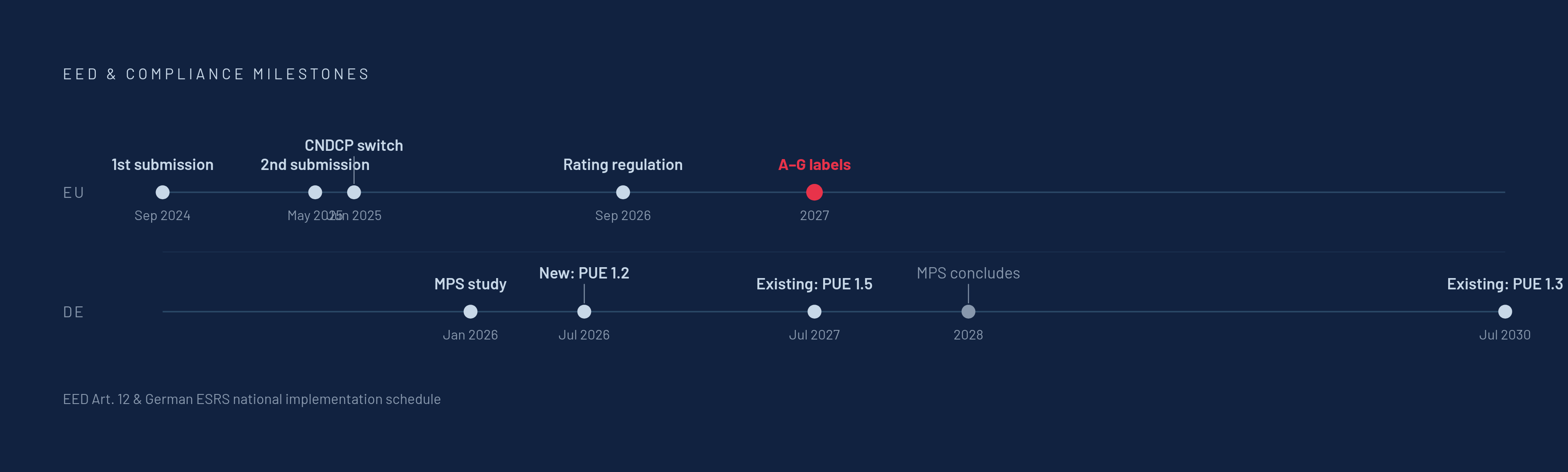
The practical planning frame has to separate when data is collected from when it is submitted, assessed or published. Heat recovery analysis for new builds and substantial refurbishments belongs earlier, when design choices are being made. National law can bring forward a submission deadline or add a binding performance target. These obligations share facility data, but they do not share one clock.
Germany’s March reporting deadline precedes the EU’s May deadline, while its enacted PUE targets create performance milestones beyond either submission date. The first electronic ratings expected in 2027 will use metrics already being reported. The study of minimum performance standards runs through about early 2028 and will help shape possible binding floors. The pending EnEfG amendment belongs on that planning timeline as something to monitor for enactment.
The strongest preparation is a continuous record that can support all of these uses without being reconstructed for each one. That record provides both a defensible submission and an operating baseline against which future proposals can be assessed. The window for helping shape minimum performance standards is open now within the approximately two-year study and consultation process. Operators with clean, continuous data can contribute meaningfully to judgments about feasibility and proportionality. Those without it will have their future obligations shaped by others’ submissions.