Nuclear Power Offtake Agreements in Hyperscale Procurement
Tech giants are betting their expansion on nuclear power they can actually control.

Nuclear Power Offtake Agreements in Hyperscale Procurement.
Hyperscalers are treating power as a procurement problem, not a utility bill
Grid availability, not chip supply, is now the thing standing between hyperscalers and their next round of expansion. Carnegie Endowment research shows data center operators spent $443 billion in 2025 and are on track to spend more than $700 billion in 2026 Hyperscale Data Press Release. That kind of capital only makes sense if the power to run those buildings actually shows up on schedule, and delays are increasingly common, driven by power availability rather than construction or permitting. As of June 2025, more than 36 projects worth a combined $162 billion sat blocked or delayed, mostly for reasons tied to power, not construction or permitting in the traditional sense datacenterknowledge.com Data 4 Nuclear 2026, 837 MM Microsoft Deal Hyperscale Data Press Release. JLL's market outlook puts expected new data center capacity at roughly 100 GW between 2026 and 2030, a number that only pencils out if the industry finds new ways around grid bottlenecks jll.com Hyperscale Data Press Release.
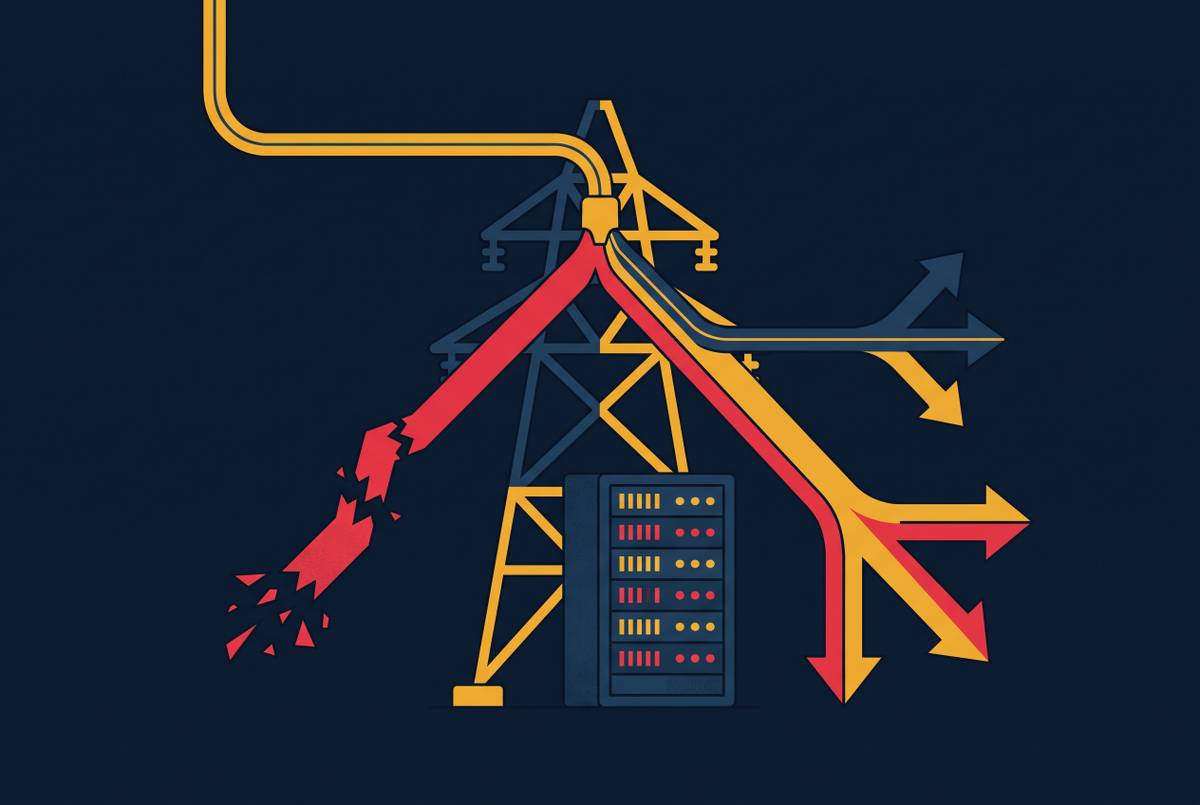
That's the backdrop for why companies like Microsoft, Meta, Google, and Amazon have started acting less like customers of the grid and more like underwriters of it. Instead of waiting on utilities to build generation and hoping an interconnection slot opens up, hyperscalers are putting balance-sheet strength behind specific power plants, the way a developer puts equity behind a building before it exists. Power has stopped being a line item and become a procurement discipline, with its own contracts, its own risk allocation, and its own negotiating playbook. Understanding how those contracts work, especially the nuclear ones, means knowing what a company actually committed to, not just what a press release says.
Offtake agreements and the specific structure nuclear requires
An offtake agreement, which most people in this space just call a PPA, is a long-term contract where a buyer agrees to purchase a set amount of power on agreed terms, and in exchange, the seller gets a revenue stream it can count on. That's the whole mechanism. What changes with nuclear is the price tag standing behind it: financing a single plant can run $1 billion to $3 billion, and no lender releases that kind of construction capital without proof the revenue is locked in first jll.com Data 4 Nuclear 2026, 837 MM Microsoft Deal.
That's why the nuclear version of a PPA looks different from a typical renewable one. A data center operator agrees to buy most or all of a plant's output for 15 to 20 years, and that commitment becomes the thing a developer waves in front of lenders to get financing closed build.inc Hyperscale Data Press Release. Renewable PPAs mostly exist to match a buyer's load with clean generation for sustainability accounting. Nuclear PPAs do something else entirely: they're financing instruments first, and clean-power instruments second, built to support plants that run around the clock rather than intermittently.
The offtaker's credit shapes what a lender will underwrite in ways unique to this kind of energy contract. A company with an investment-grade balance sheet signing a 20-year purchase commitment gives a lender something to underwrite against, standing in for the government or regulated-utility guarantees that financed nuclear plants for decades Hyperscale Data Press Release. Whether that power reaches the buyer through the public grid or gets delivered directly shapes almost everything downstream, from real estate to interconnection timelines.
Front-of-meter vs. behind-the-meter delivery commitments
FTI Consulting reports that Microsoft's 20-year offtake agreement with Constellation Energy for the Crane Clean Energy Center delivers power into PJM rather than through direct co-location Hyperscale Data Press Release. The power flows into PJM, the regional grid operator, rather than traveling straight to a Microsoft campus Hyperscale Data Press Release.
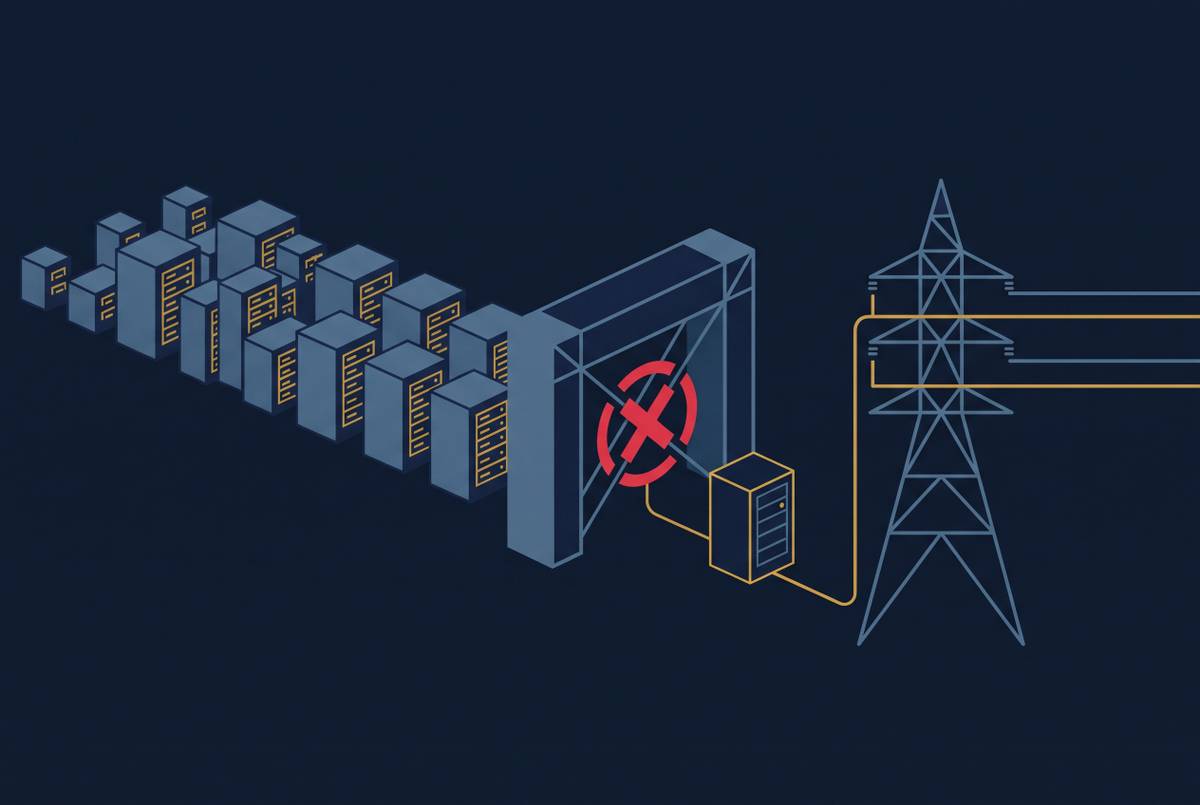
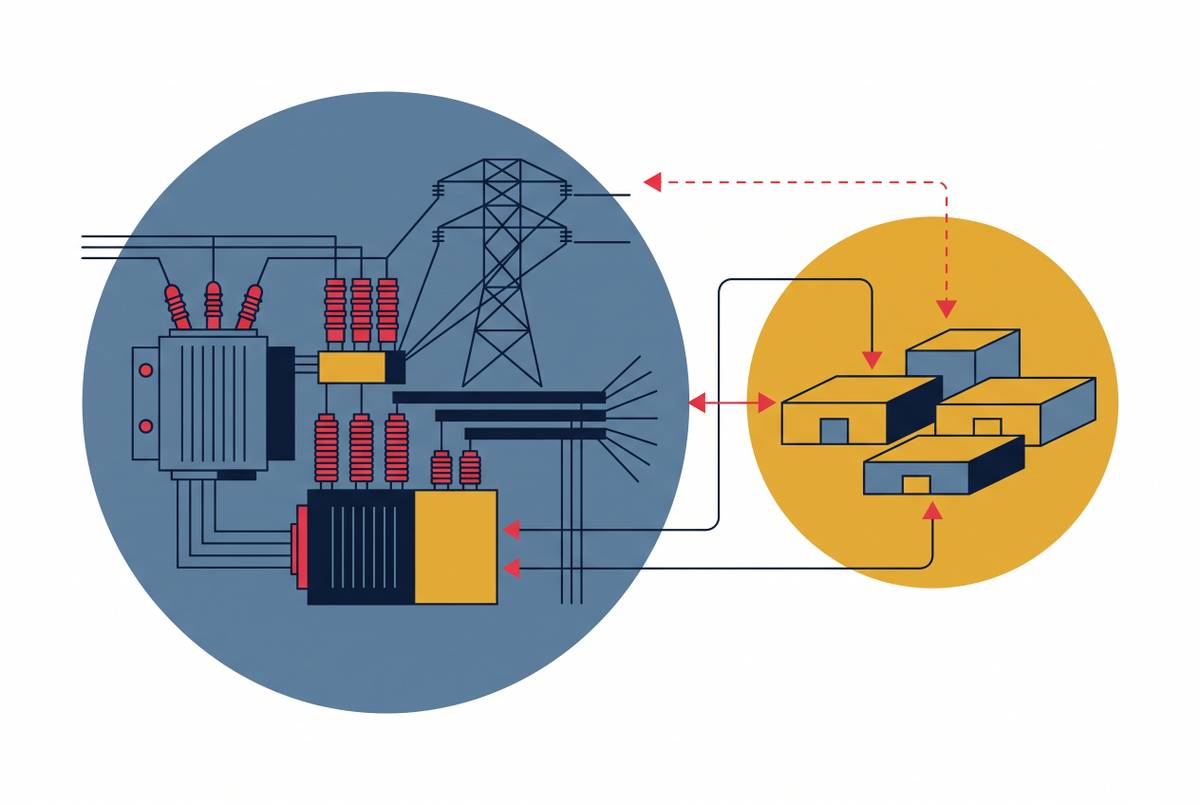
Behind-the-meter, or BTM, deals work differently. The buyer's facility sits physically connected to the plant, and power moves directly, without touching the transmission grid at all. That has real upside: interconnection queues in the U.S. can take years to clear, and a BTM arrangement skips that line entirely, which matters enormously to anyone racing a construction timeline. It also avoids transmission costs and shields the buyer from swings in wholesale market pricing.
Geography is the catch. A BTM deal locks the buyer into building near the generation source, which narrows site options considerably, but in exchange, it buys a kind of power certainty an FTM deal can't match. The market has already started pricing that trade-off into real estate: nuclear-backed sites are commanding lease rates 15% to 25% above comparable grid-constrained alternatives, based on current transactions build.inc. For anyone doing site selection or campus design, this isn't a decision that belongs to the energy procurement team alone. Whether power arrives FTM or BTM determines where the building goes, how interconnection gets engineered, and in what order the campus gets built out. FTM PPAs are grid-connected, offer broader access, follow a standard interconnection process, and involve power flowing through transmission infrastructure to the buyer's load.
The confirmed deals and market-standard structure
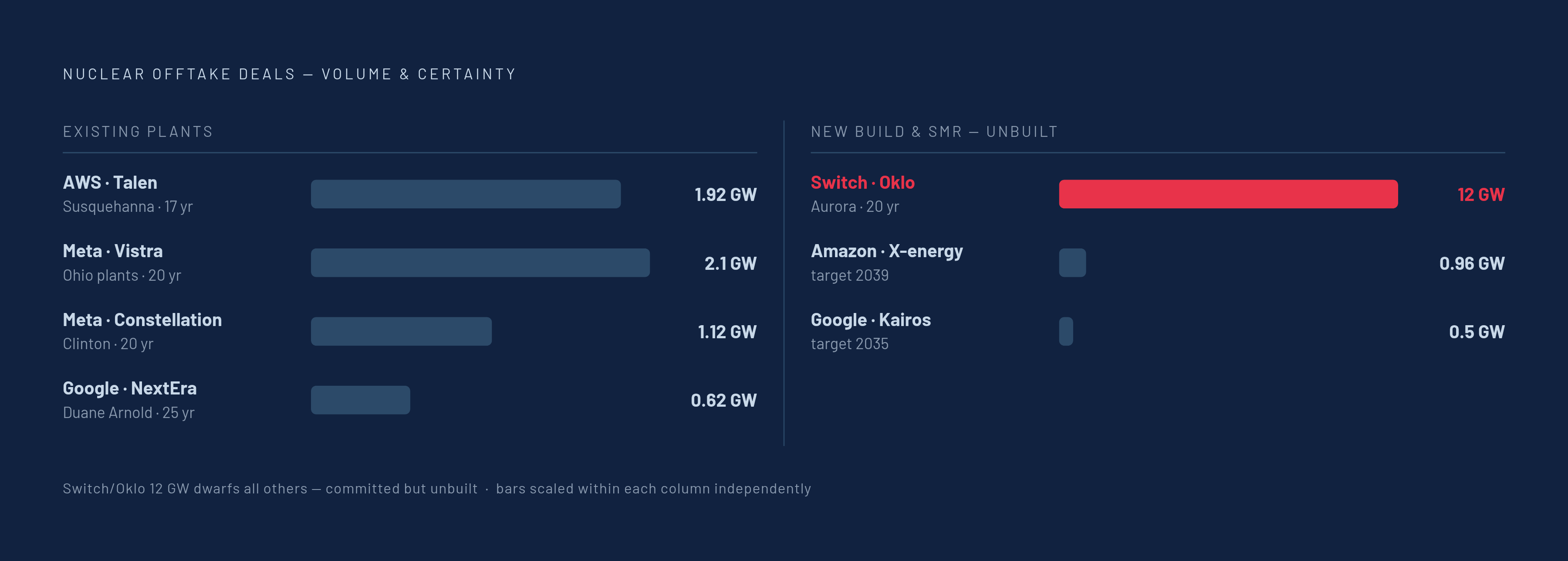
The deals on the table right now split into two clear camps: agreements tied to plants that already exist, and commitments to reactors that haven't been built yet Meta Nuclear 2026, 6.6 GW Vistra and Oklo Deals Oracle Nuclear 2026, $50B Amazon Partnership Hyperscale Data Press Release. Each carries a different risk profile, and the terms reflect that.
Meta signed its own 20-year agreement with Constellation in October 2025 for 1,121 MW out of the Clinton Nuclear Power Plant, one of the largest deals to back data center operations with existing assets Oracle Nuclear 2026, $50B Amazon Partnership Hyperscale Data Press Release. Then in January 2026, Meta went further, signing 20-year PPAs with Vistra to extend the life of two Ohio nuclear plants totaling more than 2.1 GW, part of a 6.6 GW commitment that stands as the largest corporate nuclear procurement on record Meta Nuclear 2026, 6.6 GW Vistra and Oklo Deals Oracle Nuclear 2026, $50B Amazon Partnership Hyperscale Data Press Release. Google's 25-year agreement with NextEra, signed in October 2025, covers 615 MW from the Duane Arnold Energy Center, and Google's commitment was specifically what made restarting that previously shuttered plant financially possible Oracle Nuclear 2026, $50B Amazon Partnership build.inc Hyperscale Data Press Release.
The new-build side looks riskier and further out. Amazon partnered with X-energy, KHNP, and Doosan Enerbility in September 2025 to deploy 960 MW of small modular reactor capacity by 2039, and followed that with a direct strategic investment in X-energy that December Oracle Nuclear 2026, $50B Amazon Partnership Hyperscale Data Press Release. Google signed a deployment agreement with Kairos Power targeting up to 500 MW of SMRs by 2035 Data 4 Nuclear 2026, 837 MM Microsoft Deal Hyperscale Data Press Release. Meta's January 2026 agreements with TerraPower and Oklo are non-binding, meant to signal demand for future reactor output rather than lock in delivery Hyperscale Data Press Release. Switch's 20-year master power agreement with Oklo, signed in December 2024, covers up to 12 GW of Aurora SMR capacity, the largest single commitment by volume in the entire deal set Oracle Nuclear 2026, $50B Amazon Partnership Hyperscale Data Press Release. Microsoft even signed a PPA with Helion, a fusion developer, in April 2026, the same financing logic applied to a completely different technology Hyperscale Data Press Release. TerraPower's January 2025 memorandum with Sabey Data Centers is an earlier-stage signal that SMR interest is spreading beyond the handful of biggest names Hyperscale Data Press Release.
A pattern emerges: 20-year terms have become the default for existing-plant deals, new-build agreements stretch out to 2035 or 2039, and the volumes range from a few hundred megawatts to double-digit gigawatts Hyperscale Data Press Release. Structures vary just as much, spanning binding PPAs, prepayments, non-binding memoranda, and direct equity stakes Hyperscale Data Press Release. Across 13 hyperscalers, the aggregate is 9.8 GW in nuclear procurement deals, primarily slated for commercial operation between 2030 and 2035, with only one pre-2030 asset identified, Microsoft's TMI Unit 1 restart Meta Nuclear 2026, 6.6 GW Vistra and Oklo Deals Hyperscale Data Press Release. Tech companies have put more than $10 billion behind SMR development directly Data 4 Nuclear 2026, 837 MM Microsoft Deal Data 4 Nuclear 2026, 837 MM Microsoft Deal. In May 2026, AWS and Talen Energy entered a 17-year PPA for 1.92 GW from the Susquehanna nuclear plant Data 4 Nuclear 2026, 837 MW Microsoft Deal Hyperscale Data Press Release. In October 2023, Standard Power and NuScale announced a procurement plan for 24 NuScale SMR modules across two data center sites in Ohio and Pennsylvania Oracle Nuclear 2026, $50B Amazon Partnership Hyperscale Data Press Release.
Creditworthiness and contract structure create, or fail to create, project bankability
A hyperscaler's credit rating functions like equity in a financing package it never technically owns. A 20-year purchase commitment from an investment-grade tech company gives lenders the revenue certainty they used to only get from a regulated utility's guarantee Hyperscale Data Press Release. That single fact explains why an "anchor customer," a term that shows up constantly in this market, matters so much. One company agreeing to buy most or all of a plant's output can turn a project from unfinanceable to fundable overnight.
For the advanced reactor startups, Oklo, TerraPower, Kairos, X-energy, prepayments and offtake commitments function as non-dilutive capital, bridging them toward commercial deployment without giving up equity. Amazon's move with X-energy shows the full range of what this can look like: an equity stake alongside an offtake agreement, supporting reactor design and manufacturing directly rather than just promising to buy power later Hyperscale Data Press Release.
Supply-chain dynamics also shape this market. Between 2021 and 2024, component suppliers were reluctant to scale up for nuclear-qualified parts without firm multi-unit orders in hand, a classic first-of-a-kind bottleneck Oracle Nuclear 2026, $50B Amazon Partnership Hyperscale Data Press Release. Hyperscaler commitments are the thing breaking that logjam, giving suppliers the order volume they needed to justify investment. Europe is watching closely: the March 2026 European Commission SMR strategy, including a €200 million guarantee, signals that Europe is building the policy infrastructure to replicate the private-capital model the U.S. hyperscalers pioneered Data 4 Nuclear 2026, 837 MM Microsoft Deal Hyperscale Data Press Release.
None of this works, of course, unless the economics hold up for the buyer, and on paper they do. Nuclear's levelized cost is around $77 per megawatt-hour with a capacity factor above 90%, compared to roughly $87 for renewables paired with storage Meta Nuclear 2026, 6.6 GW Vistra and Oklo Deals Hyperscale Data Press Release. Firm, round-the-clock, carbon-free power at a competitive price is a reasonable trade for locking up two decades of commitment Meta Nuclear 2026, 6.6 GW Vistra and Oklo Deals Oracle Nuclear 2026, $50B Amazon Partnership Hyperscale Data Press Release.
The real risks that term sheets cannot fully resolve
None of the structure above erases the fact that greenfield nuclear construction takes years, often many more than the contract's own delivery date implies Hyperscale Data Press Release. Hyperscalers building physical campuses around an SMR arriving before 2030 are underwriting a schedule with almost no room for slippage Hyperscale Data Press Release. Anyone positioning a site near a planned reactor should be running the numbers on what happens if that reactor slips several years and the campus has to run on ordinary grid power in the meantime. A site that only makes financial sense if the nuclear plant arrives exactly on time isn't a serious position to hold in 2026 Hyperscale Data Press Release.
Permitting adds its own friction. Projects built on federal DOE sites may face complications from contamination history, and new technologies requiring NRC design approval face uncertain timelines. Interconnection logistics and fuel procurement pile on further uncertainty, especially while the nuclear-qualified supply chain is still building out the capacity to keep up with demand.
Reading the fine print matters here too. Meta's agreements with TerraPower and Oklo are non-binding Hyperscale Data Press Release. They are a signal of intent rather than a contracted delivery of power. Headline gigawatt totals and contracted gigawatt totals are not the same number, and treating them as interchangeable is a mistake. In the near term, the honest answer to the power gap is natural gas, not nuclear. Given how long any greenfield nuclear project takes to build, data centers needing baseload power in the next few years will lean on gas as the bridge, whatever the long-term nuclear contracts say. Competition for the nuclear capacity that does exist has only intensified over roughly the past 18 months, and that scarcity is itself a risk for anyone entering the market late. As of now, no data center anywhere is actually running on power from an SMR Oracle Nuclear 2026, $50B Amazon Partnership Hyperscale Data Press Release. The commitments have moved the technology from research into a commercialization pathway, but the delivery risk hasn't gone anywhere.
Nuclear offtake commitments and facility requirements
Signing a 20-year nuclear PPA is never just an energy decision Data 4 Nuclear 2026, 837 MW Microsoft Deal Hyperscale Data Press Release. It sets obligations for the physical building on the other end: power delivery infrastructure, critical-systems design, and operational integration all have to match the contract's terms and its timeline Hyperscale Data Press Release.
BTM nuclear delivery makes this especially concrete. Campus electrical design, switchgear, and distribution architecture all need to be engineered around the reactor's specific output profile and its interconnection point, and those choices get locked in at procurement time, long before the building opens. Power density trends make the problem harder still. Rack loads have climbed sharply as AI workloads move from pilot to production, with new facilities now commonly designed for 15 to 50 kilowatts per rack, a jump from what was standard just five years ago build.inc Hyperscale Data Press Release. A facility designed today against a 2030 nuclear delivery date has to account for load profiles that will keep shifting well past the day the contract gets signed jll.com Hyperscale Data Press Release.
Documentation gets heavier too. Critical-facility delivery already demands that every design decision, equipment spec, and RFI response stay traceable, and a nuclear-powered campus adds a regulatory and contractual layer on top of that, one that punishes fragmented, ad hoc workflows. Operations-ready handoff isn't something to figure out at commissioning when the power source is a nuclear plant. DCIM, EPMS, and BMS integration need to be scoped from early design, because the ties between generation, distribution, and facility systems are too tightly wound to sort out after the fact. The bigger the contract, the less room there is for manual rework, the kind data center delivery has tolerated for years, and nuclear-adjacent projects are exactly where that tolerance runs out first.
Sources
- Meta Nuclear 2026, 6.6 GW Vistra and Oklo Deals
- Data 4 Nuclear 2026, 837 MW Microsoft Deal
- Oracle Nuclear 2026, $50B Amazon Partnership
- sec.gov
- Beyond the Hype: Assessing Hyperscaler Nuclear Commitments Against U.S. Energy Realities
- fticonsulting.com
- Beyond the Hype: Assessing Hyperscaler Nuclear Commitments Against U.S. Energy Realities