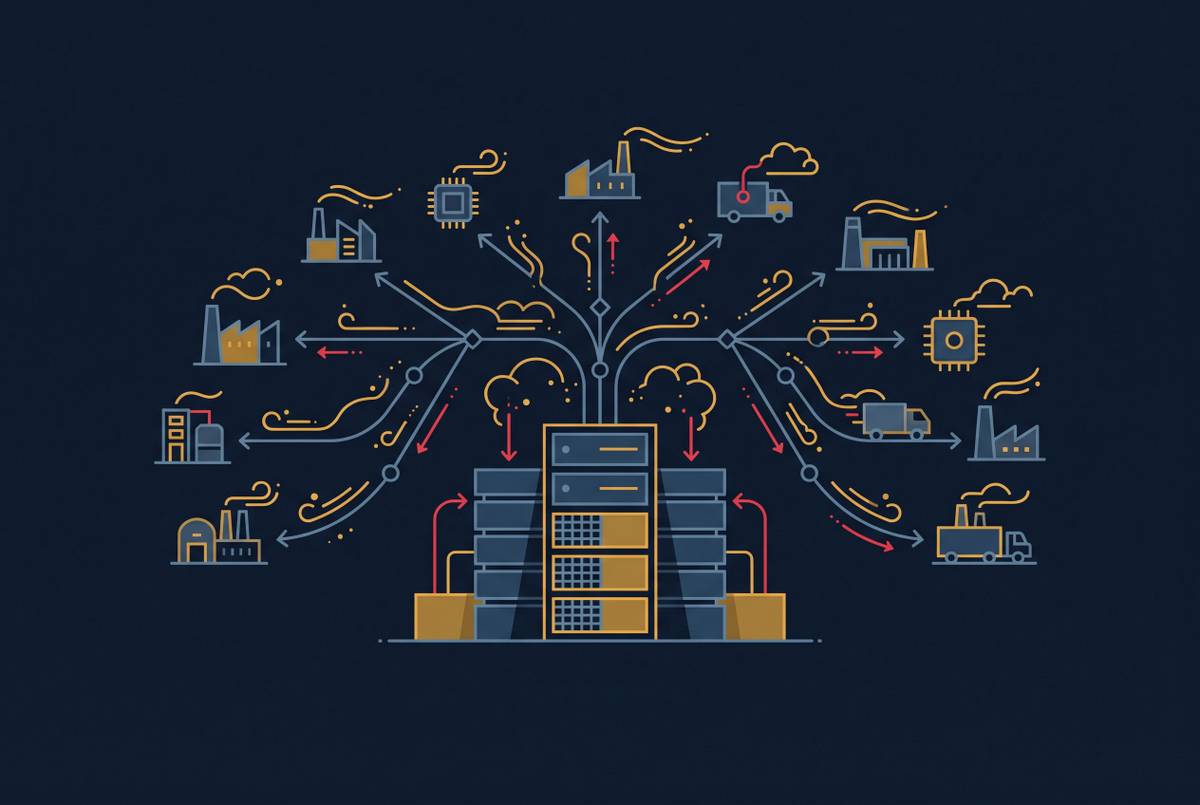
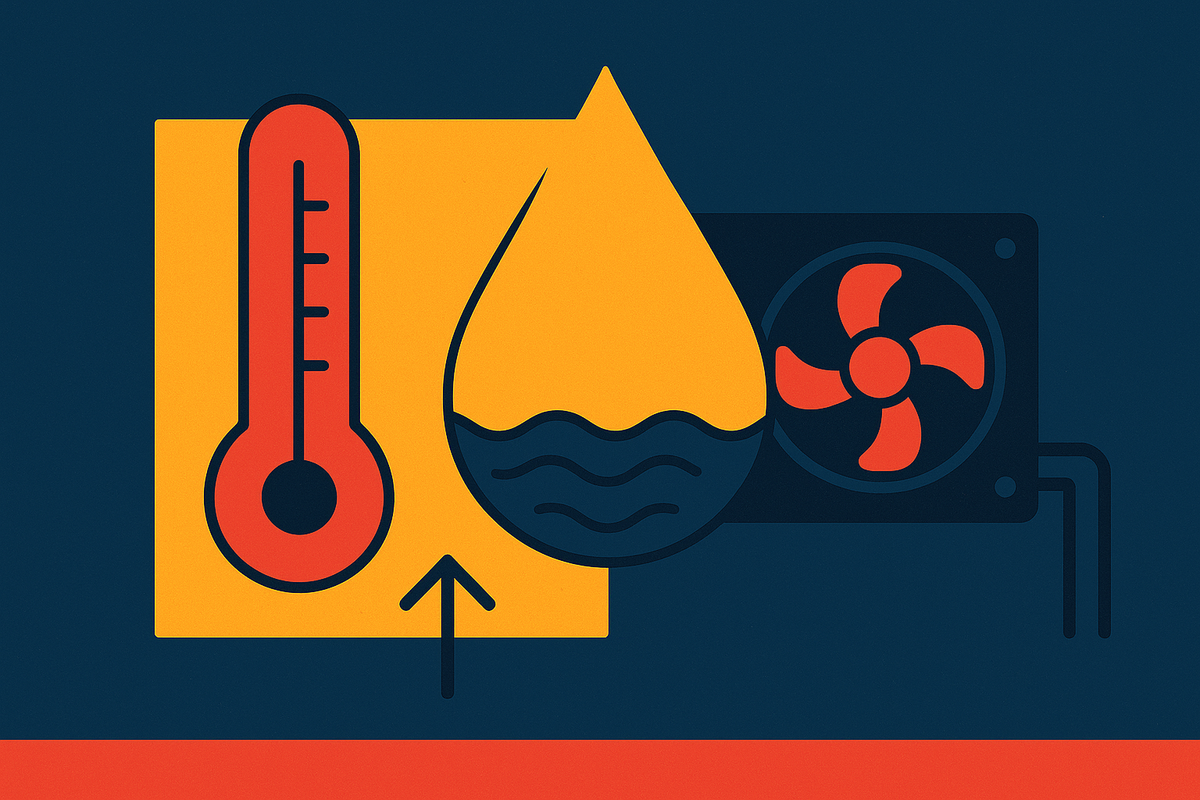
Liquid Cooling Adoption Rates and Retrofit Economics for Existing Halls
Power infrastructure and spatial conflicts, not cooling hardware.
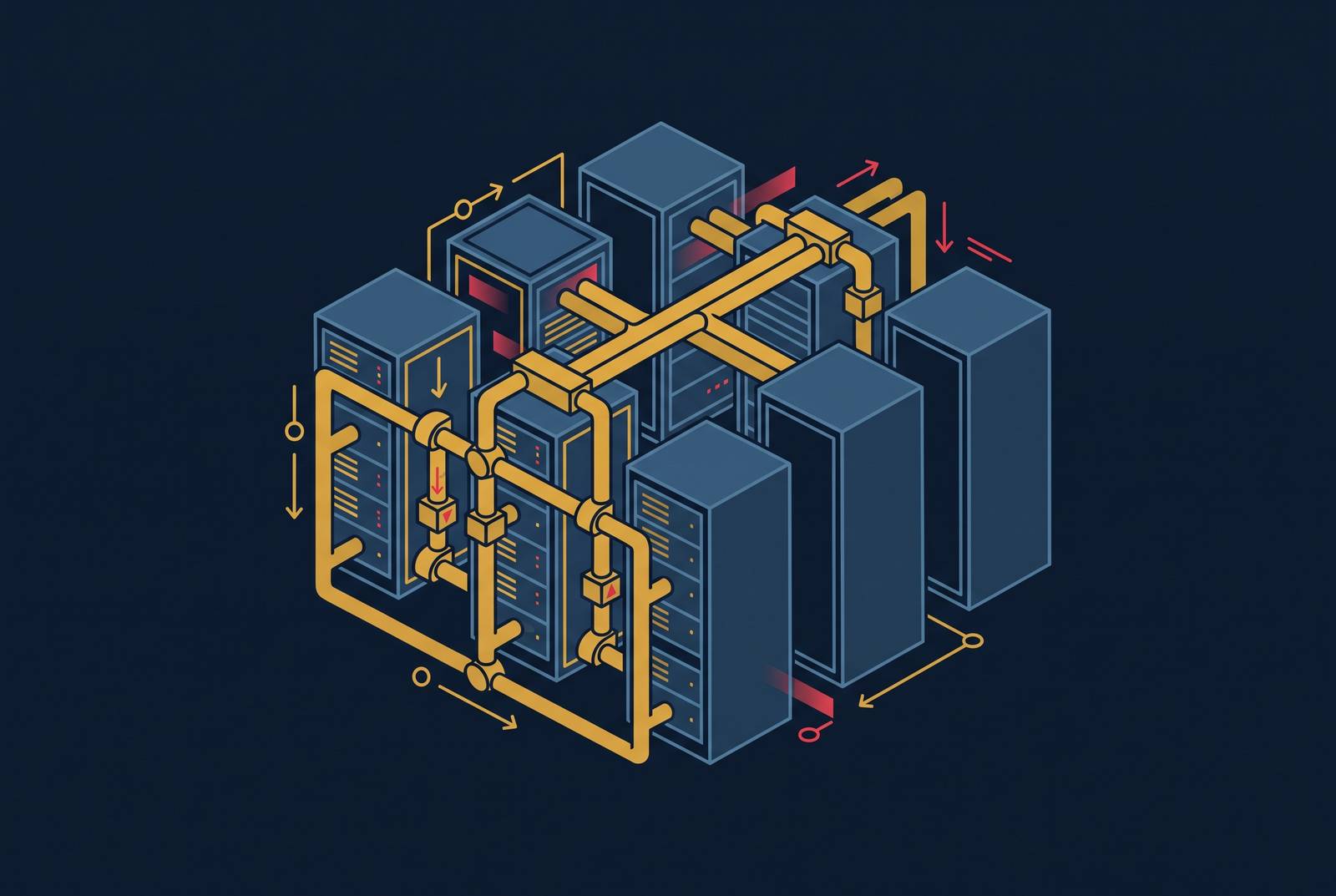
Reworking power, structure, cooling, cable routes, and operations data together is challenging. Hardware savings can make a retrofit attractive, but fragmented delivery workflows multiply the cost of making it work.
Why existing halls cannot simply wait out the liquid cooling transition
The Uptime Institute 2025 Global Data Center Survey found that liquid cooling reached a meaningful share of deployed facilities by early 2026, with a large additional cohort planning adoption within two years. Hardware is driving that pressure. Axis Intelligence Research notes that air cooling struggles above 40 kW per rack, a threshold AI GPU racks exceed by a factor of two or more. A single NVIDIA GB200 NVL72 rack has a thermal load far greater than that of a typical 2020-era server rack.
Goldman Sachs forecasts that a large majority of AI servers will run on liquid cooling by the end of 2026, up from a small minority two years earlier. Efficiency and regulation add to that pressure. Legacy air-cooled facilities remain well above the liquid-cooled PUE range of 1.02–1.20 despite incremental air-side improvements. Germany's Energy Efficiency Act mandates PUE ≤ 1.2 for data centers commissioned after July 1, 2026, adding pressure without making that new-build rule a blanket retrofit requirement. For existing halls targeting AI workloads, the question is what conversion actually costs and demands.
What the headline retrofit cost figures actually include—and what they hide
STL Partners' May 2026 analysis puts retrofitting at around $2 million per MW while warning that conversions are operationally complex and disruptive. Workload migration, downtime, lost tenancy revenues, and inherited building constraints can change the result. The benchmark is a starting point. Its usefulness depends on how closely the project matches the assumptions behind it.
Rear-door heat exchangers have lower per-rack costs and suit moderate loads of 15–30 kW, while in-row liquid-assisted cooling sits in the middle for 40–100 kW zones. Direct-to-chip retrofit has the highest per-rack cost and is required at 60 kW and above. These overlapping density bands do not make the options interchangeable. The building's capacity and the disruption to live operations also shape what is feasible.
Immersion cooling is a different proposition altogether. Its PUE range of 1.01–1.08 includes two-phase systems reaching 1.01–1.02 and single-phase systems typically at 1.03–1.08. But an existing hall needs fundamental changes to racks, floor systems, and building infrastructure to accommodate it, so those efficiency figures do not describe a straightforward retrofit. Uptime Institute's analysis of new-build premiums suggests existing-facility premiums are likely higher because piping routes, floor loading, heat rejection, CDU locations, maintenance access, and electrical capacity are already constrained.
Why power infrastructure—not cooling hardware—is the actual rate-limiter
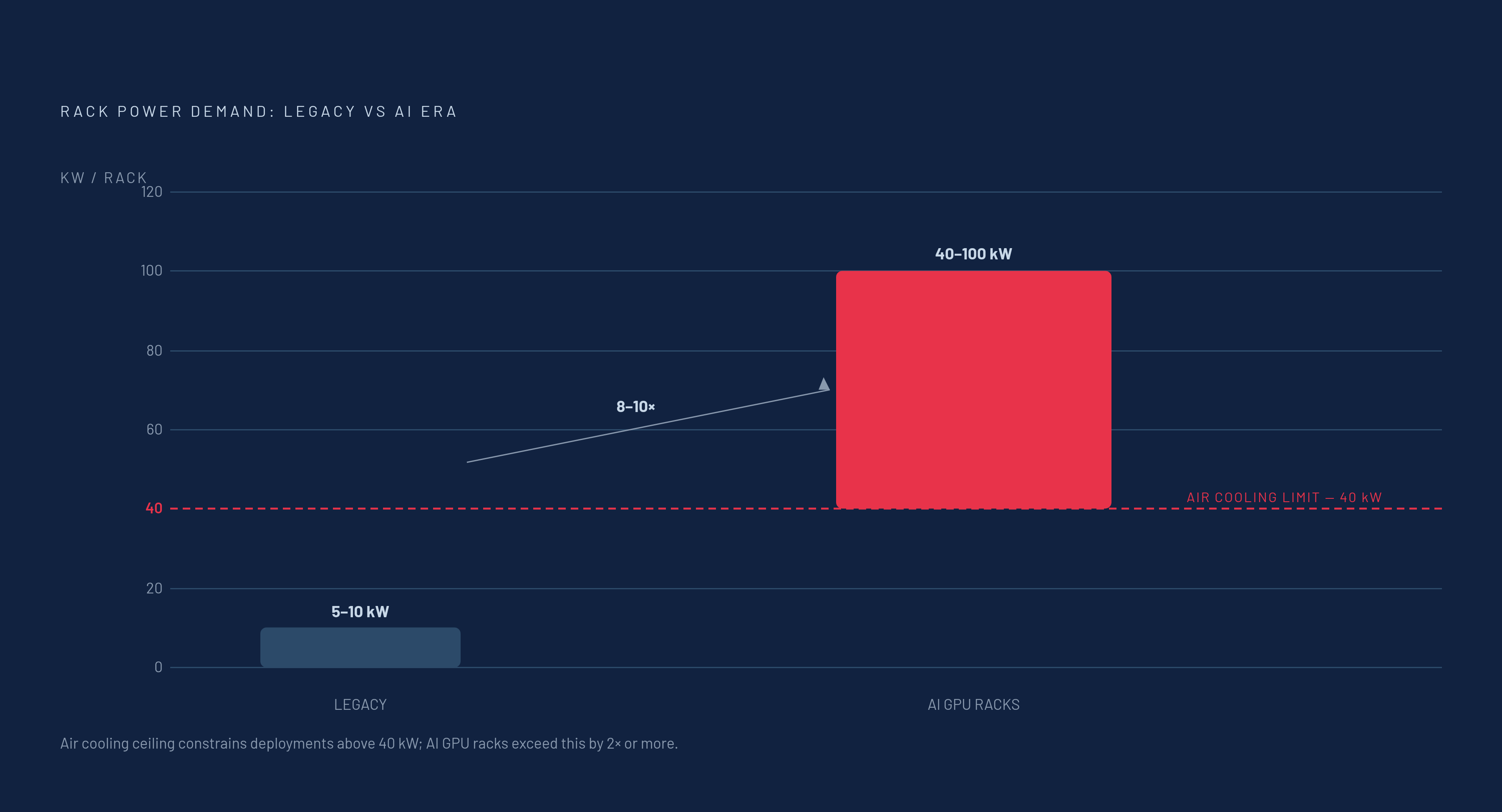
In most retrofits, the binding constraint is electrical capacity. Legacy racks drew 5–10 kW, while AI-era racks demand 40–100 kW and above. Switchgear, PDUs, busway, transformers, and UPS systems sized for the old load profile may not support the intended use. Cooling equipment can remove heat only after the site can supply the power that produces it. Pricing cooling hardware without checking how much more electrical capacity the site needs leaves out the biggest source of cost on many sites.
Without usable electrical headroom, a project can stall before piping starts. Utility upgrades take 12–24 months in many markets and add a lot to the cost per MW. An existing grid connection is therefore a strategic asset where new connections are capped or delayed, but it does not prove that the internal distribution system can support higher-density racks. That distinction changes the financial sequence. The PUE reduction and electricity savings that make liquid cooling appealing may require spending on electrical systems that per-rack cooling benchmarks leave out.
Structural constraints discovered late—the hidden cost that turns schedules into crises
Structural constraints cost much more to address when teams check them after committing to the mechanical, electrical, and plumbing design. GBC Engineers identifies raised floors unable to support cooling distribution unit weight after CDU locations have already been set. The same firm identifies uncoordinated slab penetrations that lead to field cuts compromising structural integrity or force pipe routes to be redesigned on the critical path. CDU foundations, pipe brackets, and plant room loading can also remain unreviewed until MEP design is advanced.
Older halls add another layer of uncertainty. Some were never designed for the static loads of liquid manifolds or the weight of extra cabling for GPU clusters. Underfloor space may already contain decades of cabling and air-handling infrastructure, limiting where new services can go. Moving equipment or rerouting pipes can reopen other disciplines' work and delay revenue-generating AI workloads, which makes early structural and MEP coordination a schedule safeguard.
How liquid cooling forces power, cooling, cable, and fiber to compete for the same constrained space
A liquid cooling retrofit is an interdependent rework of power distribution, cooling, cable pathways, and fiber routing. All four need room in the same building. GBC Engineers identifies structural loads, pipe routing, facility water systems, power distribution, and maintenance changes as issues that require early coordination. IoT Analytics says that the very high number of fiber optic cables is a key trend in data centers. That growth means the network cannot be treated as a minor addition after cooling and power have claimed their routes.
The physical conflict arises because coolant supply and return manifolds need space beside busway or PDU extensions, GPU interconnect cabling, and high-speed network fiber. Those pathways were allocated years ago for a fraction of the current load. Virtual Building Studio describes how it uses point cloud data to build models for liquid cooling upgrades and higher-density deployments, so teams know more about the facilities that must keep running. Under these conditions, scan-to-BIM capture becomes a prerequisite for understanding the available space.
If power, cooling, and cabling designs live in separate tools without a live link, relocating a CDU triggers manual changes in the electrical model, cable layout, and documentation. Teams must also keep the captured conditions and changed designs in step across all the models, which adds data work to the task of finding space.
Why retrofit BIM models routinely fail to survive the handoff to operations
A retrofit BIM model is not automatically usable operations data. Alpha Controls identifies three management layers that are structurally disconnected in most handoffs. The mechanical contractor delivers the building management system, or BMS, for mechanical and environmental plant. The electrical contractor delivers the electrical power monitoring system, or EPMS, for the path from utility incomer to rack, while the client's IT team buys DCIM to manage IT assets, rack space, power capacity, and network connectivity. Integration between those layers can sit in nobody's scope, leaving gaps where outages happen.
Liquid cooling adds data that most DCIM implementations were not designed to ingest. CDU telemetry, flow rate, temperature delta, pump status, and leak detection zones need explicit integration requirements before design is finalized. Commissioning is too late to define that scope. A drawing can show where equipment sits but leave out the structured data that operations needs to connect it to the systems it uses.
The operations and maintenance team also needs validated alarm logic, documented threshold rationale, trend baselines, and a clear RACI that assigns responsibilities. Without that information, a completed design deliverable still leaves operations with unfinished integration work. A connected workflow would set those requirements during design and keep the equipment data and decisions through turnover, with handoff documentation part of the same work.
How fragmented delivery workflows turn retrofit complexity into a direct cost multiplier
The delivery workflow is itself a cost driver. When teams rebuild the same information by hand in several tools, each change adds engineering work on top of the technical change itself. A rack-level change cascades across the power model, cooling layout, cable routing, BIM documentation, and DCIM data. A connected workflow can propagate those updates automatically, while a fragmented one consumes engineering hours at each step. Keeping that information in step adds to the cost of structural surprises, pathway conflicts, and electrical gaps.
A CDU moved because of floor loading, a pipe rerouted around structure, or a circuit added for a denser zone generates a chain of decisions that must reach every affected model. Email, PDF markups, and disconnected spreadsheets make that traceability harder. Teams have more equipment data to copy by hand when CDU specifications, manifold ratings, pump curves, and leak sensor parameters are held only in manufacturer PDFs. Errors copied into models, schedules, or integration specifications can then carry through to commissioning and operations.
In colocation facilities, this has a direct revenue consequence. Schedule slips caused by rework extend disruption during a live retrofit and can prolong lost tenancy revenue, an exposure absent from per-MW benchmarks. The workflow therefore needs to connect layouts, power, cooling, cable routing, documentation, RFIs, and operations-ready data in one structured environment. ArchiLabs Studio belongs in that discussion as a connected delivery environment for those linked tasks. The useful capability is for a CDU relocation to consolidate five operations into one that updates the power schedule, cable pathway, as-built documentation, and DCIM data model.
What operators should verify before committing to a retrofit approach
For engineers and project leads, the practical response is to assess the site and delivery process before choosing the cooling technology. Electrical headroom is the first checkpoint. Does the site support the target density, or does the cost model depend on a utility upgrade with a defined timeline? A structural engineer should also review CDU weight, floor loading, slab penetrations, and pipe supports before MEP design is committed. Scan-to-BIM capture should show where underfloor and overhead space is already crowded before teams settle on routes.
The next checkpoint is how disciplines will coordinate. Are power, cooling, and cabling teams working from a shared model, or will conflicts emerge in the field? DCIM integration requirements should include CDU telemetry, flow data, and leak detection during design. Ownership must also be explicit before work starts. The contract scope should identify who is responsible for integration between BMS, EPMS, and DCIM, so that the interfaces do not fall between contractors and the IT team.
Will operations get validated alarm logic, threshold rationale, and trend baselines, or only as-built drawings? CDU specifications, pump curves, and sensor parameters should be captured in structured form that feeds the DCIM data model, rather than forcing operations to reconstruct them from PDFs. Every RFI answer, design decision, and equipment parameter should be traceable through the delivery record. That traceability makes the retrofit manageable when conditions change, instead of turning each change into a search for missing decisions.