Water Usage Effectiveness Targets and Cooling Technology Trade-Offs
Narrow WUE metrics hide water pushed off-site through electricity generation.
Water Usage Effectiveness measures one thing, and only one thing: liters of water used on-site per kilowatt-hour of IT equipment energy. The Green Grid defined the metric in 2011, and ISO/IEC 30134-9:2022 later standardized it. The formula counts cooling tower makeup water, humidifier water, and evaporative condenser water. Nothing else goes into the number.
That narrow scope is intentional. The Green Grid built WUE as a tool for comparing cooling and facility designs across data centers, not as a way to total up a facility's full water footprint. The goal was a number operators could use to benchmark one design against another, not a complete account of water impact.
Two large water flows sit outside the formula. The first is indirect water: the water evaporated at thermoelectric power plants to generate the electricity a data center buys from the grid. Capturing that flow requires a separate calculation called WUE source, and most operators skip it because source calculations get complicated fast and shift with the local electricity mix. Construction-phase water use is the second excluded flow, and it never enters either version of the metric.
That gap produces a strange outcome: a facility can report a WUE of 0 liters per kilowatt-hour, running air-cooled with no evaporative system at all, and still use plenty of water. It just doesn't use it on-site. Zero on the WUE report does not mean zero water; it means the water has been pushed somewhere the formula doesn't look.
Every target built on WUE inherits this boundary. The metric is precise about what it tracks and silent about what it doesn't, and that silence is a design feature, not an error to be corrected. Understanding where the line sits is the starting point for everything that follows, because every cooling technology discussed later gets judged against this same narrow definition.
Why setting a WUE target is hard
A single WUE number looks like a fixed target, but the number moves constantly with climate, season, and workload, which makes picking one figure and building a design spec around it risky.
Season drives much of that movement. Evaporative cooling efficiency depends on ambient wet-bulb temperature, so a facility's water use swings hard between summer and winter. A hyperscale campus in Northern Virginia reported an annual fleet WUE well below 0.2 liters per kilowatt-hour, a strong number on paper. But a facility in that same operator's fleet had a planned daily peak WUE north of 1 liter per kilowatt-hour. That peak is exactly the kind of figure permitting processes tend to miss, because regulators usually look at annual averages rather than the hottest days of the year, and the hottest days are when local water systems feel the most strain.
The energy denominator causes a second kind of instability. WUE divides water volume by IT energy consumption, and AI workloads are driving rack densities up fast. The same cooling plant serving more IT watts produces a better WUE number even if the actual volume of water used hasn't changed. So as AI density climbs across a fleet, WUE improves on paper for reasons that have nothing to do with better water management.
Water source and geography introduce a third blind spot. A facility pulling potable freshwater from a drought-stressed basin can report the exact same WUE as a facility using treated reclaimed water in a basin with plenty of supply. The two sites carry wildly different local consequences, but the metric reports them as identical. Permitting bodies care enormously about that distinction. WUE has no way to express it.
So if you put these three together, a plain WUE target stated without qualification ends up specifying very little. A number alone doesn't say where the facility sits, what season produced the figure, what load profile was running, or what kind of water went into the cooling system. A usable target has to pin down location, season, load profile, and water source type alongside the number, or it describes an outcome without describing any of the conditions that produced it.
The Inverse Relationship Between WUE and PUE
For most of the data center industry's history, water efficiency and energy efficiency have pulled against each other. Pushing water use down tends to raise energy use, and pushing energy use down tends to raise water use. Teams designing cooling systems have had to pick a point on that trade-off, not escape it.
The physics explain why. Evaporative cooling systems raise WUE but lower PUE, because evaporating water is a highly efficient way to reject heat and it reduces the mechanical work a chiller plant has to do. Air-cooled systems do the opposite: they drop WUE, sometimes all the way to zero, but PUE climbs because compressors have to work harder without water's help. Neither side of this trade-off is a design mistake. It's a structural consequence of thermodynamics, and every cooling plant built around air or evaporative systems alone has had to live inside it.
AI workloads have broken the terms of that negotiation before it can even happen. Next-generation AI accelerator racks draw far more power than air cooling can handle at all, regardless of how much energy penalty an operator is willing to accept. The air-cooled side of this trade-off simply isn't available anymore for the highest-density deployments on the market. That has pushed liquid cooling, in its various forms, from a niche option into the default path for new AI infrastructure, and it's why the rest of this piece spends most of its time there. Liquid cooling doesn't just shift the trade-off, it changes which technologies are even in the running.
Evaporative cooling: the baseline most existing facilities are measured against
Evaporative cooling runs most of the data center fleet installed today, and most of the WUE figures used in regulatory filings and ESG reports reflect its performance. Any new target gets measured against this baseline whether the facility uses the technology or not.
The physics are simple. Water absorbs heat as it evaporates, carrying thermal energy away from the facility and into the atmosphere. Cooling towers run this process around the clock, so they evaporate a steady stream of makeup water to reject heat from inside the data hall.
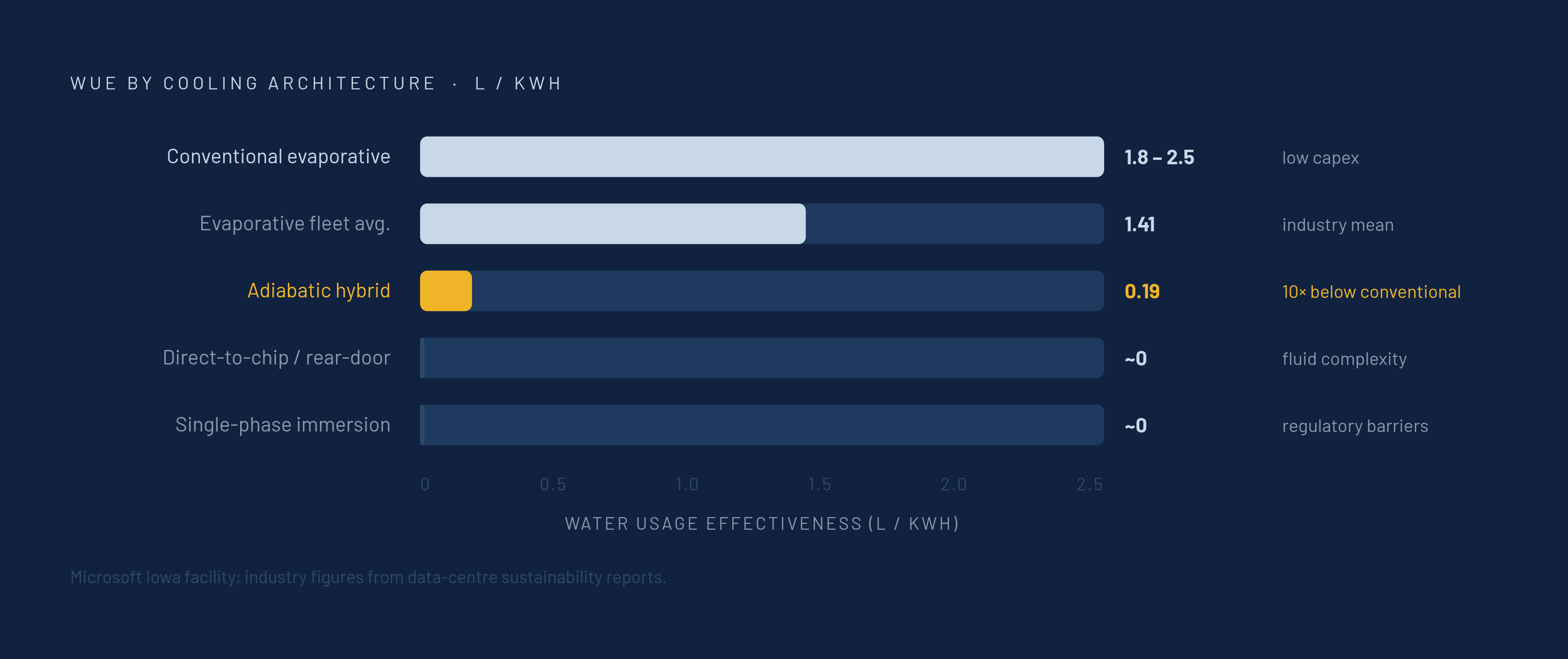
Equinix's 2025 figures show how this plays out at scale: a global WUE of 0.91 liters per kilowatt-hour across its entire data center portfolio, against 1.41 liters per kilowatt-hour for the subset of sites running evaporative cooling specifically. The gap between those two numbers matters. A fleet-wide average can hide the technology-specific figure that decides whether a given site meets a given target, so teams setting targets need the technology-level number, not the blended one.
Evaporative cooling earns its place in the fleet honestly. It reduces compressor work and improves PUE compared to dry mechanical systems, in any climate where the wet-bulb temperature supports it. That energy advantage is why the technology has stuck around for decades despite its water appetite, and it remains a legitimate choice where water supply allows for it.
The infrastructure demands sit in the middle of the complexity scale. Cooling towers carry legionella risk, so facilities have to run water treatment programs and chemical dosing schedules permanently. That operational cost is invisible in a WUE figure. The number tells you how much water moved through the system. It says nothing about what it costs to manage the microbiology of that water safely.
Regulators have started pushing back on this baseline directly. Nevada banned evaporative cooling towers in new construction across Las Vegas and Henderson starting in September 2023. That policy doesn't make water consumption disappear. It shifts the water use toward air-cooled or hybrid designs, relocating where water gets consumed without eliminating the underlying demand. The same displacement problem that appeared with zero-WUE air cooling earlier in this piece occurs here, in regulatory form.
Adiabatic and hybrid air cooling: achieving lower WUE targets without full liquid infrastructure
Adiabatic cooling sits as a middle path between full evaporative systems and dry air cooling. These systems only use water when outside temperature crosses a set threshold, running completely dry, at a WUE of 0, the rest of the time. So it decouples water use from energy use more precisely than an open cooling tower ever could.
Microsoft's Iowa facility shows how this works in practice. The system activates water only when outside temperature passes 29.4°C, and for the rest of the year it runs dry. That design yields an annual WUE of approximately 0.19 liters per kilowatt-hour, compared with 1.8 to 2.5 liters per kilowatt-hour for a conventional chilled-water plant running an open evaporative tower. That's roughly a tenfold reduction in water use, achieved with a design decision about when water turns on rather than a wholesale change in cooling architecture.
The infrastructure burden here is lighter than any form of liquid cooling. There's no need for coolant distribution units, no secondary pumping loops, and no compatibility questions with server hardware, because the cooling boundary stops at the room and never reaches into the rack. If you want a lower WUE target without taking on the engineering and cost of rack-level liquid systems, adiabatic cooling is often the most direct route.
Climate determines how well that route works. A threshold design built around 29.4°C in Iowa will activate water rarely, because Iowa's climate rarely pushes past that line for long stretches. The same design in Arizona will activate constantly, producing a much higher annual WUE even with identical equipment. If you set a WUE target with adiabatic cooling, you need to model the local climate's wet-bulb exceedance hours, the number of hours per year ambient conditions cross the activation threshold, before you commit to a target number. Specifying the number without the climate model behind it repeats the mistake the earlier section on target-setting warned against.
The displacement dynamic from the evaporative section appears here too, in miniature. A facility that moves from an evaporative tower to an air-cooled mechanical plant to post a WUE of 0 is pulling more electricity to do it, and if that electricity comes from a thermoelectric plant, indirect water use rises even as the on-site number improves. Direct WUE gets better. Total water consumed, counting the grid side, may not.
Direct-to-chip and rear-door heat exchangers: water-free rack-level cooling and its infrastructure cost
Direct-to-chip cold plates and rear-door heat exchangers are seeing the most active deployment of any liquid cooling technology in AI infrastructure right now. Both can hit near-zero WUE in a closed-loop setup, circulating coolant through a sealed system that rejects heat to dry coolers or fluid coolers and evaporates no water on-site.
Direct-to-chip systems run cold liquid over micro-convective blocks mounted on the GPU and CPU themselves, pulling heat away at the source. Operators increasingly run these loops with warmer inlet water, somewhere between 18°C and 25°C, instead of fully chilled water, because warmer water cuts chiller plant power substantially and it improves facility-level PUE. That choice carries a real engineering cost: warmer inlet temperatures can cause temperature spikes in the silicon itself, so the PUE gain comes with a thermal validation burden that has to be worked through carefully before it's deployed at scale. Optimizing WUE and PUE at the same time, in other words, introduces its own constraint.
Rear-door heat exchangers work at the rack boundary, not the chip. A heat exchanger mounted on the back of the rack catches hot exhaust air before it reaches the room and cools it with liquid right there. Because it can be added to existing air-cooled infrastructure as a supplement rather than a replacement, it carries a lower coordination burden for retrofit projects than ripping out an entire air-handling system.
Moving to either technology changes the shape of a build. Coolant distribution units, secondary pumping loops, leak detection systems, and pipe routing through the data hall all become part of the project scope, and the cost structure of the build shifts meaningfully away from a straightforward air-cooled design. Coordinating that scope gets harder as more trades get involved: power distribution has to account for new mechanical loads, cable routing has to work around new piping, and documentation has to track changes across all of it as cooling parameters get tuned during commissioning. A change to inlet water temperature or loop configuration late in a build can ripple through power, cabling, and documentation all at once, and keeping those pieces in sync is as much a part of the WUE conversation as the thermal numbers are.
Where the WUE number actually lands depends on what happens at the facility boundary, not inside the rack. A direct-to-chip system that rejects its heat to a dry cooler gets close to zero WUE. The same system, rejecting heat to a cooling tower that uses evaporative heat rejection, brings water consumption right back into the calculation at the facility level. The rack-level technology alone doesn't decide the outcome. The heat rejection method downstream of it does.
Single-phase immersion: the low-WUE option that survived the PFAS supply-chain collapse
Full immersion cooling pushes WUE further than any other cooling architecture available today. Servers sit fully submerged in dielectric fluid, which removes air-side evaporation from the picture entirely and rejects heat through a sealed fluid circuit instead.
Immersion splits into two categories, and their fluid chemistries carry real regulatory weight. Two-phase immersion submerges motherboards in a fluorocarbon fluid that boils on contact with the chips, using the latent heat of vaporization to pull heat away with very little mechanical work, which lets PUE performance get close to 1. That performance came with a cost: fluorocarbon fluids belong to a class of chemicals now facing tightening regulatory restrictions and supply disruptions across multiple jurisdictions. Single-phase immersion, which uses a non-boiling dielectric fluid instead of a fluorocarbon that boils, avoided the regulatory exposure that has put two-phase systems under pressure, and that's a large part of why single-phase has emerged as the more viable long-term path for operators building out immersion cooling now.
For a team setting a WUE target, immersion cooling represents the far end of the spectrum, the technology to weigh once air cooling has been ruled out by rack density and the warmer-water trade-offs of direct-to-chip systems need to be avoided. The WUE number it delivers is about as strong as the metric allows. The chemistry behind that number, and which regulatory environment that chemistry can survive in, matters just as much as the figure on the report.