Waste Heat Recovery Economics in High-Density Data Center Campuses
Liquid cooling makes waste heat valuable enough to justify recovery investment at data center scale.

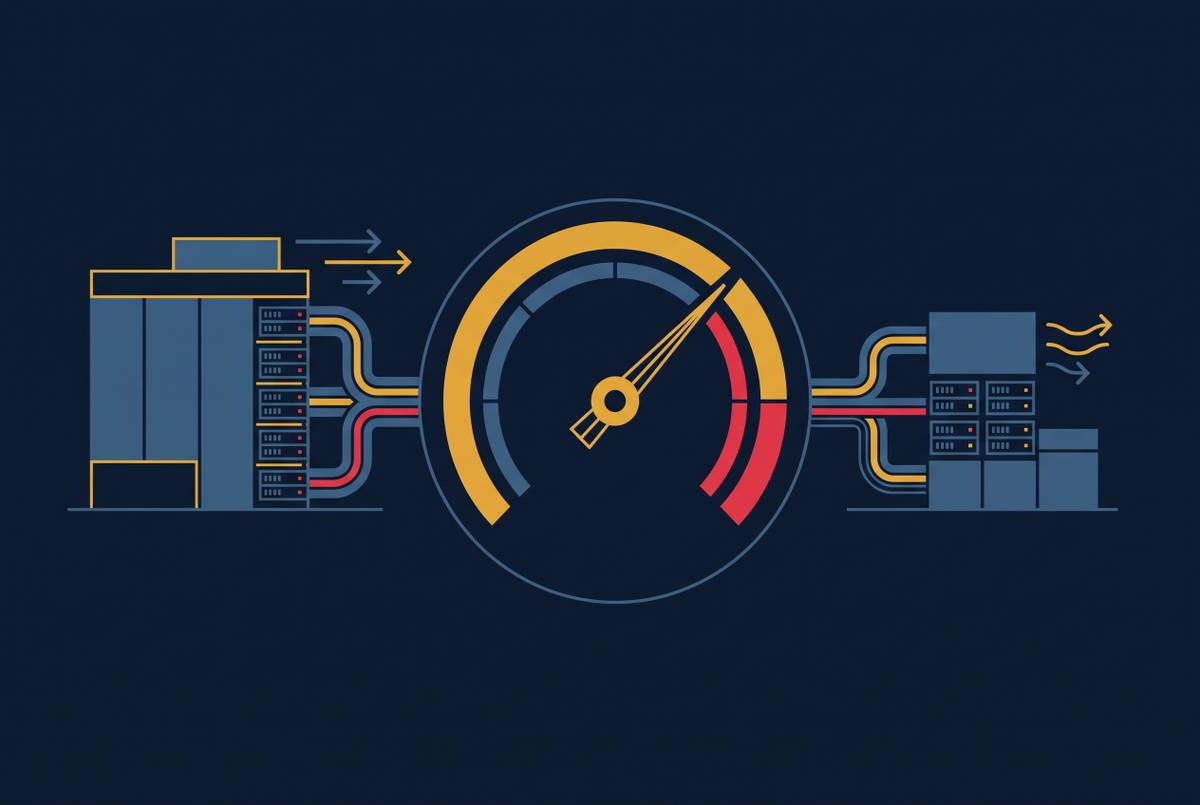
The costs and returns of waste heat recovery at high-density data center campuses now belong in the main case for investment. At 40+ kW per rack, liquid cooling is a physical requirement, and that changes the cost of exporting heat. Recovery can become a meaningful revenue source. But the return depends on the site, the buyer and decisions made before construction begins.
Why liquid cooling at high rack densities changed the thermal economics of waste heat
Air-cooled servers at legacy rack densities give off heat that is too cool to use directly in district heating networks. A heat pump must bridge that gap, adding equipment, capital cost and complexity before the heat can serve anyone outside the facility. In the past, that extra system made recovery barely worth the cost in many places.
Liquid cooling changes this because the coolant that leaves high-density racks can be warm enough to use directly or almost directly in fourth-generation district heating networks, known as 4GDH. These networks can use heat at lower temperatures than older systems can. The required temperature lift therefore shrinks or disappears. A heat pump may still be needed, depending on the receiving network, but it is no longer an unavoidable part of every recovery design.
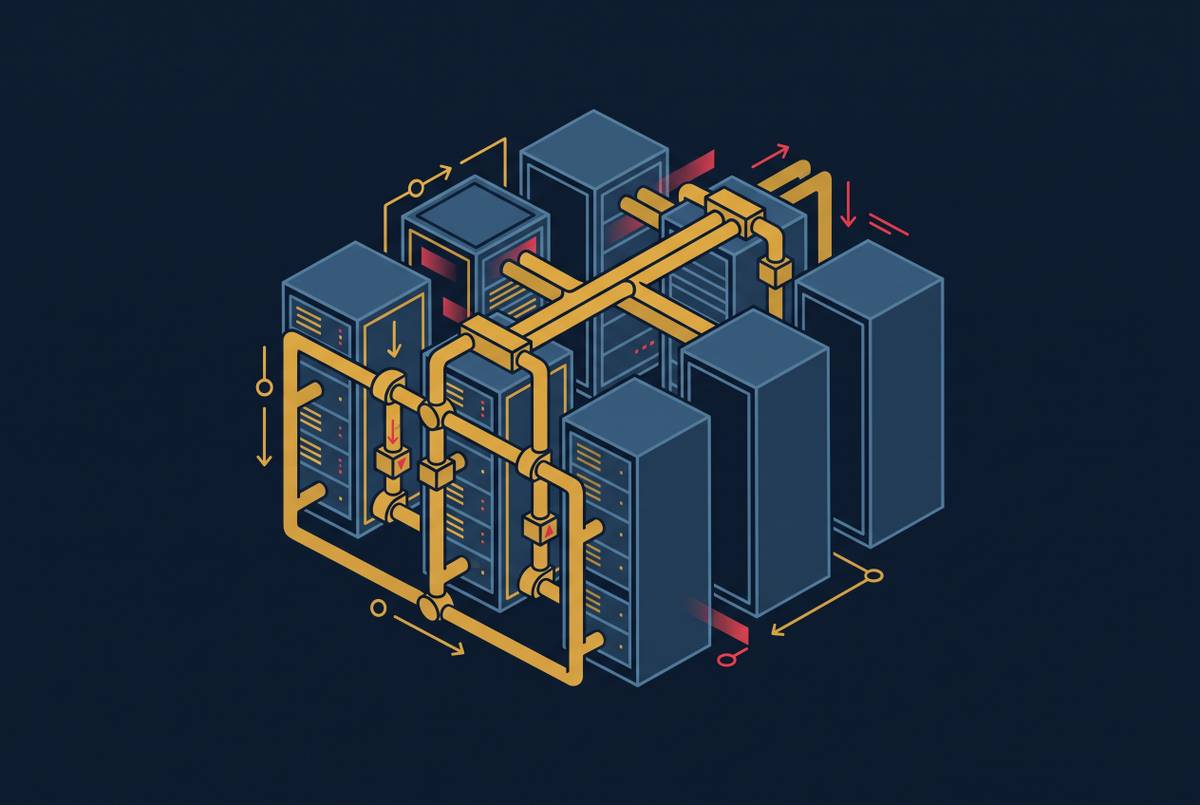
The decisive change is that high-density GPU workloads already require the liquid-cooling infrastructure. The campus must pay to collect and move that heat whether it sells the output or rejects it. Heat export builds on a mandatory system. Its incremental cost is therefore a fraction of the cost of creating recovery as a standalone installation, which changes the financial starting point before any heat sale is negotiated.
How the EU Energy Efficiency Directive turned heat recovery from voluntary to obligatory
European regulation adds a binding obligation to that engineering shift. Article 26 of the EU Energy Efficiency Directive, or EED, imposes a use-or-justify obligation for facilities above 1 MW, with a cost-benefit assessment for new or substantially refurbished facilities. It also requires waste heat notification to nearby district heating operators. Translating European policy into a campus specification requires accounting for the directive’s lack of a fixed reuse percentage.
Article 26 also imposes annual energy data reporting to the European data centre database, or through national authorities where a member state has established an intermediary scheme, and public disclosure through the database. Reporting is part of delivery. The facility needs data that can support those submissions as well as its assessment of heat recovery. A cooling design without a reporting plan leaves part of the obligation unresolved.
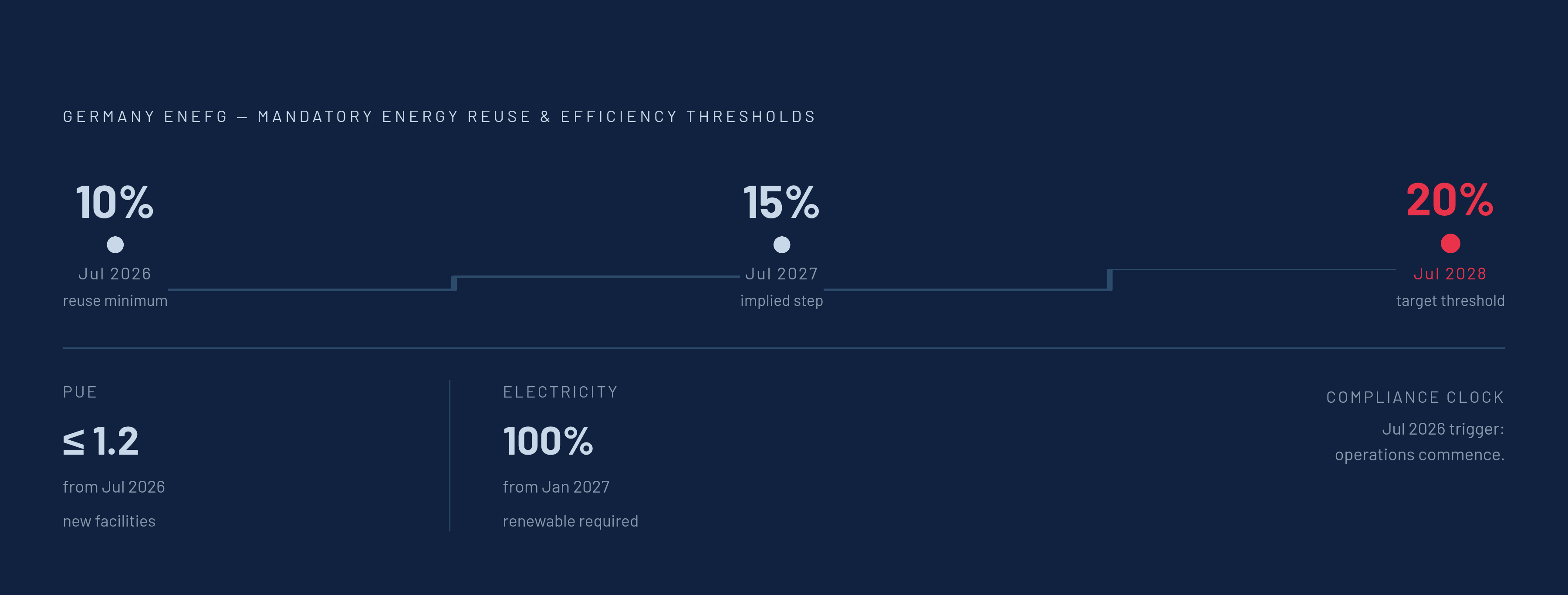
Germany’s Energy Efficiency Act, or EnEfG, adds numerical requirements. Section 11(2) requires data centers commencing operations on or after July 1, 2026, to reuse at least 10% of energy, with increases from July 2027 and again to 20% from July 2028. Germany also requires facilities commissioned from July 1, 2026, to achieve power usage effectiveness, or PUE, no greater than 1.2, and requires fully renewable electricity from January 2027. These requirements apply nationally. The Energy Reuse Factor, or ERF, also has implications for permits and sovereign compute eligibility, so internal efficiency alone is not the whole compliance case.
What the revenue and capital structure actually looks like at campus scale
A large AI campus can produce enough recoverable thermal energy to supply a significant portion of a mid-sized European city’s heating needs. At that scale, heat sales can generate meaningful cash. The volume distinguishes campus recovery from a small installation whose export revenue cannot support the connection investment. But a large thermal output is only the supply side of the transaction. Revenue still depends on the price and the amount a buyer can use.
The price paid for that heat under heat purchase agreements, or HPAs, varies from market to market. Nordic prices are higher than those in central European hubs because 4GDH infrastructure is well established and the fuels that the heat replaces cost more. Frankfurt and Amsterdam offer larger volume opportunities at somewhat lower prices per unit of energy. Agricultural contracts pay less than district heating sales. They can nevertheless provide a useful revenue stream when an adjacent greenhouse is accessible and a municipal network is not.
The investment comes before the income does. Both the data center and the heating network face substantial capital costs, and payback varies with campus scale, connection distance and the agreed heat price. Investment in district heating is likely to have a negative net present value, or NPV, at small facilities, while medium and large campuses can have a positive NPV. That is not a guaranteed return for every large site. Retrofit costs are materially higher than designing for reuse from the outset, so delaying the decision can weaken an otherwise viable project.
Why geography determines whether the economics close
Stockholm, Copenhagen and Helsinki offer strong conditions for heat sales because mature networks, high displaced-fuel costs and active municipal partners coincide. Frankfurt and Amsterdam offer a different balance, with hyperscale concentration supporting large volumes but lower HPA prices extending payback. Location determines more than the connection cost. It also determines who can buy the heat and what that buyer would otherwise pay for energy.
Demand for district heating falls sharply in summer, so less of the heat is used and sales bring in less over the year. European operators have responded by co-locating greenhouses to absorb surplus heat at agricultural contract rates. Aquifer thermal energy storage, or ATES, is another way to store heat from one season for use in another. Large installations are becoming cost-effective at AI campus scale, although payback in this application is longer than for direct district heating sales.
North American campuses often have no municipal heating network to connect to, so researchers are studying another way to use the heat. Rice University’s study in Solar Energy modeled a solar thermal-boosted organic Rankine cycle, or ORC, system in Ashburn, Virginia, and Los Angeles, California. Both modeled cases produced more power over the year at lower levelized electricity costs, with better results in Los Angeles because solar irradiance was higher there. Research has yet to show that this can earn as much at campus scale as European HPA income. For planners, the practical implication is to assess viable heat offtakers with power, fiber and risk during site selection, rather than looking for a buyer after the location is fixed.
What operating deployments show about how the model works in practice
Meta’s Odense site uses large ammonia heat pumps to bring the outlet temperature up to 70–75°C for the district heating network. Meta supplies the captured heat free of charge. That arrangement exchanges direct heat revenue for community goodwill and regulatory standing, while showing that the receiving network can still require a substantial temperature lift.
atNorth’s FIN02 facility in Espoo began delivering waste heat to a neighboring Kesko store in November 2025. This smaller operating deployment demonstrates that non-municipal offtake can provide a practical route where the local demand is close enough to the facility.
Microsoft and Fortum’s Kirkkonummi project demonstrates the other end of the scale, but it should not be described as an operating data center heat supply. Heat pump plants were starting to run during the 2025–2026 heating season, while waste heat recovery from the Microsoft data center was expected to start in 2027. The project is intended to supply approximately 40% of district heating for a metropolitan area serving hundreds of thousands of users. The distinction is important for project schedules.
Equinix and A2A’s Milan arrangement, announced in July 2026, offers a more directly replicable commercial structure. Equinix’s ML5 data center will sell heat to A2A’s district heating network, bringing in revenue and adding to the heat the local network can supply. Unlike Meta’s free-heat model, it gives exported heat a revenue line. Its significance is contractual as much as technical, linking the campus to an established network buyer while providing a template for meeting EED obligations. The announcement describes planned supply, however, and should not be treated as evidence of completed operating performance.
What the design team must resolve before construction begins
Specify heat export together with the cooling system. The design must set the primary loop’s flow rates, fluid chemistry, pressure ratings and variable-speed pump control to suit thermally bursty AI workloads. These parameters are difficult to retrofit. The heat exchanger and secondary loop must also be engineered in parallel, because they form the interface with the buyer’s network. The need for a heat pump and its capacity depend on connection distance and the required temperature lift.
Utility and municipal HPA negotiations take time, and a late start risks finishing infrastructure without a contracted buyer. The campus energy model must also include a way to use summer surplus through agricultural co-location, ATES or other industrial offtake. Full year-round utilization is not a sound assumption. The ERF target belongs among the design inputs too, with room for utilization shortfalls rather than a design that barely reaches Germany’s applicable minimum.
The handoff to operations needs equal precision. Cooling distribution unit, or CDU, telemetry, thermal metering for HPA verification, building management system integration and structured data for data center infrastructure management must be specified as contract deliverables. Those deliverables need acceptance criteria for both operations and regulatory reporting. Waiting until commissioning means having to piece them together just when the facility needs a record of the system it can use.
ArchiLabs Studio’s connected workflow is one example of how that record can be built from design onward. It links critical-systems engineering and equipment parameters to an operations-ready handoff for DCIM and BMS. Structuring thermal metering, CDU telemetry and reporting data early lets operations and compliance teams inherit a connected record instead of manually assembling one from separate models and spreadsheets.
How campus planners should frame heat recovery in the project business case
Campus planners should put recovery in the first pro forma as infrastructure with a potential revenue line, rather than a sustainability program with only a cost line. Mandatory cooling capital is the starting point. The model should then distinguish the incremental export investment from the cooling system the campus already requires. It must use the site’s connection distance, available HPA pricing, facility scale and seasonal utilization.
The model also needs to recognize compliance risk. A facility without a credible reuse plan may face permit delays or exclusion from sovereign compute programs, and Germany’s EnEfG allows fines up to €100,000 for non-compliance. ERF therefore affects financing as well as income from heat. Early capital commitment can avoid a larger retrofit expense as well as support future sales, while the operator earns revenue or supplies heat free of charge according to the contract structure.
Where district heating is unavailable, industrial co-location, including greenhouses, food processing and pharmaceutical users, can offer alternative offtake and partial revenue. ORC warrants separate assessment as a research pathway. Any alternative must be assessed against the applicable reuse obligation. The time to keep costs down is at the design stage, before construction begins, before talks with offtakers stall and before the clock starts running on ERF compliance.