Behind-the-Meter Generation vs. Grid-Served Power for Large Campuses
Power decisions lock in site design and critical systems before construction even starts.
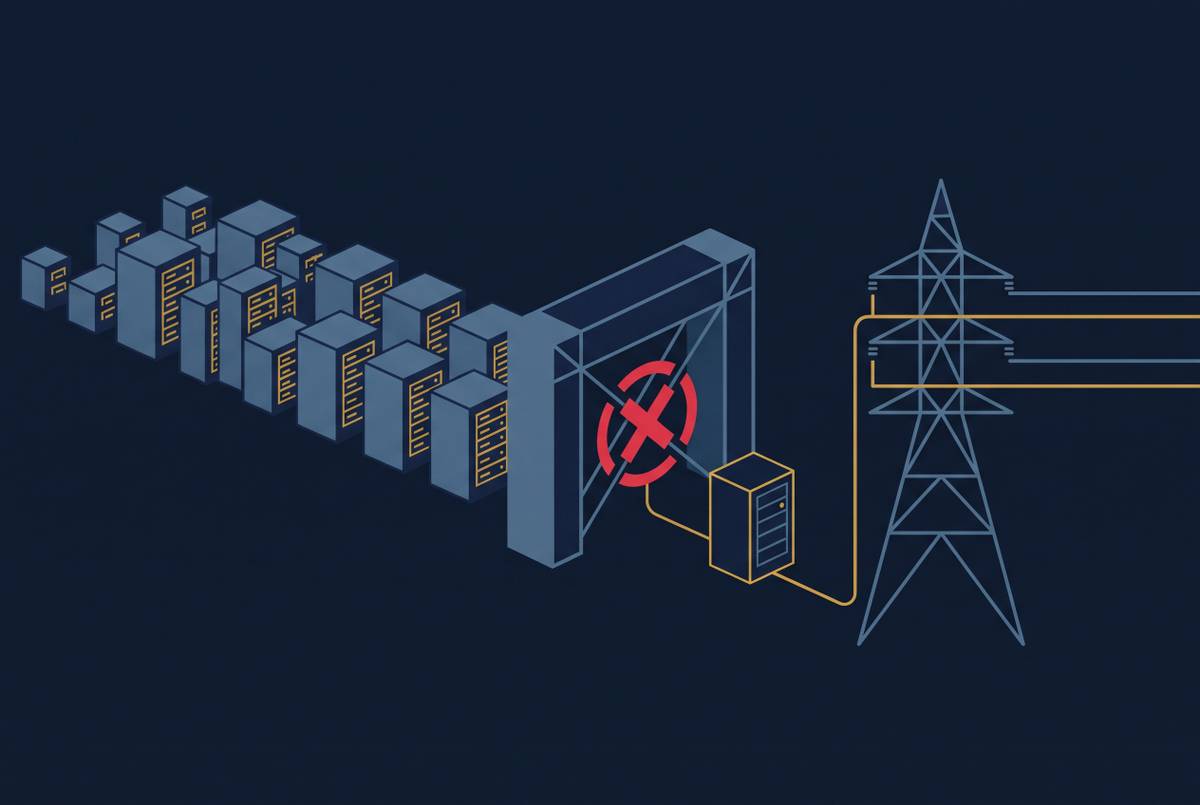
Choosing between behind-the-meter power and grid-served power for a large campus is not a procurement detail you sort out after the design is done. It locks in site layout, cooling strategy, and critical-systems architecture before anyone pours a foundation. Interconnection queues that once cleared relatively quickly now stretch many years in major regions like PJM, and average project timelines in queue before reaching commercial operation have grown substantially. That gap is why power architecture belongs at the front of the conversation, not somewhere near the end of it.
What behind-the-meter means in practice, and how it differs from grid-served at the campus scale
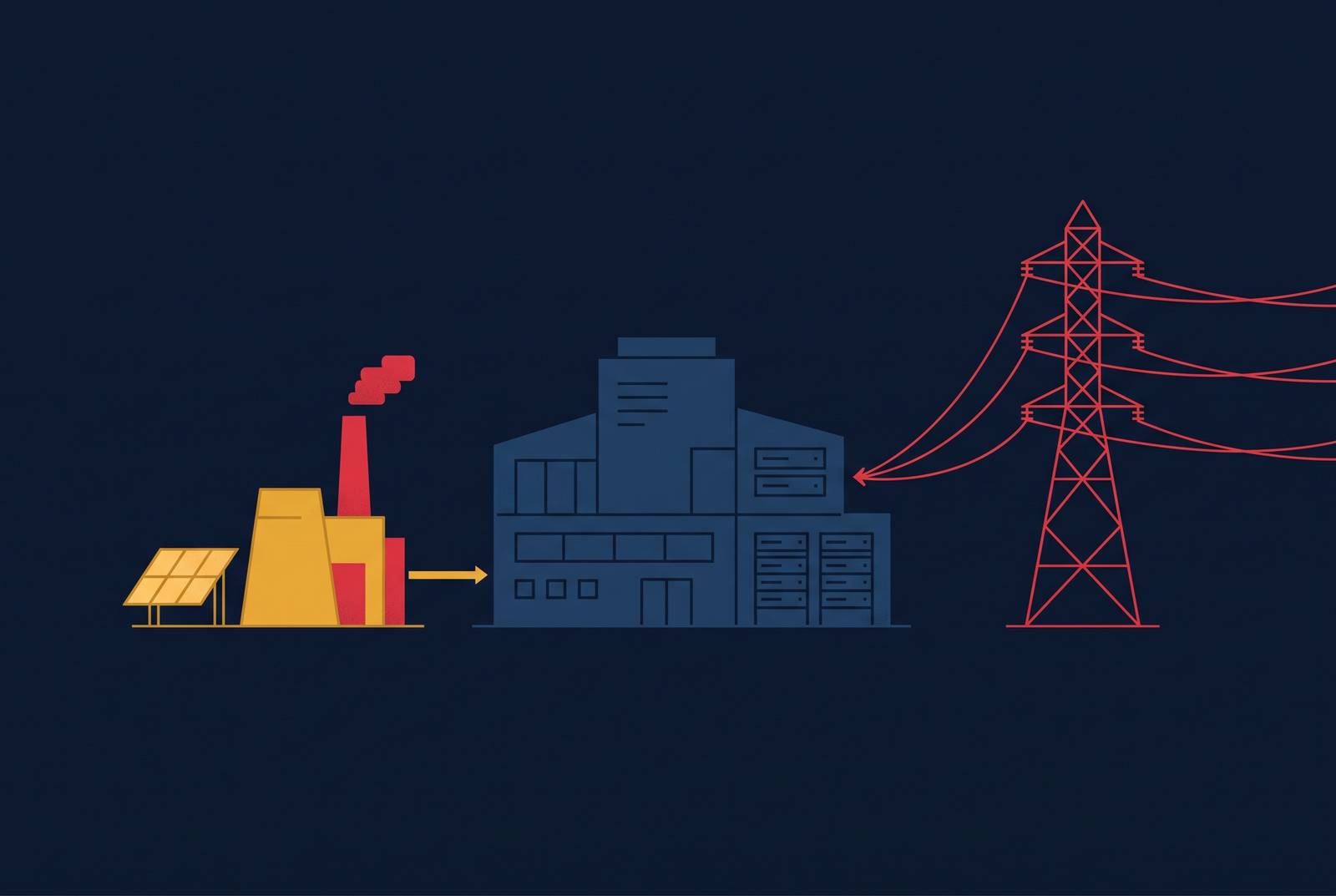
Grid-served is the model most people picture when they think data center. The utility delivers power at one point, the meter, and everything downstream (substation, switchgear, distribution, UPS) gets built outward from there. The campus is a load. It draws power. It doesn't make any.
Behind-the-meter flips that around. Generation sits on the customer's side of the meter, so the campus makes its own power and burns it on site. A grid tie, if one exists at all, is there to patch gaps, not carry the main load.
Treating BTM as one category is where planning goes wrong early. The term covers a real range, and each version changes what gets built on site in a different way. Supplemental BTM covers part of the load, with the utility picking up the rest. CoreSite runs this at its SV9 and BO1 campuses, pairing fuel cells with standard utility service. Primary BTM with grid backup handles daily operation on site but keeps the utility line live for resilience, the pattern behind most gas-plus-battery hyperscaler campuses announced in 2025 and 2026. Fully islanded means no dependence on the public grid, period: Joule's 1.3 GW Utah campus is aiming for full islanding from Rocky Mountain Power, and Energy Abundance's Data City near Laredo sits in that same category.
The equipment behind these projects varies just as much: gas turbines (aeroderivative and heavier frame units), reciprocating engines like the Jenbacher line, solid-oxide fuel cells from Bloom Energy, and gas paired with battery storage. Each has its own footprint, its own fuel needs, its own heat output, and each pushes site design in a different direction before a single rack goes in.
Grid-served campuses still run backup gear, diesel gensets, UPS, batteries, all the usual stuff. But the job changes depending on the path. On a grid-served site, backup covers an outage on a grid you can mostly count on. On a BTM site, the campus has to build full operational continuity itself, because there's no steady outside supply waiting behind it if something fails.
Regulators aren't ignoring BTM either, whatever the name implies. Regulators have moved to require large co-located loads to pay for transmission service, with thresholds determining which BTM generation customers can still net load under existing rules. Some jurisdictions go further and classify BTM facilities as network loads that share the cost of transmission upgrades too.
How the power architecture decision reshapes site layout from the earliest planning stage
Grid-served site selection follows a fairly predictable script. Proximity to transmission matters. So does available capacity at a nearby substation. The campus organizes around one or two utility delivery points, and distribution runs inward from the property line. A generator yard for diesel backup eats up some space, sure, but it's a support function, not something driving the land-use plan. Utility easements shape the perimeter. They don't touch the middle of the site.
BTM breaks that logic completely, and it's the part planners underestimate the most. The generation plant is a co-equal land use next to the data hall, a production facility in its own right, and it eats real acreage doing it. It's a co-equal land use next to the data hall, a production facility in its own right, and it eats real acreage doing it.
Gas turbines and reciprocating engines need combustion air intake, exhaust stack clearance, and fuel infrastructure, whether that means a pipeline interconnection or on-site storage tanks. They also need real acoustic setbacks from anything occupied. Battery enclosures bring their own fire-separation rules on top of that, adding another layer of structural and electrical coordination before anyone touches the data hall design.
Fuel supply becomes a site-selection criterion in its own right, not something worked out later. Energy Abundance's Data City near Laredo is a 50,000-acre campus sited around access to local natural gas today, with a longer-term plan for salt-dome hydrogen storage in Duval County and pipeline connections to Corpus Christi. That's a land decision made years before the first server rack shows up.
Cooling adds another layer of conflict. Inlet air cooling and exhaust heat management for the generation plant have to be coordinated with data hall cooling, because both systems are pulling on the same site resources at the same time.
Scale changes the picture again. At several hundred megawatts, the generation plant is already a serious industrial facility sitting next to the compute. At multi-gigawatt scale (Fermi America's Project Matador is targeting up to 11 GW, Pacifico's Pecos County site is targeting 5 GW), what's actually getting built is a power station with a data center attached to it. That has to be planned like industrial infrastructure from day one, not treated as an oversized accessory to the compute.
Power architecture needs to be locked before master planning starts. No exceptions. Each path produces a different land-use diagram, different access and egress requirements, and a different approach to easements. Get the sequence backwards, and the site plan ends up getting redesigned around a power decision instead of the other way around, which is exactly the expensive mistake this whole approach is meant to avoid.
The distinct critical-systems coordination challenges each power path creates
On a grid-served campus, power arrives at a known voltage and frequency, set and held by the utility. The engineering team designs everything downstream, substation, main switchgear, UPS, PDU, rack, treating utility power quality as a given. Backup generation gets sized as a contingency layer, sitting off to the side of the main design problem.
BTM takes that given away. Now the engineering team is coordinating two power systems that interact constantly, the on-site plant and the internal distribution network, and power quality, frequency regulation, and fault response all belong to the campus design team. None of it gets handed off to a utility. That's why BTM projects carry more engineering risk up front, before a single generator ships.
The coordination demands have no real match on the grid-served side. Multiple generation units need to sync before any load transfer happens, and designing controls for paralleling gas turbines or reciprocating engines is a specialized scope on its own. The campus also has to define which loads matter most and build automatic shedding sequences for when generation capacity runs tight. Battery systems have to coordinate with both the generation plant and the data hall distribution to manage ramp rates, frequency response, and peak shaving, and every interface point becomes its own coordination job. Gas supply, too, becomes as critical as utility uptime used to be, which pulls dual-feed gas lines, on-site storage sizing, and supply contracts straight into the critical-systems conversation.
Cooling coordination shifts as well. Waste heat from the generation plant, exhaust plumes, rising inlet air temperature, all of it changes the ambient conditions the data hall cooling has to fight against. None of that exists on a grid-served campus, because there's no combustion plant sitting next door to begin with.
The coordination surface, power, cooling, controls, fuel, all running in parallel across the plant and the data hall, is just bigger on a BTM campus. A conflict caught late costs more the bigger the system gets: late-stage coordination conflicts have driven costly rework events on grid-served projects, and that same category of mistake gets more expensive, not less, once you're coordinating a generation plant alongside it.
Regulatory work adds its own layer. Oracle's Project Jupiter is a clean example: the original filing split the site into two separate microgrids, East and West, each sized just under the federal 250-ton major-source threshold. That meant the generation plant design had to move in lockstep with air-permit engineering from the start, not get bolted on once the plant was already designed.
Power density and AI workload requirements and the stakes for both paths
Older data center designs assumed rack densities around 15 kW. Industry analysis puts AI-optimized halls at 60 to 120 kW per rack, four to eight times the old baseline. Heat follows the same curve: a typical server throws off roughly 1.5 kW, while AI GPU servers put out five or six times that. Cooling has to be built for a genuinely different thermal load.
On the grid-served side, higher density appears at the interconnection point as bigger numbers: more peak demand, a larger substation, heavier switchgear, tighter distribution design. The underlying architecture stays the same. The utility still sets power quality. The utility still owns frequency.
BTM feels this shift more directly, and it's where a lot of the announced projects are going to get tested. The on-site plant has to be sized and dispatched against a load profile that spikes harder at the peak than anything the old model dealt with. Battery sizing and dispatch logic determine how well the plant handles AI training workloads that ramp fast and hard, and the coordination between generation controls and the UPS/PDU chain has to account for transients that older plant controls were never built to absorb.
Cooling gets rewritten on both paths, not just the BTM one. Raised-floor and perimeter cooling don't cut it for AI-density halls anymore. Chilled water loops, stainless steel piping, structural systems rated for heavier compute, all of that is standard now. On a BTM campus, that same cooling system also has to be coordinated against heat coming off the generation plant sitting a few hundred feet away.
None of it scales up cleanly from an older design. Both paths now demand power, cooling, and structural coordination happen early, in a way that simply wasn't necessary when 15 kW per rack was the norm.
What the current wave of announced BTM projects reveals about developers resolving these design commitments
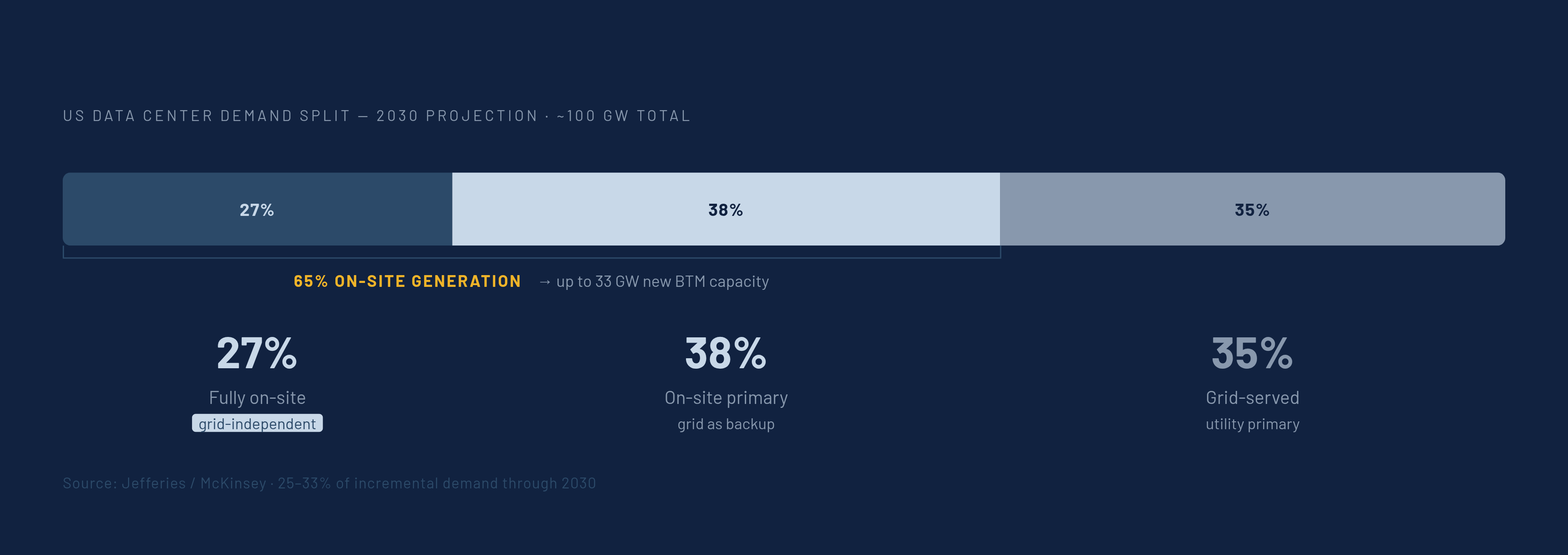
The scale here makes the point on its own. SemiAnalysis Energy Model tracks 75 GW of firm, binding BTM orders in the supply chain for AI compute right now, with about 20 GW of that ordered in a single quarter, Q2 2026. Roughly 3 GW of operational US data center IT capacity is expected to run behind the meter by the end of 2026. A Jefferies investor note citing McKinsey research puts BTM at 25 to 33% of incremental data center demand through 2030, which, against a forecast of around 100 GW of total data center demand by that year, works out to as much as 33 GW of new BTM generation over five years.
The named projects show how developers are actually resolving these tradeoffs in steel and concrete, not in a press release, and the equipment choices say as much as the megawatt totals do.
Stargate's Shackleford County, Texas site runs on Jenbacher reciprocating engines behind the meter, a modular approach where each engine is a discrete unit added as compute phases come online, though each one still needs its own exhaust, fuel line, and controls integration. Stargate's Doña Ana County, New Mexico site takes the opposite equipment path, running Siemens and GE gas turbines to power the campus independent of the local grid. Frame turbines mean bigger individual units, more capital sunk per unit, and a different footprint: larger pads, taller exhaust stacks.
Joule's 1.3 GW Utah campus is going fully islanded from Rocky Mountain Power. This means the full controls stack described above with no utility backstop for frequency or fault handling. That's the hardest version of this to pull off, and the one with the least room for error once the campus goes live.
Energy Abundance's Data City near Laredo starts at 300 MW and 1 million square feet in 2026, with a stated path to 5 GW and more than 15 million square feet over time, plus a phased shift from natural gas to fully green hydrogen. That transition sits inside the master plan from day one, since the hydrogen phase depends on infrastructure and pipeline connections that had to be factored into the original site selection, not added on after the fact.
Pacifico's Pecos County campus is targeting 5 GW off-grid, combining gas generation with 1.8 GW of storage, aiming for 1 GW online by 2028 and the full 5 GW by 2030. Storage at that scale is its own major coordination job, tying the battery system to both the gas plant and a data hall build-out happening in phases. Fermi America's Project Matador is still in development, targeting up to 11 GW and 15 million square feet by 2038, and it stands as something close to an upper bound on how far phased BTM planning can stretch.
Large BTM microgrid projects are also taking shape beyond the United States, showing that this pattern extends across different regulatory environments and grid contexts.
The joint venture between Chevron, Engine No. 1, and GE Vernova is built around seven GE Vernova 7HA gas turbines, targeting sites across the Southeast, Midwest, and West. At that scale, turbine plant design and data hall design can't run on separate tracks. They move together, or they don't move.
Equinix has paired with Bloom Energy for a significant deployment of solid-oxide fuel cells spread across multiple data centers in several states, the supplemental, hybrid model rather than full islanding. That's a retrofit problem, fitting fuel cell footprints into existing utility-served campuses, and it's a different design challenge entirely from the greenfield builds above.
SemiAnalysis reports that Microsoft has signed more than 5 GW of BTM nameplate capacity in 2026, including 2.7 GW with Joulent and Chevron and over 2 GW through turnkey leases with companies like Crusoe. Google is deploying 930 MW of off-grid aeroderivative turbines in Armstrong County, plus 900 MW of Bloom Energy fuel cells in Wyoming.
One pattern holds across nearly every project on this list: generation gets added in phases that track compute build-out, not delivered all at once. That forces the distribution and controls architecture to be designed for expansion from day one, since retrofitting that flexibility later costs far more than building it in up front. Bloom Energy's own data, cited by CoreSite, projects that 27% of data center facilities will run fully on-site generation by 2030, with another 38% using on-site generation as their primary source. Those two numbers together lead to a hard-to-avoid conclusion: most new capacity being planned right now is being planned to skip the grid, not lean on it.