Diesel Genset Procurement Lead Times and Fleet Sizing Strategy
Long lead times force procurement decisions before design, and OEM backlogs now extend into 2028.
Diesel generator procurement used to be a purchasing task: pick a unit, place the order, wait a few months, install it. That model is dead. Lead times on large standby diesel units now stretch past 100 weeks, OEM backlogs run into 2028, and permitting rules in states like Virginia and Illinois are changing the equipment spec itself. Fleet sizing can no longer wait for power and cooling design to settle first. Procurement has to lock in early, or it becomes the thing that pushes commercial operation dates by a year or more.
Data center generation market growth beyond standard procurement models
U.S. data center diesel capacity went from 20 GW nameplate to 55 GW between 2018 and 2024. That's not a bump, it's a near-tripling in six years, and it explains why OEMs can't just add a shift and catch up. This is a structural mismatch between demand and factory output, not a supply hiccup that clears in a quarter or two.
Virginia shows what that looks like concentrated in one place. By the end of 2025, the state had over 10,500 permitted generator units and roughly 27 GW of nameplate standby capacity. That's more standby generation sitting in one state than the entire grid of many countries. state than the entire grid of many countries.
The dollar figures back up the scale. Estimates put the data center generator market in the high single-digit billions of dollars to just over $10.3 billion in 2025 and 2026 (Precedence Research, Fortune Business Insights), with a rough doubling forecast by 2034. Meanwhile the IEA's Electricity 2026 Report projects global data center electricity demand hitting 945 TWh by 2030, up from 415 TWh in 2024. Vendors are not equipped to match that curve with the factory floor space they have today.
Lead times across generator sizes in 2026
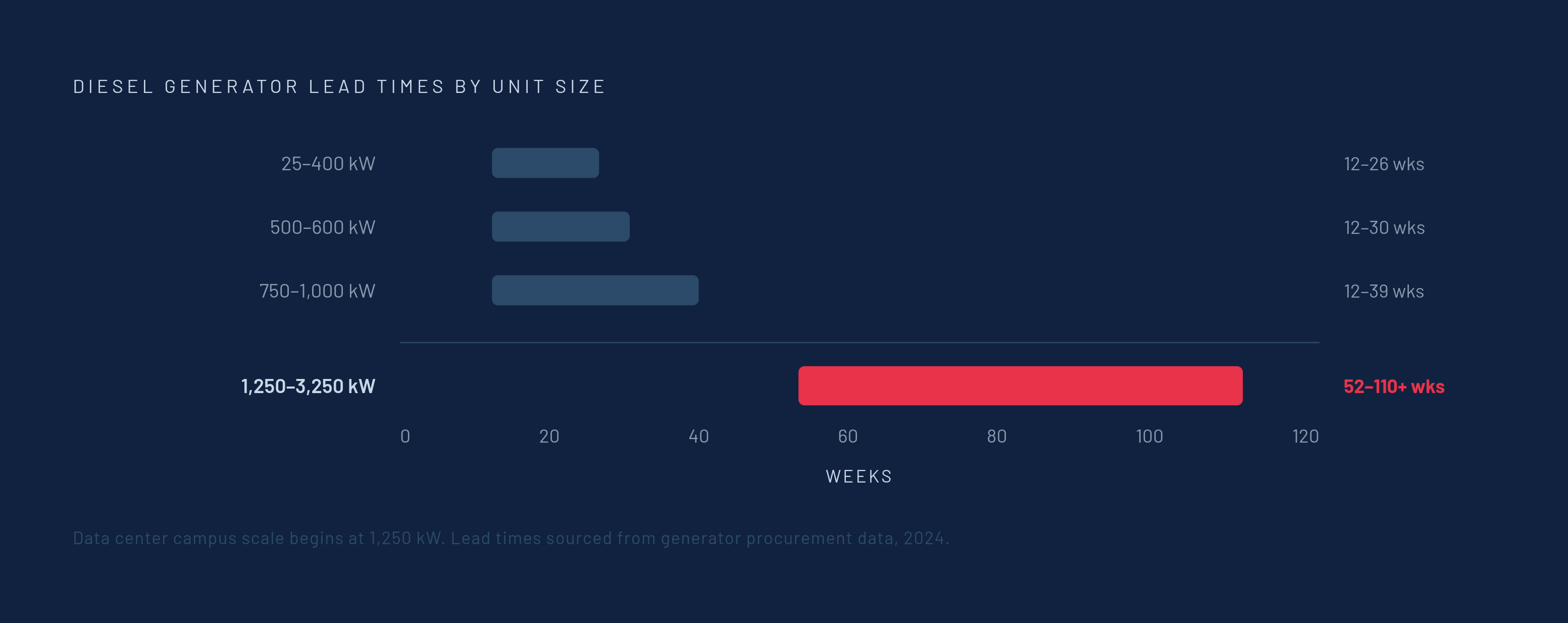
Numbers here matter more than adjectives. SecondWatt puts average data center equipment lead times at 42 weeks, 83% above where they sat in 2019. data center equipment lead times at 42 weeks, 83% above where they sat in 2019. JLL's global average is 33 weeks, already 50% above pre-2020 levels. Neither number is good news, and the real story appears once you break it down by unit size.
Smaller standby units still move at something close to a normal pace:
- 25 kW to 400 kW standby diesel: 12 to 26 weeks
- 500 kW to 600 kW standby diesel: 12 to 30 weeks
- 750 kW to 1,000 kW standby diesel: 12 to 39 weeks
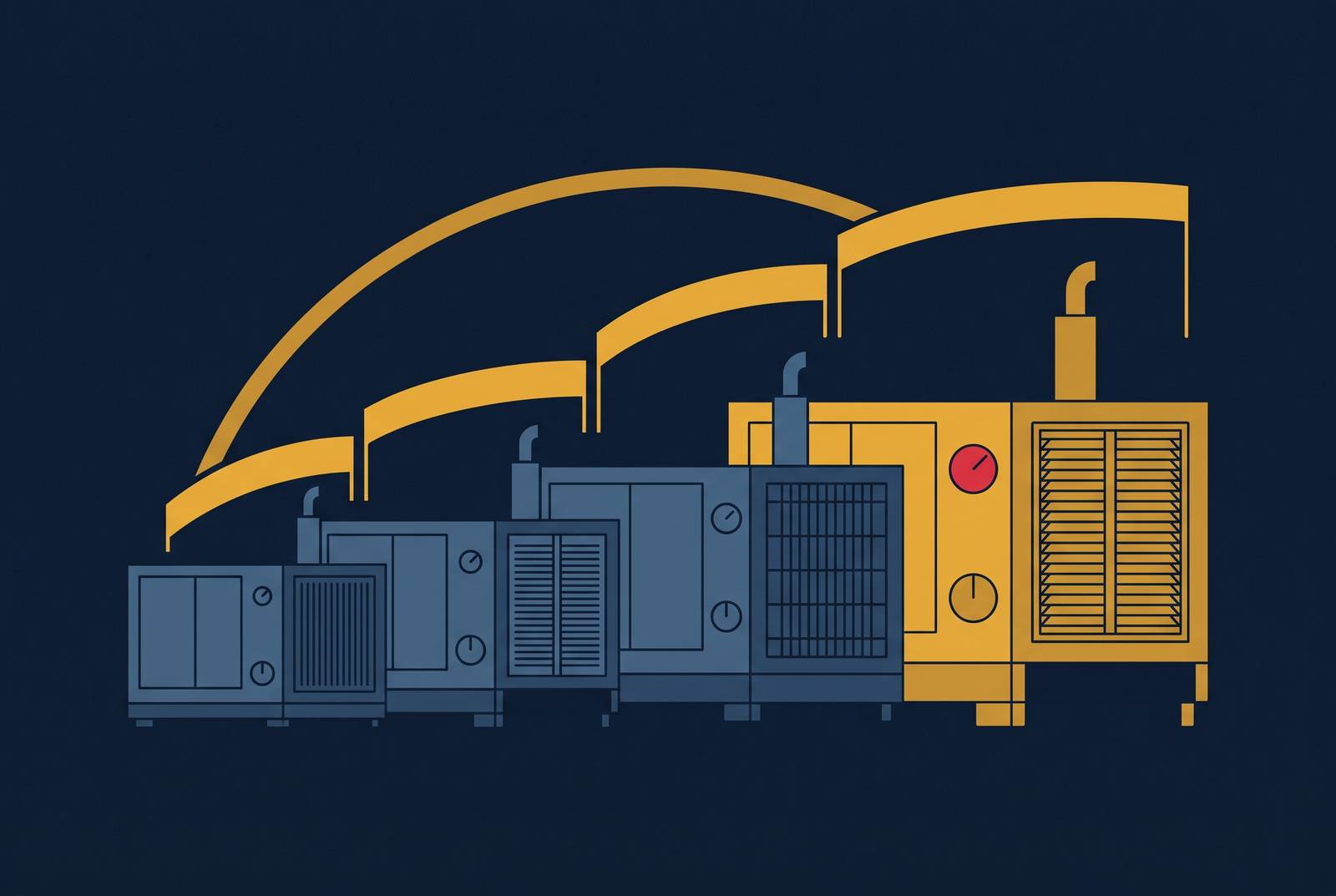
Then the curve breaks. The 1,250 kW to 3,250 kW band, the size class that actually runs a data center campus, is quoting anywhere from 52 to 110 weeks or more depending on OEM and factory allocation. That spread reflects genuinely unpredictable large-frame availability. It's telling you large-frame availability has become genuinely unpredictable, and two projects ordering the same model on the same week can land 40 weeks apart depending on factory allocation.
Stream Data Centers' own trajectory captures the shift: lead times went from a 20 to 30 week range to 72 to 104-plus weeks. A procurement cycle that used to take about six months turned into a two-year planning problem, almost overnight by industry standards.
Distributor stock, meaning used or surplus units, ships in 2 to 6 weeks. For projects that can't absorb a year-plus wait, that's often the only real option left on the table.
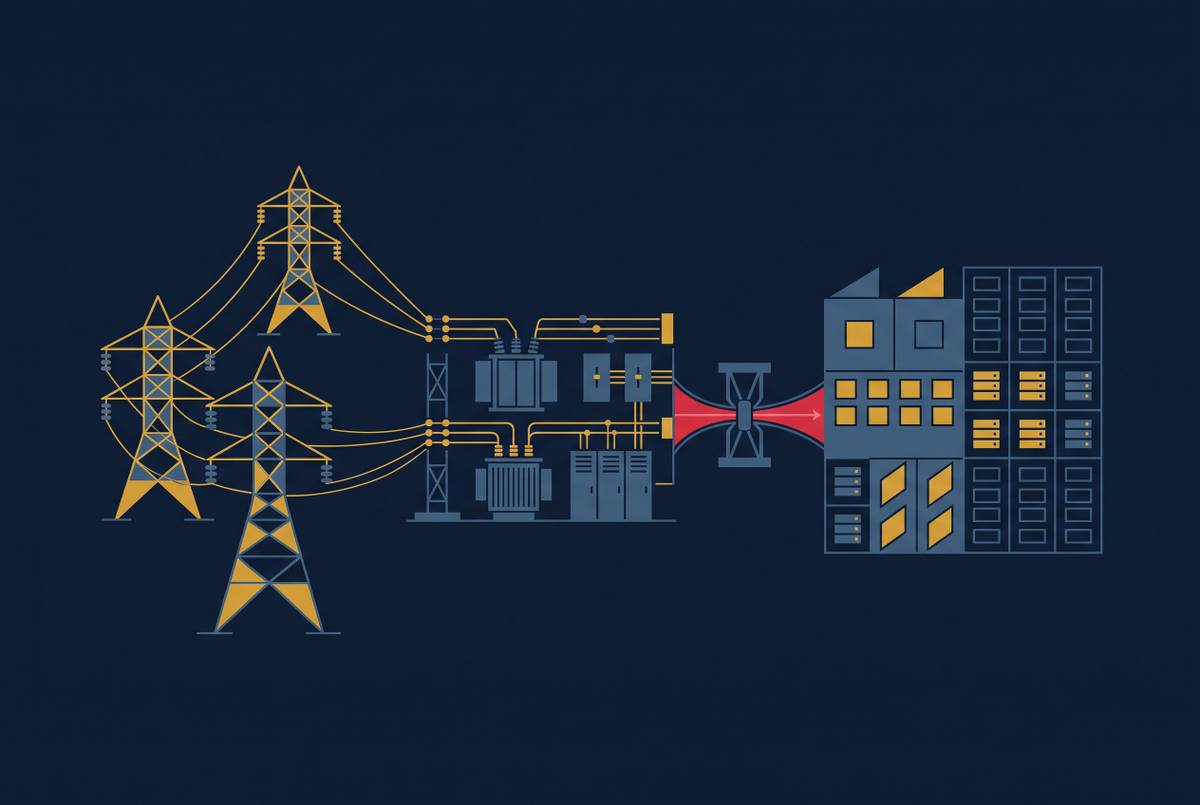
Even when the generator itself is available, it often isn't the actual constraint anymore. Medium-voltage switchgear lead times can stretch to 72 weeks or more according to DC Atlas. Generator step-up transformers can carry some of the longest lead times in the entire supply chain. A campus can secure its gensets and still sit stalled waiting on the gear that connects them to the grid.
OEM backlogs locking down factory capacity into 2028
Caterpillar reported a record $63 billion backlog in Q1 2026, up 79% year-over-year. The company is tripling its large reciprocating engine capacity and adding roughly 15 GW of annual output, but that expansion doesn't fully come online until sometime between 2027 and 2029. Anyone ordering today is ordering against capacity that doesn't exist yet.
Cummins is already sold out of its data center generator allocation through 2028. The company doubled capacity on its 95-liter high-speed diesel engine platform in 2025 and still can't keep pace with orders. Data center-related revenue hit around $3.5 billion in 2025, with 10 to 20% growth projected for 2026, which tells you demand is still climbing even as the backlog grows.
Rolls-Royce's Power Systems division now pulls over 80% of its power-generation revenue from data centers, and it's already booking orders for 2027 and 2028 delivery. Rolls-Royce's Power Systems division is already booking orders for 2027 and 2028 delivery.
The clearest signal of where this market is heading is the Caterpillar and Hunt Energy long-term strategic agreement to deliver power solutions for data centers. That kind of deal reserves OEM capacity ahead of the open queue, which means buyers without a similar arrangement are competing for whatever's left after strategic partners get served first. Reservation, not just ordering, is becoming the real procurement lever.
The four dominant OEM platforms and their published ratings for fleet capacity
Four platforms dominate the large-node market right now:
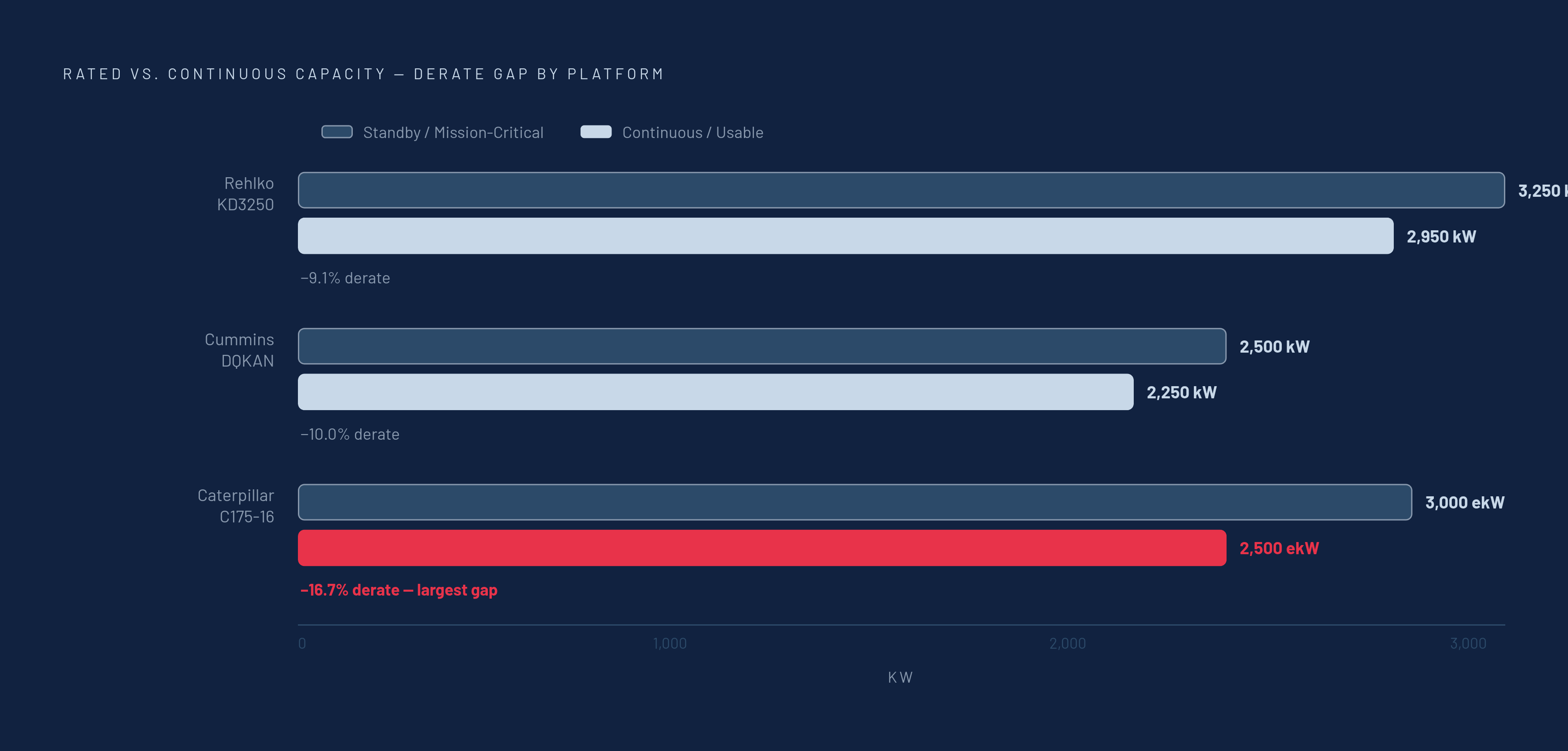
Cummins DQKAN (QSK60 platform): 2,500 kW standby, 2,250 kW Data Center Continuous. Cummins publishes an explicit Data Center Continuous rating, which matters once duty cycles extend past pure emergency backup. Caterpillar C175-16: 3,000 ekW mission-critical, 2,500 ekW continuous. Long-standing hyperscale default, but it carries the largest published derate in this group. Rehlko KD3250: 3,250 kW standby, 2,950 kW prime. A notably small derate percentage relative to its standby rating. Generac: 2025 lineup spans 2.25 MW to 3.25 MW emergency standby diesel, marking the company's direct move into hyperscale-scale standby.
The trap here is subtle but expensive. Buyers look at a standby number on a spec sheet, build their redundancy math around it, and only later discover that number applies strictly to emergency duty. It doesn't cover demand response, bridge power, or extended outages (SecondWatt).
Dropping from 3,000 ekW mission-critical to 2,500 ekW continuous on the Cat C175-16 is a 16.7% cut in usable capacity. Compare that to Rehlko's KD3250 at roughly a 9.1% derate, or Cummins' DQKAN at around 10%. A campus that specs its fleet at the critical rating on a Cat platform is losing meaningfully more usable capacity than a team that built around Rehlko or Cummins, even if the nameplate numbers looked similar on paper.
The rating class itself is the deeper issue. Emergency standby power (ESP) ratings cap annual runtime at 200 hours and limit average load to 70%. Those ratings simply fail Tier III and Tier IV standards. Any facility expecting prolonged utility outages, without hard runtime limits, needs a Data Center Continuous (DCC) rating instead. Specify ESP where DCC belongs, and the fleet looks fine on paper right up until the first extended outage.
AI-era load density breaking the assumptions behind conventional N+1 sizing
N+1 redundancy math assumes you know what "1" is. AI workloads have made that assumption shaky. Nvidia's Blackwell reference designs pack 120 to 130 kW into a single rack, somewhere around 12 to 25 times the density of a conventional server row. It's the reference design AI campuses are being built around.
Load projections are moving just as fast as the hardware. Some hyperscale tenants that signed 120 MW leases in 2022 came back requesting 270 MW after GPU rack upgrades changed their density math. A fleet sized correctly at signing was wrong within two years because the underlying hardware moved faster than the power contract did.
Scale at the top end gets almost hard to picture. Hyperscale campuses routinely run dozens of generators per site. Across Virginia, data center operators average 54 diesel generators per facility. Those numbers are a useful gut check against any fleet count a design team pencils in early. If a napkin sizing comes in wildly below what comparable campuses actually run, that's a signal for a second look before procurement locks it in.
Where BESS and UPS fit into the sizing calculation
Battery storage isn't optional backup anymore. Large-scale BESS now runs standard alongside generator fleets at AI data centers, and it does two jobs at once: it bridges the gap between a grid failure and generator synchronization, and it absorbs the load transients that AI workload startups throw at the system, transients that would otherwise stress generator controls directly.
Think of the three layers by how long each one is built to hold the load:
BESS: seconds to minutes
Sizing any one of those layers in isolation gets you a fleet that looks fine on a spreadsheet and fails in the field. A generator fleet correctly sized for N+1 redundancy, paired with an undersized BESS, can fail its very first extended AI training run simply because the battery layer wasn't built to absorb that startup transient. The three layers have to be sized together, as one system, or the math doesn't hold.
A mechanical risk lies within this dynamic: wet-stacking, produced when generators run at light load for extended periods. The issue is well documented across the industry. When generators built with N+1 or N+2 headroom run at light load, which is common in an over-provisioned fleet, unburned fuel builds up in the exhaust system. Left unaddressed, that's a maintenance and reliability problem that compounds over time. The procurement fix is straightforward: require either a permanent load bank installation or a documented load-bank service plan as part of the genset package, not as an afterthought bolted on post-commissioning.
Emissions permitting as the second binding constraint that must be resolved before procurement can close
Five years ago, the binding constraint on a 3 MW standby project was the lead time on the frame itself. In 2026, it's the air permit attached to that frame, and increasingly, the permit is the thing that decides which equipment can even be ordered.
Virginia moved first. For any data center air permit application submitted on or after July 1, 2026, the state's DEQ cannot issue the permit unless it sets emissions limits for each engine-generator set equal to or below a "Tier 4 equivalent" standard (National Law Review). Meeting that bar requires three things on every unit: a selective catalytic reduction system (or equivalent) for NOx, a diesel oxidation catalyst system (or equivalent) for CO, and a diesel particulate filter (or equivalent) for particulate matter. According to Data Center Knowledge, adding SCR systems, particulate filters, and continuous emissions monitoring across a hyperscale campus running dozens or hundreds of generators could add substantial equipment and compliance cost.
Illinois is close behind. For applications submitted after December 1, 2026, many new diesel-fired emergency generators at data centers in the state will need to meet EPA Tier 4 standards (SecondWatt).
That timeline is reshaping the secondary market in real time. SecondWatt has observed asking prices around $685,500 for a 2,000 kW standby Tier 2 Cummins DQKAB, and around $666,765 for an MTU 16V4000 DS2000 at the same tier. Those are solid price points, but only for projects sited in jurisdictions where the permit basis still allows Tier 2 equipment. That window is real today. It's also narrowing fast, as more states adopt Tier 4-equivalent rules and close off the option Virginia and Illinois are already shutting down.
Sources
- Data Center Supply Chain Lead Times: The Reality Behind Delivery Delays · DC Atlas
- Diesel Generators for Data Centers: 2026 Procurement Guide
- Data Center Backup Power: 2026 Buyer Strategy
- Data Center Generators: 2026 Capacity & Cost Guide
- Diesel Generator Lead Time: 2026 Buyer's Guide
- generatordieselchina.com