Power Capacity Reservation Fees and Utility Tariff Negotiations
Engineers now negotiate utility tariffs by setting power capacity figures under deadline pressure.
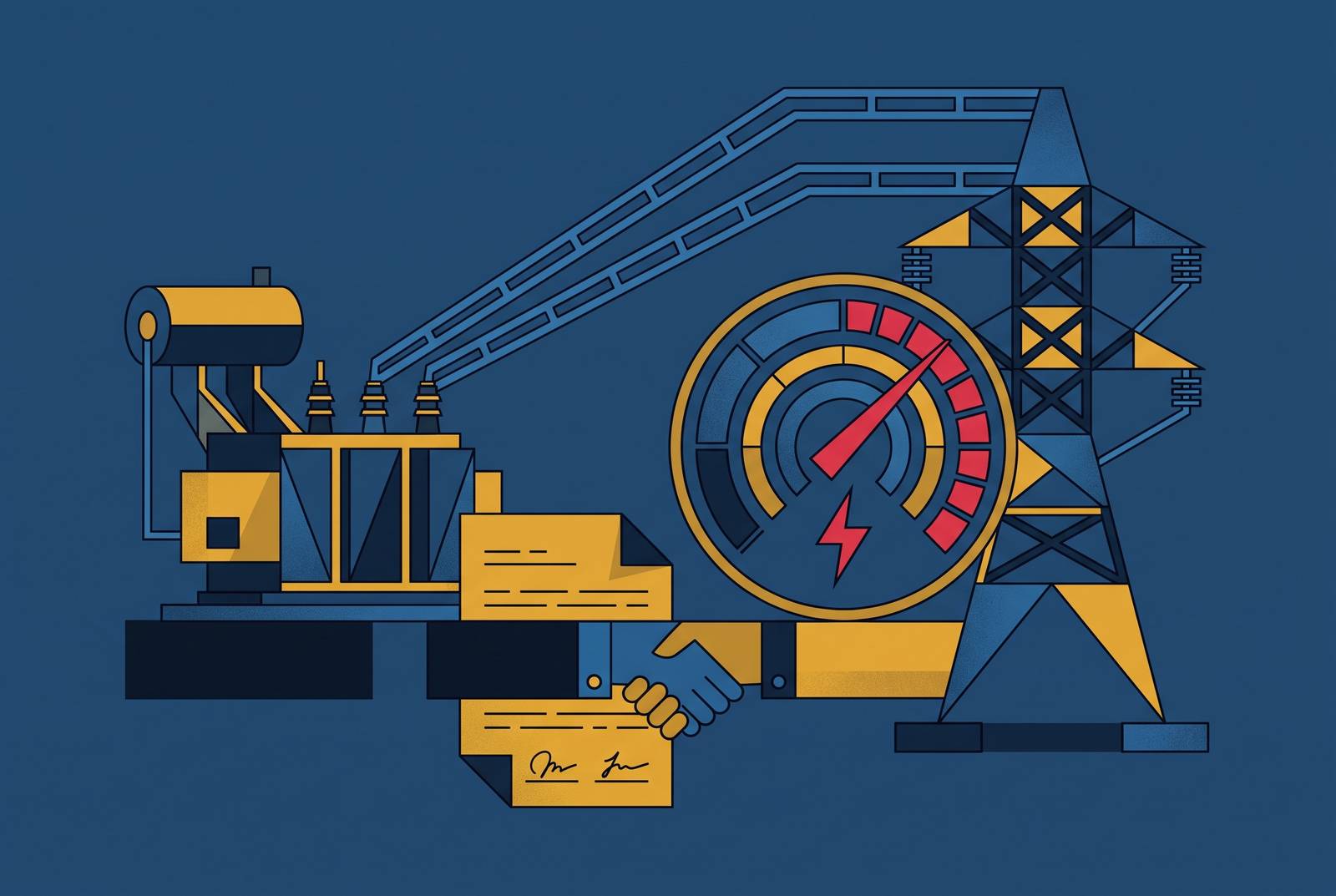
Data centers can go from groundbreak to switch-on in 12 to 18 months Why Data Centers Reserve Power They Never Draw (And Who Pays). Getting that same facility connected to the grid takes 5 to 7 years, and that gap makes power capacity reservation one of the highest-stakes phases of the entire project Why Data Centers Reserve Power They Never Draw (And Who Pays). The design team's ability to produce a precise, defensible capacity figure now shapes what a developer can commit to at the negotiating table, and what fees that developer carries for a decade or more afterward. Engineers and project leads who never thought of themselves as party to a utility tariff negotiation are now, functionally, the ones writing its terms. Power Capacity Reservation Fees and Utility Tariff Negotiations.
Power reservation as a project-delivery problem
National interconnection queues have stretched to a median of roughly 60 months as of the end of 2023, and PJM's timelines run even longer than that national figure. Set that against a construction timeline measured in months: developers have to lock in capacity commitments, and the fee structures tied to them, long before the design is finished Why Data Centers Reserve Power They Never Draw (And Who Pays).
That mismatch changes what a load figure actually is. A number that started out as a preliminary planning estimate, something an early-stage design team might have treated as a rough placeholder, becomes a contractual obligation with financial consequences running a decade or more into the future. Whoever sets that number at the interconnection stage is making a decision the finance team, the operations team, and the utility's rate case attorneys will all be living with long after the building is running. That's a strange kind of leverage to hand an engineer filling out a form under deadline pressure, but that's exactly the position the current system has created.
The regulatory wave that arrived all at once
State regulators did not ease into large-load tariffs. According to the Smart Electric Power Alliance, regulators approved 29 of them in 2025 alone, with another 77 pending across 36 states Edison Electric Institute Why Data Centers Reserve Power They Never Draw (And Who Pays) Federal, CO Action on Data Centers and Large Power Loads. By September 2026, 25 states had at least one large-load tariff on the books, and 7 more had one pending, a pace that spread across dozens of jurisdictions in roughly the same window Edison Electric Institute.
The federal layer moved almost as fast. On October 23, 2025, Secretary of Energy Chris Wright directed FERC to weigh an Advanced Notice of Proposed Rulemaking on interconnection procedures for large loads, defined as anything over 20 MW, with final action requested by April 30, 2026 Edison Electric Institute Why Data Centers Reserve Power They Never Draw (And Who Pays) Federal, CO Action on Data Centers and Large Power Loads. Then, on December 18, 2025, FERC unanimously ordered PJM to rework its tariff to handle co-located loads, a response to arrangements like Amazon's data center at Talen Energy's Susquehanna nuclear plant and Microsoft's deal to restart Three Mile Island Federal, CO Action on Data Centers and Large Power Loads. Whether FERC even has the statutory authority to regulate large-load interconnections this way is still contested: Davis Graham has flagged challenges under the major questions doctrine, and NARUC has argued the ANOPR steps on states' retail electricity jurisdiction. None of that uncertainty has slowed state commissions down. The tariff landscape is being built right now, jurisdiction by jurisdiction, whether or not federal regulators resolve their own authority first.
Layered on top of all this is the Ratepayer Protection Pledge, issued March 4, 2026, and accepted by seven of the largest hyperscalers and AI companies. It carries no legal force. But regulators, intervenors, and lenders will treat it as the benchmark anyway, and any developer who didn't sign it should expect to get measured against its terms in a proceeding regardless.
What the fee structures require from a developer
The reason these fee structures exist at all traces back to a specific number. Monitoring Analytics reported that data centers accounted for $6.5 billion of the $16.4 billion in costs from PJM's December 2025 capacity auction, and about $6.2 billion of that was tied to data centers that hadn't even been built yet. That's the "phantom capacity" problem in a single figure: developers reserving grid capacity raises ratepayer costs long before, or instead of, a facility ever drawing a watt. Reservation fees are the regulatory answer to that gap.
Ohio requires projects above 25 MW to pay for at least 85% of reserved capacity regardless of actual use, over agreements running up to 12 years with an early-exit fee. Virginia's Dominion Energy case, approved November 25, 2025, created a new rate class for customers of 25 MW or more, locked into 14-year contracts with minimum demand charges kicking in January 1, 2027. Tri-State's proposed Colorado tariff scales its evaluation fee by project size: $80,000 for a 45 MW project, $150,000 at 100 MW, $250,000 at 200 MW More data centers are coming to Colorado, demanding more power than t… Data Center State Policies, 2026.
The state-by-state list keeps going. Missouri's SB4, signed April 9, 2025, requires large electrical corporations to build tariff schedules for customers projected above 100 MW of annual peak demand, with rates required to reflect each customer's fair share of costs Data Center State Policies, 2026. Michigan approved its Consumers large-load tariff on November 6, 2025, and Missouri approved Evergy's version the following day. Oregon's HB 3546, the "Power Act," signed June 16, 2025, requires electric companies to contract directly with large energy users on transmission, distribution, energy, capacity, and ancillary services. Arizona's APS rate case, filed June 13, 2025, proposes its own cost allocation changes for large high-load-factor customers.
Read across all of them, the pattern is the same: the commitment attaches to reserved capacity, not consumed power. The contractual anchor is the load figure declared at interconnection, full stop, not whatever the meter shows once the facility is running. The Ratepayer Protection Pledge's third commitment, on minimum payment obligations functioning like take-or-pay arrangements, mirrors this structure closely enough that Davis Graham expects it to get cited even against developers who never signed the pledge. In its filing of April 2, 2026, Colorado / Xcel Energy set out approximately $600,000 in upfront commitments, developer-funded generation and transmission, and an optional clean transition component, with the Colorado PUC warning that if the utility "negotiates away these approved commercial principles and a large customer does not materialize as expected, Public Service may share the risk associated with the shortfall in expected revenues" The New Political Economy of Data Center Power - Davis Graham. Minnesota HF16 was enrolled as Minn. 216B.1622 on June 26, 2025, provides that the commission may approve, modify, or reject tariffs for "very large customers" and requires the commission to consider how best to achieve assignment of all costs attributable to very large customers, not exempt under subdivision 3, to that class or subclass.
How an imprecise load figure becomes a decade-long liability
The number a developer submits at interconnection, total reserved megawatts, becomes the floor for minimum bill math, the trigger point for early-exit fees, and in some tariffs the basis for the upfront security deposit itself. Developers have historically leaned toward conservative-high estimates at that stage, reserving more than they expect to need so they never get caught short. Under a structure like Ohio's, where 85% of reserved capacity gets billed no matter what actually gets used, that old habit carries a quantified, multi-year cost.
Stretch that mistake across a 14- or 15-year contract term, the kind Virginia and the DOE-endorsed guiding principles both call for, and even a modest overstatement of peak demand compounds into real money. And the capacity figure driving all of it was never a single, clean number to begin with. It's a function of planned IT load broken out by phase, the redundancy architecture chosen (N+1 versus 2N), assumptions about power usage effectiveness, cooling load, and which phases of the project are actually committed versus merely optioned. Get any one of those inputs wrong, and the number that goes to the utility, the number that becomes a legal obligation, is wrong too.
Where design team workflows break down under tariff pressure
That capacity declaration doesn't live in one place. It spans at least four disciplines: data hall layout setting rack count and density, electrical engineering determining power topology and redundancy factor, mechanical engineering sizing cooling load off the IT load, and phasing and scheduling determining which capacity belongs to which contract period. In most delivery stacks today, each of those disciplines works in its own tool, and the interconnection application itself gets assembled separately, often in a spreadsheet or a narrative document that lives outside all of them.
Take something as ordinary as a rack density change, say a move from 50 to 100 kW per rack toward the higher-density configurations AI workloads are now driving Data Center State Policies, 2026. That single change ripples through power, cooling, and cabling all at once. In a fragmented workflow, each discipline notices the change on its own schedule, at a different time than the others, which opens a window where the capacity figure sitting in the interconnection application no longer matches what the design actually calls for Data Center State Policies, 2026. RFIs and design revisions during the pre-submission period make this worse: one equipment substitution, one phasing tweak, and the peak demand figure can shift with no automated flag warning the team preparing the utility filing. The failure isn't always over-reservation, either. Under-reservation carries its own risk, including renegotiation, delay, or a tariff penalty landing at exactly the moment a project's schedule has no room left to absorb it.
Requirements for a defensible capacity figure in the design process
A capacity figure that can survive scrutiny needs to be traceable down to the watt: every load in the peak demand declaration, whether it's a rack, a PDU, a cooling unit, lighting, or auxiliary equipment, should point back to a specific design document or equipment spec. That traceability isn't just for the first submission. Utilities will come back with questions, tariff counsel will need to defend the underlying assumptions in a rate proceeding, and the developer's own team will need a record of what changed and when.
The figure also has to be current, reflecting the design as it stands rather than a snapshot frozen at the moment the interconnection application was first drafted. That means the design data feeding it has to stay live as the project moves forward. Redundancy architecture has to be spelled out explicitly in the calculation, because a 2N electrical topology with diverse cooling paths produces a materially different peak demand number than an N+1 design running the same IT load, and utilities are scrutinizing this distinction more closely than they used to. Phasing needs its own treatment too: committed load and optioned load are not the same thing, and tariffs like Virginia's minimum demand charge structure apply differently depending on which bucket a given megawatt falls into.
Equipment data is a quieter risk, but a real one. Capacity figures built off manufacturer nameplate ratings, rather than actual operating specs, tend to run systematically high, since nameplate and operating numbers often diverge by a meaningful margin. None of this adds up to a single deliverable. What the design team actually owes the process is a documented, version-controlled load model, with clear assumptions, a named source for every input, and a defined procedure for updating it as the design keeps moving.
Connected design workflows and their effect on tariff negotiations
The requirement beneath all of this is simple to state and hard to build: a change anywhere in the design, whether it's rack layout, equipment selection, phasing, or cooling topology, must propagate automatically into the load model, rather than sitting there waiting on someone to notice and reconcile it by hand. A connected workflow keeps rack layout, electrical topology, cooling load, and equipment schedules linked to each other, so design iterations stop creating daylight between what the design actually says and what the utility submission claims.
The right tool for that job is a deterministic rule. The relationship between rack count, density, redundancy factor, and peak demand is a calculation with one correct answer, not something to be estimated. Automation belongs exactly where precision is non-negotiable, applying fixed rules rather than inferring an answer. Equipment data should flow straight from manufacturer specs into the load model and equipment schedules, rather than getting re-keyed by hand into every downstream tool, since manual re-entry is where transcription errors creep into capacity figures. RFI and submittal tracking should tie directly to the design model too, so that resolving an RFI updates the load model as part of the same step, instead of leaving that update as a separate task someone might forget.
This kind of connected environment functions as a central project OS: layouts, critical-systems engineering, cable routing, documentation, RFIs, and operations-ready handoff all inside one workflow, so the capacity figure sent to the utility is a live output of the current design rather than a document someone maintains on the side. For tariff negotiations, that changes the timeline. The design team can produce a current, documented, version-controlled figure on the utility's schedule, not on whatever cadence the team's next manual reconciliation happens to fall on.
Process elements for project teams before the interconnection application is filed
Utility counsel and tariff counsel need a seat at the table before the design reaches schematic phase, since the specific tariff terms in a given jurisdiction determine which capacity assumptions carry the most contractual risk. A single authoritative load model should exist early, too, with a clear owner, a defined set of design inputs feeding it, and a stated protocol for what happens when one of those inputs changes.
Phasing plans need to map directly onto the tariff's minimum bill structure. Where a tariff applies minimum charges to total reserved capacity from day one, the way Ohio's 85%-of-reserved rule does, phased reservation can cut long-term exposure, but only if the phasing actually shows up in the interconnection application. The phasing model has to be connected to the load model, not sitting apart from it. Redundancy assumptions need to be written down explicitly as well: the gap between N+1 and 2N at a given IT load can shift the peak demand declaration by a meaningful amount, and utilities with sharp tariff counsel will ask about it.
Every iteration of the capacity figure deserves a date stamp and a record of what changed, since tariff proceedings and rate cases can surface months or years after the original filing, and being able to explain why a number moved between revisions isn't optional at that point. Interconnection applications are rarely final the first time around, either, so the revision cycle itself needs a plan: a workflow that produces a fully reconciled figure quickly, without a manual sweep across five disconnected tools, is what determines how much schedule risk that cycle adds to the project Why Data Centers Reserve Power They Never Draw (And Who Pays). The direction of travel across the Ratepayer Protection Pledge and the various state commission guiding principles points to one converging standard, and design teams that build toward it now will spend a lot less time explaining themselves later.
Sources
- Data Center State Policies, 2026
- Federal, CO Action on Data Centers and Large Power Loads
- The New Political Economy of Data Center Power - Davis Graham
- Large Load Projects and Tariffs (September 2026)
- Why Data Centers Reserve Power They Never Draw (And Who Pays)
- More data centers are coming to Colorado, demanding more power than they'll need. Will customers foot the bill?
- U.S. Data Center Gold Rush Drives Surge in New Utility Tariffs | SEPA
- Rate of play: How US states are changing the rules around data centers and power - DCD