Why Rack Relocation Documentation Debt Becomes a Portfolio Governance Crisis
Skipped moves leave documentation debt that spreads across systems.
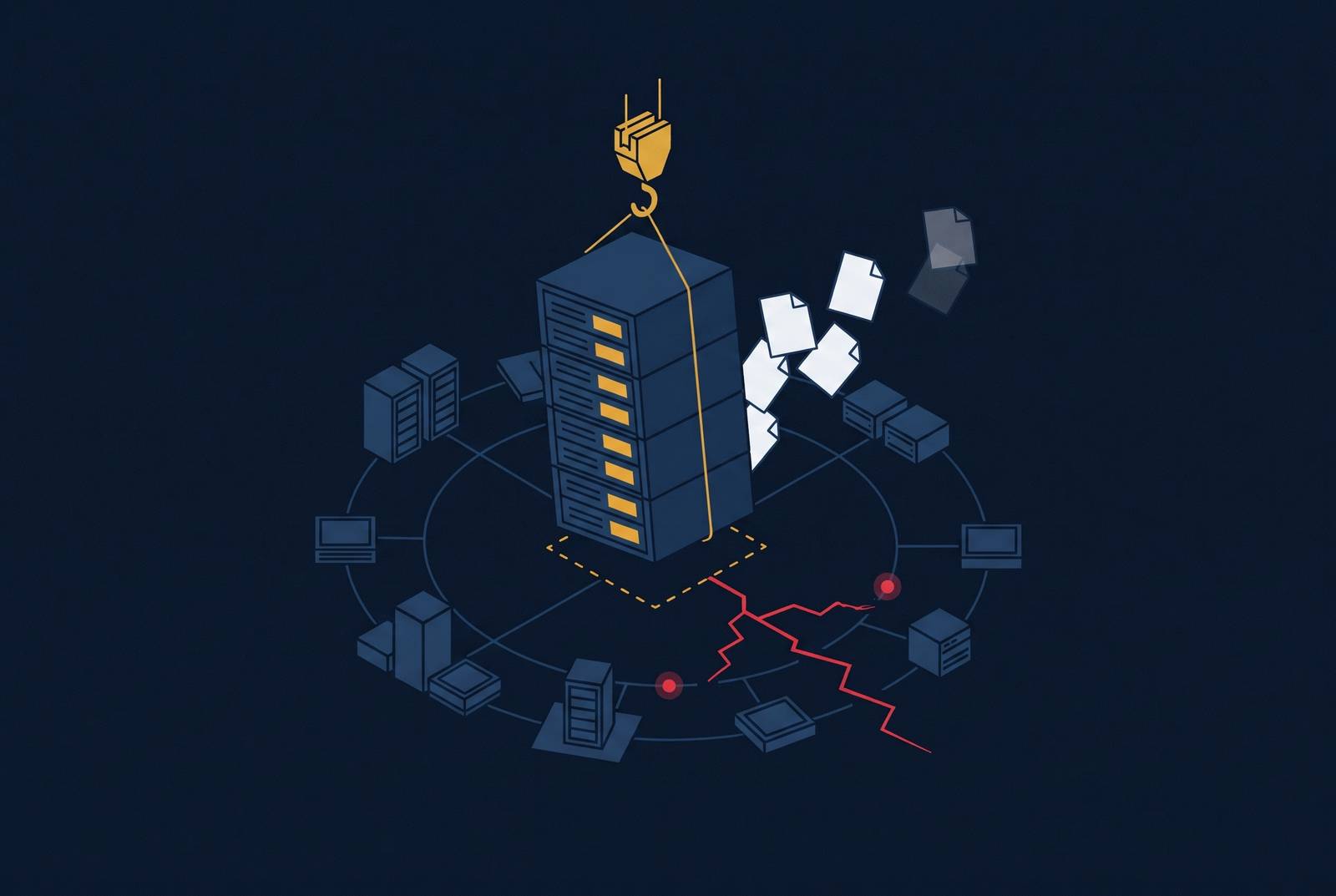
A rack relocation needs automated change propagation across power and cooling assignments, cable schedules, rack elevations, and operational records. Without that connection, each completed move can leave documentation debt that compounds into a portfolio governance crisis. The structural remedy is a connected workflow in which one recorded change updates every dependent record before the move is considered complete.
How a rack relocation creates a documentation obligation, and what happens when that obligation goes unmet
A rack reaches its new position and the move closes, but the port map still describes the old setup. A cable label is wrong. The equipment has moved, while part of its documented identity has stayed behind. JK Technology Services describes the consequence when no one can confirm the last correct setup as “everything seems fine, but the outage clock keeps ticking.” Physical completion and operational completion are not the same.
Every relocation creates obligations across asset registers, power feed assignments, cable schedules, rack elevations, patch panel port maps, circuit IDs, and DCIM records. If an obligation goes unmet, the gap can pass into every downstream system that treats the unfinished record as current truth. The unpaid work becomes documentation debt, with the next task inheriting the uncertainty.
A completed move therefore needs a handover package that describes what was actually installed. That includes the final asset register with new locations, as-built rack elevations, the network diagram, cabling certification results, and patch panel port maps. Circuit IDs and carrier contacts, IP addressing and DNS changes, power feed assignments, and a closed punch list complete that account. These are not optional finishing touches after delivery. Documentation written after the fact is already degraded because it must reconstruct the move.
Why fragmented toolchains make incomplete documentation the path of least resistance
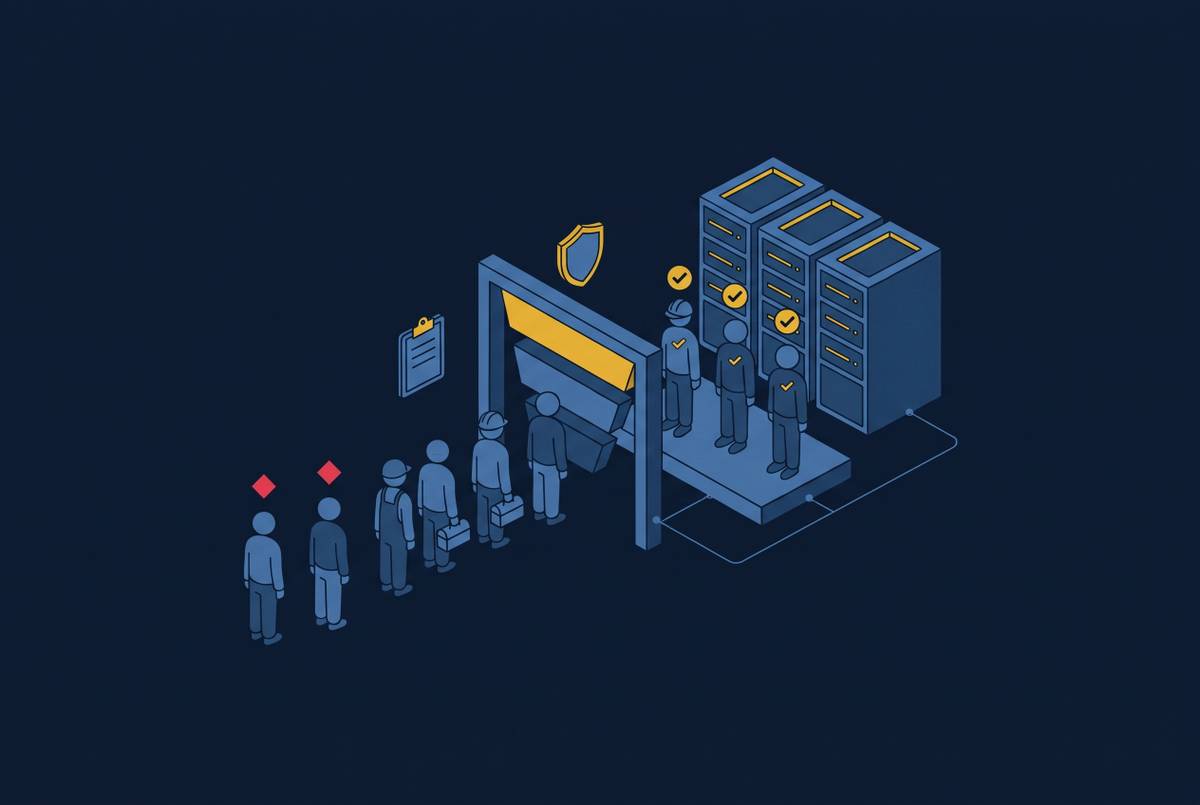
Facilities, network, and cloud teams have long used different tools and data schemas. A move crossing those boundaries must therefore be transcribed into several systems. Each team may finish its physical work while another record still needs attention. The workflow makes those two states possible. Closing the move ticket before completing the documentation is a predictable result of that separation.
BIM provides geometry, but the DCIM import requires a parallel effort to collect operational data from submittals and shop drawings. Those documents may sit in a construction management platform that operations can no longer get into after project closeout. The same asset must then be described through disconnected processes. Rather than inheriting a usable execution record, operations inherits another data-collection job.
Geometry alone also does not describe the sequencing of a real move. Without built-in version control for branching a relocation scenario and merging changes back, deviations accumulate outside the model. An informally answered RFI about cable routing, a power whip specification, or a rack elevation becomes an undocumented as-built deviation if the answer never reaches the model. The work advances, but its record does not. Each such decision adds to the debt before the work reaches the formal handoff.
JK Technology Services sets the inventory standard in terms an auditor would recognise. Serial numbers, dependencies, and physical condition must match the current state. Yet validated inventory that meets that standard is the exception. The mismatch is built into a process that requires repeated manual entry across tools. More diligence can help with an individual update, but it cannot remove the repeated work that makes incomplete documentation the easier route.
How individual debt units compound into portfolio-scale governance failure
With dozens of moves per year, unfinished updates become more than a few one-off gaps. Each move adds records that may be wrong, while later work still relies on them. The growth is not merely additive. A new move against a degraded baseline is harder to reconcile because the team must first establish whether the starting record was correct. The cost of resolving the latest discrepancy includes part of the unresolved history.
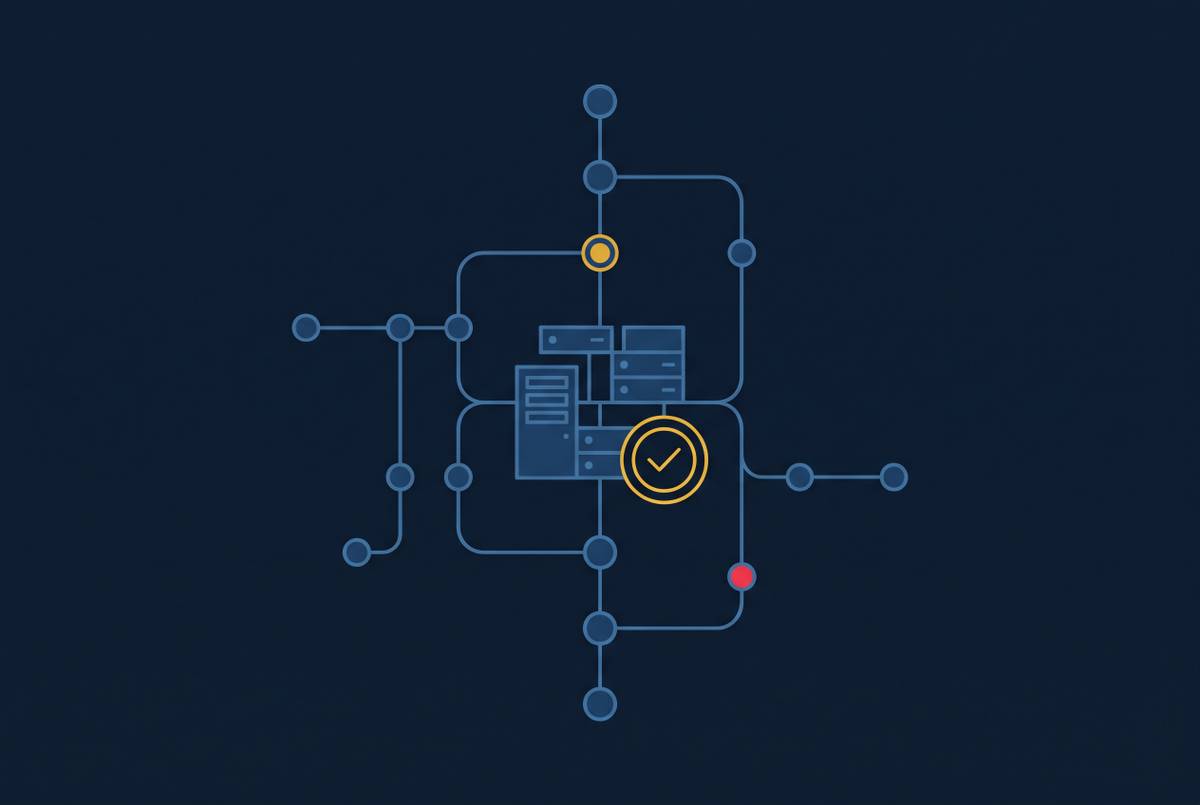
That produces a chain reaction inside the management tools. Outdated inventory feeds misleading capacity reports, alerts attach to incorrectly catalogued equipment, and change records diverge from the real environment. Those outputs then become inputs to later work.
3EX Hosting's 2026 checklist gives a concrete dependency example. Moving a web server without its corresponding database host breaks the stack. If that relationship is absent from the record, an accurate location for the web server alone does not make the next move safe. The planner needs the relationship as well as the asset. At portfolio scale, undocumented dependencies turn subsequent relocations into attempts to navigate without a reliable map.
This is what makes the problem a governance crisis. No single system of record holds the current truth, yet teams still need an authoritative basis for approving changes and assigning responsibility. Comparing tools does not settle a dispute when their baselines are already unreliable. Rework can consequently spread across every downstream tool and team that used the bad record. The original omission may have been small, but its reach grows with each dependent decision.
Power and cooling assignments are the highest-stakes records to let drift
When a rack moves without updates in both the EPMS and the DCIM, the next planner calculates headroom from an incorrect assignment. That calculation starts from a false premise. Even careful arithmetic cannot show how much capacity is available when the record puts demand on the wrong feed.
The same checklist makes the pre-move obligation concrete. Total kW requirements must be calculated by summing the nameplate power of every server and adding a margin for N+1 redundancy. PDU compatibility must also be established, down to connector type, before the move. Move day is too late for that discovery. These requirements connect the equipment being relocated to the power infrastructure expected to support it, so the resulting assignments need to remain current after relocation.
High-density AI workloads amplify this exposure because design loads well above standard rack density are increasingly common. An undocumented assignment error in a high-density row can have much greater consequences than the equivalent error in a conventional rack environment. A conventional rack still needs an accurate power record, and a relocation still depends on cooling conditions that match the intended use.
Armstrong's AI-ready relocation checklist treats power and cooling constraints as a sign to start planning a relocation. Its lack of a mandatory audit step for target facility power and cooling verification leaves a documentation obligation unresolved unless current conditions are established during delivery. A reason to move is not evidence that the destination can support the equipment. Power and cooling records must show what is actually in place and replace assumptions carried over from the plan.
Capacity planning decisions built on drifted records produce decisions that cannot be trusted
A capacity planning tool can produce a plausible recommendation from inaccurate DCIM data. The output may look orderly because the tool has processed its inputs as intended. Its foundation is still false. When users trust the recommendation, the error may remain hidden until the next move or expansion encounters a physical constraint. An audit can expose the same gap at a point when there is little time to reconstruct the records.
Where power availability constrains development timelines and approvals take a long time, stale records can support commitments the organisation cannot fulfil. The reverse is just as costly. Real headroom can remain invisible and unused because the recorded assignments suggest that capacity has already been consumed. In both cases, documentation debt skews decisions about where to invest.
JK Technology Services notes that demand in markets such as Northern Virginia means new facilities are leased before they are built and timelines are tighter than ever. Bad inventory data enters those decisions before the physical contradiction becomes visible. Replanning then takes place under the same time constraints that made the original decision urgent.
Automated DCIM discovery does not remove this structural problem. Even discovery running at high accuracy leaves a meaningful share of devices requiring manual reconciliation, and that work grows with facility and portfolio size. The remaining work is a hidden governance tax. Discovery can help identify discrepancies, but it does not replace a delivery workflow that keeps dependent records aligned when changes occur.
Why the operations handoff is where accumulated debt becomes irreversible without deliberate intervention
The construction-to-operations handoff concentrates all of that unresolved work at the moment accountability changes. The contractor team demobilizes, and operations inherits an environment whose documented accuracy it must accept or reconstruct. Access to construction records may also disappear after closeout. The route back to the evidence narrows.
An accurate DCIM execution record changes the nature of that transition. If it has been maintained throughout the build, handoff can be a structured event with clear completion criteria. If it has been treated as secondary, handoff becomes a negotiation over what is complete and who owns the discrepancies.
Building information model and DCIM schemas must be aligned and shared asset identifiers established before construction begins. Waiting until after commissioning makes that alignment costly and incomplete. A shared identifier gives the records a common asset to refer to, while schema alignment addresses how its information moves between systems. Both decisions belong upstream of the handoff. They cannot be replaced by a final request for better paperwork.
Astralis Tech's UK 2026 guide describes the breadth of a complete recommissioning record after relocation. It includes network configuration, connectivity and routing, power management, firmware compatibility, rack positioning, cooling optimisation, security reinstatement, and operational testing. Each part can become a debt entry if it is not documented during the move. Reconstructing all of them after delivery is an attempt to recover an execution history that the workflow failed to preserve.
How do automated updates after a rack move become a structural remedy?
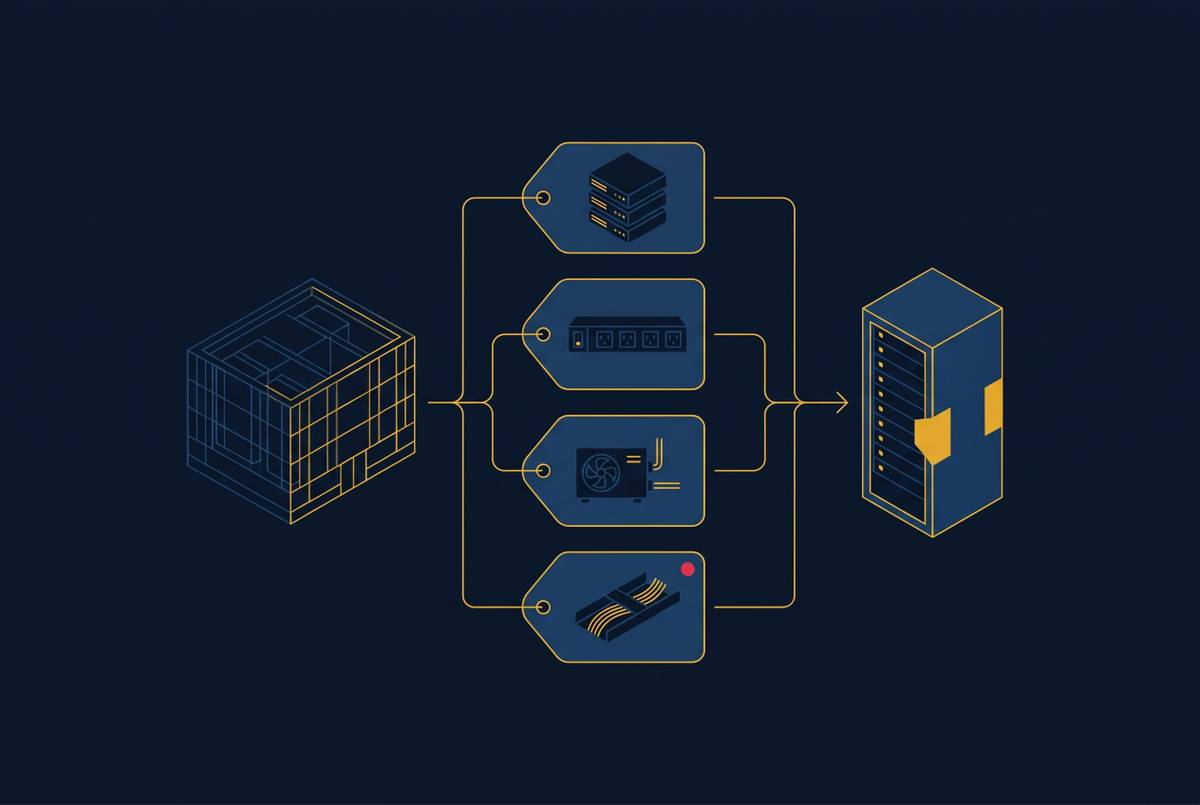
Cascade-aware automation makes one recorded change propagate through every dependent record. A rack move should update power assignments, cooling records, cable schedules, rack elevations, DCIM records, and operational handoff packages without manual retranscription at each boundary. Showing several systems together leaves the same work to do if each still has to be updated on its own. A connected workflow treats the documentation consequences as part of the move itself.
Deterministic rules and AI have different jobs in that workflow. The rules enforce the cascade so that every rack move triggers every required record update. AI supports flexible, language-rich work such as RFI comparison and specification extraction. Neither replaces the other. Equipment data extracted from manufacturer specifications should flow straight into models, schedules, and validation rules without anyone having to re-enter it each time the tools change.
Traceability must remain intact through that process. JK Technology Services frames chain of custody as a control system covering who had the asset, where it was, and its condition. Gaps in that account lead to documentation gaps and extended outages. The UK guide likewise calls for audit-ready documentation and strict custody controls across rack mapping, cable removal, and transport. Every asset must be traceable from extraction through final disposition, with its operational record kept alongside it throughout that process.
The practical test is whether a move can close while its dependent records still describe the old environment. More checklists leave that possibility intact if the tools remain disconnected. Connected discipline instead pays for accurate records as delivery proceeds, with updates tied to the changes that create them. That cost is incremental and predictable. The economics of fragmentation become fully visible only when a move, audit, or expansion forces the organisation to repay its accumulated debt at once.