Structured Asset Taxonomy Requirements for BIM Handoff That DCIM Systems Can Actually Ingest
Define asset taxonomy before construction to move BIM data into DCIM without rework.
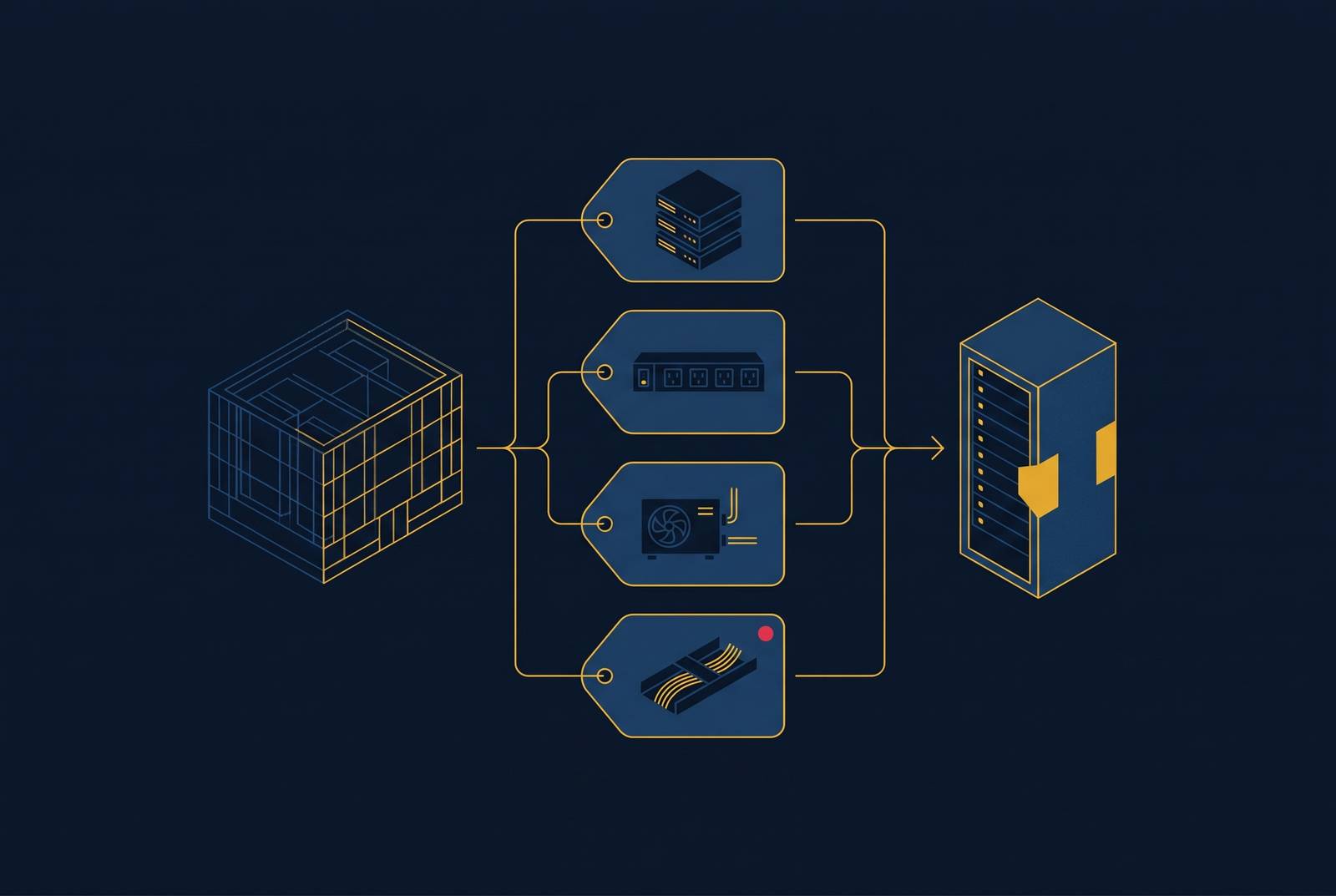
A DCIM-ready BIM handoff requires an asset taxonomy defined at project kickoff. That taxonomy must specify shared identifiers, required attributes, asset relationships, and monitoring-point tags that the receiving system can ingest. Getting structured asset data from BIM into DCIM without manual re-entry depends on making those rules contractual, assigning ownership, and testing them against live operations.
Why BIM-to-DCIM handoffs fail at the data layer, not the model layer
At commissioning, the operations team discovers that the completed model cannot be imported into DCIM without rework. The familiar complaint is that “the BIM didn't transfer.” Yet the geometry may be sound. A mechanical unit can have detailed duct routing but no structured fields for its rated capacity, maintenance intervals, firmware version, and monitoring point identifiers. The model satisfies a construction deliverable but not the receiving system's data requirements.
That distinction changes where the repair belongs. Better modeling alone cannot fill in missing operational records or make identifiers match across systems. When those identifiers diverge, integrations, reports, and model references need manual translation, with the work growing across asset classes and system boundaries. A digital twin does not escape that problem. Moving from a visualization tool to an operational asset requires it to reconcile design intent with as-built conditions and live, structured data.
Why the taxonomy is never defined at kickoff, and what that costs downstream
The failure begins when operational data is treated as something to assemble at handover. By then, the model's structure already reflects other priorities. Construction, IT, and operations work to different timelines and definitions of completion, so asset tagging and DCIM fields can fall between their deliverables. Nobody has to reject the taxonomy for it to disappear. It simply never becomes an early requirement that shapes the model.
Retrofitting that requirement is expensive and rarely complete. The construction team has demobilized, equipment submittals are scattered, and the opportunity to capture accurate installation data has passed. The DCIM platform therefore needs to be provisioned and partly configured before construction finishes, so as-built conditions can be captured incrementally. Otherwise, differences between the reported inventory and what is in the racks leave ghost assets and stranded capacity. Contracts can address this with a simple but often missed requirement to fill in DCIM data and set naming rules and acceptance criteria during construction, before they are requested at handover.
What does a DCIM system need before it can ingest BIM asset data?
DCIM needs a structured network of assets. Its ingestion process must place each record in the right hierarchy, normalize identifiers, and recognize when records from different vendors describe the same asset. De-duplication depends on those relationships and identifiers being usable. Free-text descriptions cannot take the place of a shared asset identity. The incoming schema must support both the initial import and later synchronization.
BMS, EPMS, and DCIM need shared identities to combine environmental monitoring, electrical measurements, and asset records without repeated translation. Sunkara's DCIM 3.0 framework describes a semantic knowledge graph that turns telemetry and configuration into contextual understanding. For that context, structured identifiers and relationships must be in place before the data arrives, without having to guess the relationships after import.
Maintenance is part of the requirement, too. CPCON reports that asset databases drift 2 to 5 percent per month where there is no automated tracking. A taxonomy that allows a clean import but no ongoing updates starts to be less useful as soon as the facility changes.
The two available standards — IFC and COBie — and what each one actually covers
IFC and COBie perform different jobs in the handoff. IFC, or Industry Foundation Classes, is an open-standard schema covering geometry, materials, systems, and attributes across the building model. COBie structures handover information through 19 data tables and 144 data fields. The National Institute of Building Sciences maintains the current reference standard in NBIMS-US V4. The two standards are complementary.
Neither format decides what the project must populate. Schema alignment still has to identify which BIM attributes transfer to DCIM and which operational fields need another source. Some model detail is of no use in operations, and geometry cannot supply all the data needed to run the facility. For most federal and enterprise builds, a hybrid arrangement is the realistic approach. DCIM holds authoritative operational records for assets, spatial relationships, power topology, and environmental monitoring, while BIM remains the design-of-record reference.
Naming conventions — the rules that make every asset identifier resolve correctly across systems
The practical specification starts with a shared naming convention. Construction, IT, and operations should agree on it before construction begins and enforce it before the first asset is modeled. Each identifier must be unique, persist through the asset lifecycle, and resolve across BIM, CMMS, DCIM, EPMS, and BMS. Renaming later spreads the repair across linked objects.
A well-formed identifier has a defined structure built from location hierarchy, system class, and sequence. Location encoding includes facility, data hall, row, rack, and U-position, while system classification distinguishes power, cooling, network, fire protection, and security. With that structure, DCIM can find equipment and filter records without having to interpret free-text descriptions. Point naming also needs clear rules for who owns commands, setpoints, alarms, and resets before protocol mapping starts.
ArchiLabs Studio applies naming conventions as structured rules at the model level. Its approach propagates the correct identifier through power, cooling, cable, and documentation when a rack moves or equipment changes. That connected workflow addresses the renaming burden that otherwise falls across separate tools.
Attribute schemas — which data fields must be populated for each asset class, and by whom
A correct identifier attached to an empty record is still an ingestion failure. The attribute schema must define required fields and acceptable values for each asset class, together with the phase responsible for supplying them. Different equipment needs different data. The record for a UPS needs its rated capacity, input/output configuration, runtime at load, and firmware version. A CRAC unit requires airflow rating, cooling capacity, refrigerant type, and setpoint range, while a server requires make, model, serial number, U-position, power draw, and network port assignments.
Those differences determine who supplies each part of the record. The design team provides equipment type, location, and system relationships, while vendors provide performance specifications through approved submittals. The commissioning agent supplies as-installed and verified operating parameters. Each transfer needs a formal acceptance step. Firmware versions and monitoring point identifiers must come from submittals and commissioning records.
The data in manufacturer PDFs should go into structured model attributes, schedules, and validation rules. Studio's structured data approach links that specification data to the model without anyone having to enter it again by hand. Warranty information, spare parts lists, and preventive maintenance intervals also belong in the operational handoff, although construction deliverables often omit them.
Classification hierarchies — how to structure the asset tree so DCIM can navigate it
The path for physical containment goes from facility to data hall, row, rack, and U-position. The power path runs from utility feed to main switchgear, distribution panel, PDU, outlet, and device. These are different navigational axes. DCIM must be able to query either without a manual lookup.
The hierarchy must also encode relationships across asset classes. A rack belongs to a row, receives power from a PDU, and depends on cooling from a CRAC unit. Its cooling dependency is a relationship shaped by airflow geometry and hot-aisle/cold-aisle configuration, which must extend from the spatial model into the operational data.
That cross-system structure is what makes impact analysis possible. Power events become thermal events within minutes, while BMS controls cooling, EPMS monitors electrical systems, and SCADA provides operator visibility. A hierarchy optimized for only one layer leaves the others without the context needed to follow the dependency.
Tagging standards — how Project Haystack and protocol-level point naming connect the taxonomy to live operations
Asset records alone do not connect the model to operations. The taxonomy must also identify monitoring points and connect them to the equipment they describe. Project Haystack provides the tags site, equip, point, and meter to standardize meaning across platforms. Those tags bridge asset identity and telemetry identity. When used during design, they give commissioning a mapping that is already defined, so names do not have to be worked out under deadline.
Names at the protocol level must follow the same asset taxonomy. Common assignments include SNMP v3 for IT monitoring, Modbus RTU/TCP for power equipment, and BACnet for BMS and HVAC. Northbound connections from DCIM to NOC/ITSM use HTTP/HTTPS APIs and MQTT. The tagging schema must also preserve the command, setpoint, alarm, and reset ownership established earlier, so overlapping control authority does not become a commissioning failure.
PUE provides a concrete test of this alignment. Its calculation requires synchronized data from EPMS and DCIM, so inconsistent tags between those systems make the reported figure unreliable.
Cable and fiber routing — why physical routing data must be part of the taxonomy, not an afterthought
Cable routing is often treated as construction coordination data and omitted from the operational handoff. That omission breaks connectivity tracing in DCIM. For a route modeled for clash detection to work as an operational record, it still needs a cable ID, circuit served, origination and termination points, and routing path. Each cable must connect to the assets it serves, the ports where it terminates, and the pathway it follows. Those links enable automated impact analysis when moving a rack, which otherwise calls for cable tracing by hand.
The physical consequences make this more than a documentation gap. Cable trays serving server rows compete with chilled water supply and return mains for the same overhead space. Resolving a field clash can mean rerouting live cable tray or cutting and re-welding insulated pipe. The same routing information is needed to coordinate construction and to trace connections during operations. Discarding its structure at handoff separates two uses of the same asset data.
Studio plans cable pathways through the data hall and routes trays to avoid clashes with other services. Because that routing shares a workflow with rack layout and power topology, the resulting data is structured for DCIM ingestion rather than left for separate extraction and reformatting.
How to define taxonomy requirements at project kickoff — a contractual and workflow framework
The lesson for a project team is to make taxonomy compliance an acceptance condition. Construction contracts should name the required DCIM fields by asset class, the naming convention, and the acceptance criteria at each commissioning milestone. “Provide the model” is not enough. The deliverable must include populated operational data, with a named party responsible for taking it through handoff.
The taxonomy specification should be written during design development. It must cover naming conventions, required attributes, classification hierarchies, tagging standards, and point ownership. Operations should review it before construction documents are issued, and the construction contract should reference it as an acceptance criterion. This gives the receiving team a defined role before the model's structure hardens.
The integration architecture also needs a design-stage decision. Federated models preserve source-system fidelity but add synchronization complexity, while consolidated models require more normalization upfront and produce a more stable operational artifact. For federal builds, ATO considerations belong in this decision because access-control constraints affect which connections are viable.
Ownership must then transfer explicitly from the construction contractor to operations, with documented responsibilities and a sustainment plan for ongoing change control. At commissioning, sensor and telemetry validation must confirm that every tagged monitoring point resolves correctly in the live system.
Studio connects layouts, critical-systems engineering, cable routing, documentation, RFIs, and operations-ready handoff within a single project workflow. Its role is to keep the agreed taxonomy attached to the work as the project changes. A separate specification can drift from the model. A connected workflow lets the kickoff requirements govern the downstream deliverables that operations actually receives.