Standard Design Programs and Reference Architectures Across Multi-Site Portfolios
Standard designs only work when data flows cleanly from architecture to operations at handover.
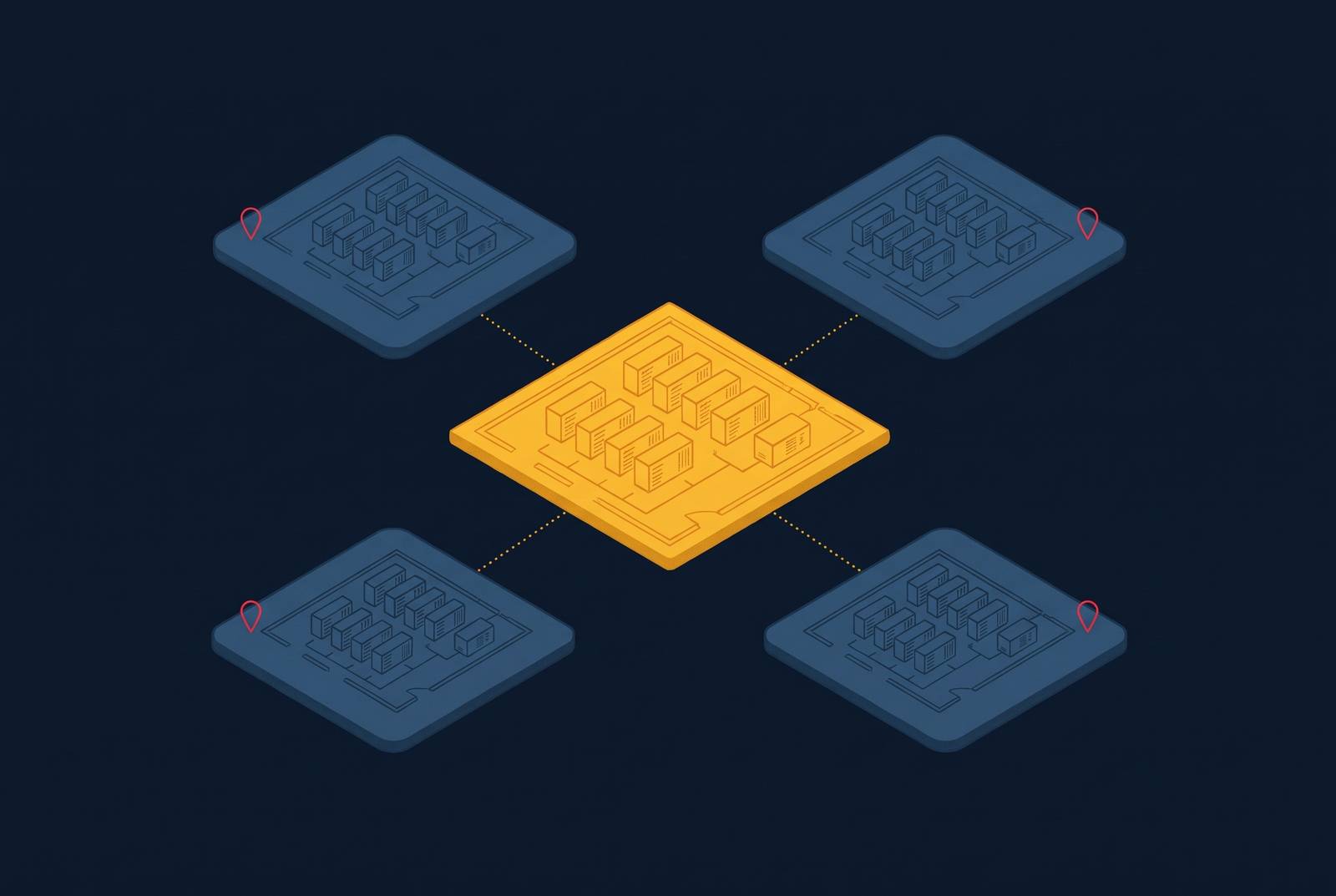
A standard design program makes multi-site delivery repeatable by defining what stays fixed, what can vary, and who approves changes. For a DCIM-ready handoff from design models to operations, that standard must set out shared asset identifiers and data structures that line up before construction begins. ArchiLabs Studio supports this work through coordinated schedules, asset records, and API-ready data for DCIM, EPMS, and BMS, rather than leaving operations to reconstruct design information at handover.
Why multi-site portfolio delivery keeps failing without a standard design program
For a portfolio owner, the promise of scale is that each new site should benefit from the work already done. Instead, the design process often starts again. The team repeats concept development, review, coordination, and rework, consuming the same engineering effort that the first project required. Individual projects may be sound, but the portfolio has no repeatable delivery system.
The damage extends beyond the design schedule. A different power topology, cooling approach, or cable routing convention introduces another set of relationships that must be coordinated and tested. Those differences slow commissioning because each facility needs its own resolution of problems that could have been settled once. Local exceptions accumulate into a portfolio-wide integration burden. A team that has not established a repeatable approach by its fifth site has no reason to expect its fifteenth to become easier simply because it has built more facilities.
What a standard design program actually is — and what it is not
A standard design program is a governed system of decisions. It specifies what stays fixed across sites, what may vary, and who can approve a deviation. The fixed layer includes architecture-level choices such as the structural grid, power topology, cooling strategy, critical-systems integration approach, and asset naming conventions. The variable layer accommodates utility interconnection, local code requirements, ground conditions, plot geometry, and regional equipment lead times.
A reference architecture is an input to that system. It is a blueprint that a vendor publishes or an in-house team develops to show how compute, networking, power, and cooling fit together. The program governs how that blueprint is applied, modified, and maintained across the portfolio. A folder of reused drawings does not provide that authority, even if its contents are technically strong. The governing principle is to standardize the repeatable parts and customize only what the site forces, with change control, deviation approval, and version management keeping that boundary intact.
How AI-era rack densities are redrawing the fixed/variable boundary
AI workloads make that boundary harder to draw. Conventional rack designs assumed power demands in the single-digit kilowatt range, while high-density GPU racks need electrical distribution, mechanical systems, and structural loading to meet very different demands. The old assumptions do not simply scale up. Power topology, cooling strategy, and rack layout now depend more heavily on the workload a facility serves. A portfolio standard must account for those differences without turning every workload decision into permission for a custom design.
Liquid cooling shows why this is a governance problem. Dedicated coolant distribution, rack flushing protocols, and leak detection need to be standardized as a system across sites. EdgeConneX’s modular reference design program calls for standard, maintenance, and emergency operating procedures that meet the needs of high-density AI infrastructure. Its operational-readiness approach also has cross-functional teams work together throughout the facility lifecycle.
Sites built for large-scale model training and sites configured for distributed inference have different layout, redundancy, and network topology requirements. One blueprint may not serve both well. The program must set out site classes and decide which parts of the architecture stay fixed in each class and which can be configuration options. Those decisions belong before site design begins and before the supporting systems are selected.
Why critical-systems coordination — power, cooling, and cable — must be resolved in the standard, not on each site
The chosen redundancy arrangement and the distribution boundaries between utility, generator, UPS, busway, and PDU affect cooling plant sizing, structural loading, and maintenance access. Leaving those relationships unresolved transfers the coordination work to each project, where different teams can reach different answers. The standard must set out both which equipment each discipline can use and how the systems fit together.
That consistency also creates a basis for portfolio procurement. EdgeConneX’s program shows how standardized generators, UPSes, switchgear, and cooling units make bulk procurement feasible. Per-site variation removes that leverage and the schedule benefits it can support. Network design follows the same logic. Aruba’s ESP Data Center Design Validated Solution Guide documents spine-leaf topology for AI workloads as a reference architecture choice governing connections among switches, storage, and compute nodes. Embedding that choice in the standard prevents sites from developing incompatible fabrics that cannot be operated or monitored consistently.
A rack move exposes the practical coordination problem. It can trigger changes across power, cooling, cable routing, and documentation, and a site-specific design makes that rework difficult to transfer elsewhere. ArchiLabs Studio addresses these dependencies through connected layouts, power and cooling coordination, cable routing, and documentation. A change should cascade through the connected work, replacing separate manual revisions. Otherwise, the portfolio loses both the coordinated result and a reusable lesson for the next site.
How reference designs are evolving from static blueprints into maintained platforms — and what that demands of the delivery team
A reference design becomes less useful when it cannot change in response to operational feedback or new workload requirements. Schneider Electric and NVIDIA’s March 2026 partnership uses AVEVA software and NVIDIA Omniverse to develop lifecycle digital twins supporting design, simulation, build, operation, and maintenance of gigawatt-scale AI factories. Procore and NVIDIA’s partnership in the same month integrates the Procore Platform with the NVIDIA Omniverse DSX Blueprint to establish a continuous digital thread.
That shift demands explicit version control from the delivery team. When a cooling technology becomes standard or a power density tier is added, every downstream site in design or construction must be assessed against the change. An update is not automatically appropriate everywhere. The program needs an owner with authority to issue revisions and hold sites accountable to the version they are building. Without that owner, standards that seem to be shared drift into versions that differ from site to site without anyone choosing those differences.
The same discipline changes how equipment and software are selected. The program therefore becomes a procurement filter as well as an engineering framework. A proposed solution must meet a project’s needs and fit the architecture as it is kept up to date. That makes ownership of the standard consequential to purchasing decisions as well as design reviews.
How do design models deliver a DCIM-ready BIM handoff to operations?
A DCIM-ready handoff from a design model requires shared asset identifiers and explicit alignment between the model’s data structure and the receiving systems’ requirements. Those decisions must be made before construction begins. A program that specifies drawings and construction deliverables but leaves asset data undefined can produce consistently built facilities that are operated inconsistently. Each site then inherits a different integration arrangement, assembled by different contractors.
The receiving systems have different jobs, but some of those jobs involve the same physical assets. BMS covers mechanical and environmental plant, EPMS covers the electrical path from utility to rack, and DCIM covers IT assets, rack space, power capacity, and network connectivity. Different contractors often deliver these systems, each with its own scope of work. Integration can fall outside all of them. Without a shared identifier strategy and a common requirement for data alignment, each contractor can deliver a working system while leaving the owner with incompatible records.
Asset naming fragmentation is the visible result of that gap. The same physical asset can have different identifiers in each system, so people have to match the records by hand during monitoring, capacity management, and incident response. Across multiple sites, that work compounds. The standard must specify both how assets are identified and how their records are structured for the receiving systems. Retrofitting those relationships after handover costs more than defining them once, and it blocks the shared operational knowledge the portfolio was supposed to accumulate.
ArchiLabs Studio delivers coordinated schedules, asset records, and API-ready data to DCIM, EPMS, BMS, and owner systems through a single workflow. The claim covers structured delivery. The useful comparison is with a handoff that leaves operations to translate design information or manually re-enter it. When the required data is structured during design, handover becomes confirmation that the records are in the agreed form. The software supports that outcome, but the program must first define the identifiers, data requirements, and responsibility for integration.
How the standard design program governs RFIs, submittals, and change traceability across a portfolio
Commissioning validates systems against design intent, so undocumented decisions create a break in the evidence needed to explain what was built. That break becomes expensive during testing. An RFI answered outside the project record may settle a question at the time but leave no way to trace the answer to the design decision it supports. At portfolio scale, the loss extends beyond the current project. The decision cannot inform the next revision of the standard if the program’s owner cannot find and evaluate it.
RFIs, submittals, and change orders form a connected record. A submittal change can trigger a change order, and the relationship must preserve what was decided, why, and what it cost. Managing those instruments separately can sever that chain. An approved equipment substitution or power topology deviation on one site then remains confined to local use. Capturing the decision allows the governance team to distinguish a necessary site exception from evidence that the standard needs revision.
AI-assisted submittal checking can support that traceability before purchasing commits the project. It compares a vendor submittal with the approved basis of design, specifications, drawings, and contract requirements before a purchase order is released. AI-assisted submittal checking produces a cited, requirement-by-requirement exception list. Discrepancies stay in the traceable record. The same principle applies to RFI responses, which need a recorded connection to design intent so that commissioning and future design reviews can use the answer.
What separates teams that build a standard design program that scales from those whose standard quietly fragments
Teams that scale treat the standard as a governed, versioned artifact with an explicit owner. That ownership has to include enforcement authority. Every approved deviation must enter the project record, and the team reviewing a new site must be able to require compliance or escalate an exception. The next revision must also include feedback from the teams that operate commissioned sites. These responsibilities work together because a versioned document alone cannot control changes that are never recorded or reviewed.
The organization must span the facility lifecycle as well. EdgeConneX’s operational-readiness approach has teams from engineering, construction, operations, and risk management work together throughout that lifecycle. This keeps the standard from becoming a document passed between teams with no continuing responsibility for its use. Tooling has to support the same continuity. Layouts, power models, cable routing, and documentation kept in disconnected files can diverge as soon as a change reaches one file but not the others.
Data in manufacturer PDFs has to be pulled into models, schedules, and validation rules before it can be used for automatic validation. Without that connection, a site can install equipment that has quietly departed from the standard. ArchiLabs Studio brings layouts, critical-system coordination, cable routing, documentation, RFIs, validation, and operations-ready handoff into one workflow. Connected automation allows changes to propagate rather than become a queue of manual revisions across disciplines and sites.
The standard design program is the mechanism that turns a portfolio into a delivery system. Governance gives it authority, ownership, and a controlled path for learning. ArchiLabs gives teams the tools to keep those decisions connected through design changes and handoff. Neither replaces the other.