FERC Order 2023 Impact on Data Center Interconnection
FERC's new rules force data centers to pick their grid service tier before breaking ground.
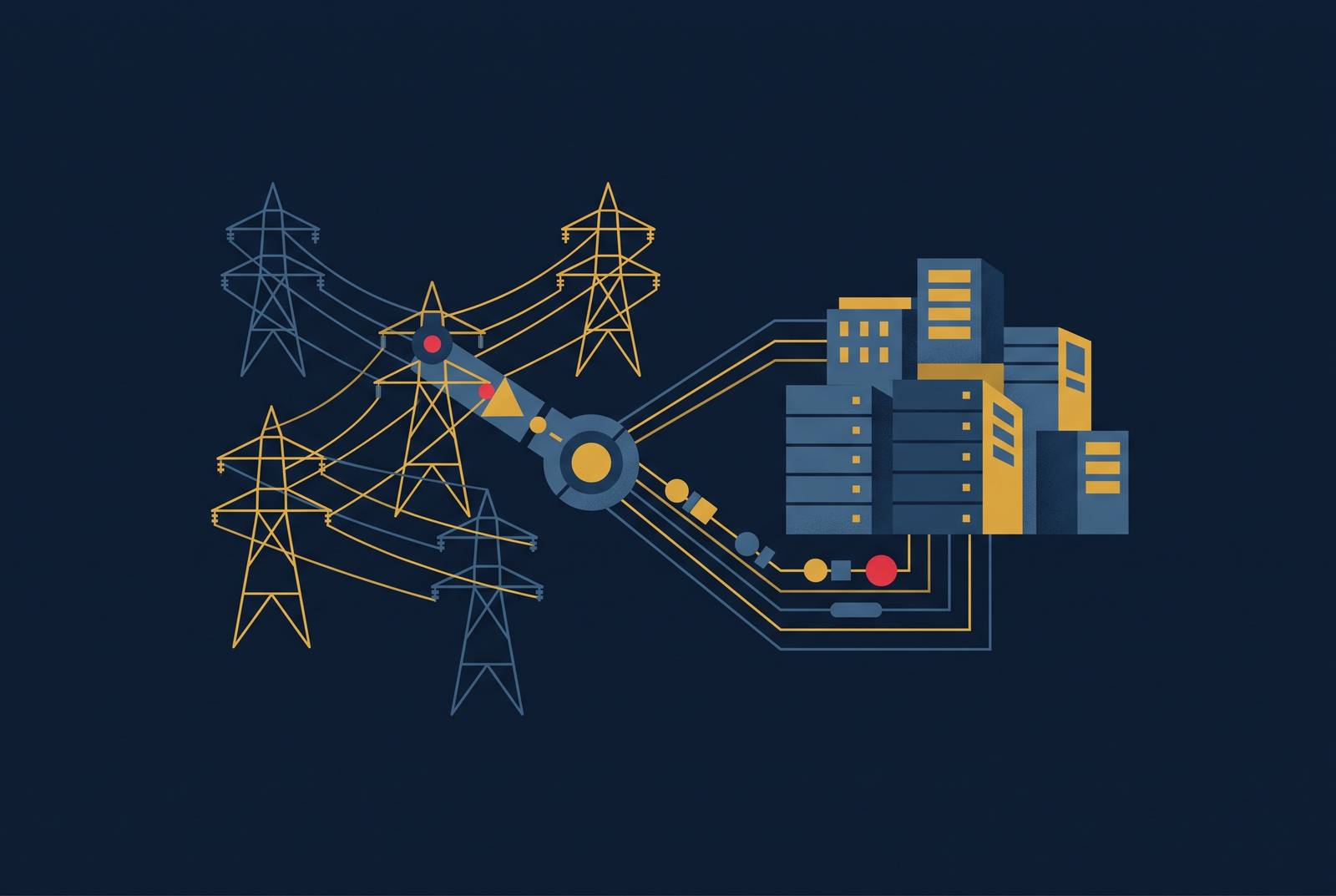
FERC Order 2023 rewired how generators get onto the grid. It said nothing about how data centers do, and that silence has now split into two of the most consequential rulemakings the agency has issued in years: a December 2025 order rewriting PJM's colocation rules, and a June 2026 set of show-cause orders aimed at all six major grid operators. Together, they mark the moment interconnection stopped being a queue problem and became a design problem, one that data center developers now have to solve before they pour a single foundation.
What Order 2023 changed, and where it stalled
Order 2023 came out in July 2023, and its target was the generator interconnection queue: the backlog of wind, solar, storage, gas, and nuclear projects waiting for a study slot. Before the order, PJM and most other grid operators ran queues on a serial, first-come-first-served basis. A project entered, got studied on its own timeline, and everyone behind it waited. Order 2023 replaced that with cluster studies: batches of projects studied together, prioritized by commercial readiness rather than by whoever filed first. FERC called it "first-ready, first-served," and backed it with real teeth. Transmission providers now face financial penalties for missing study deadlines, have to publish capacity heatmaps so developers can see where headroom exists, and require a nonrefundable $5,000 fee just to enter a cluster window, a small but real filter meant to screen out speculative filings. The order also let battery storage share a single interconnection request with a co-located generator.
None of that touched load. Order 2023 was written for things that put power onto the grid, not things that pull power off it. Data centers, which interconnect as demand customers, sat completely outside its scope. Nobody built the order with hyperscale computing in mind, because in 2018 there wasn't much need to. A large data center back then ran a fraction of today's loads. Today, hyperscale campuses have grown dramatically in scale, and a handful of announced AI campuses are being planned at unprecedented sizes. Rack density alone tells the story: single-digit kilowatts per rack a few years ago, over 100 kW now. Meta broke ground on a 900 MW facility in Wisconsin. The load side of the grid grew up fast, and the rulebook never caught up.
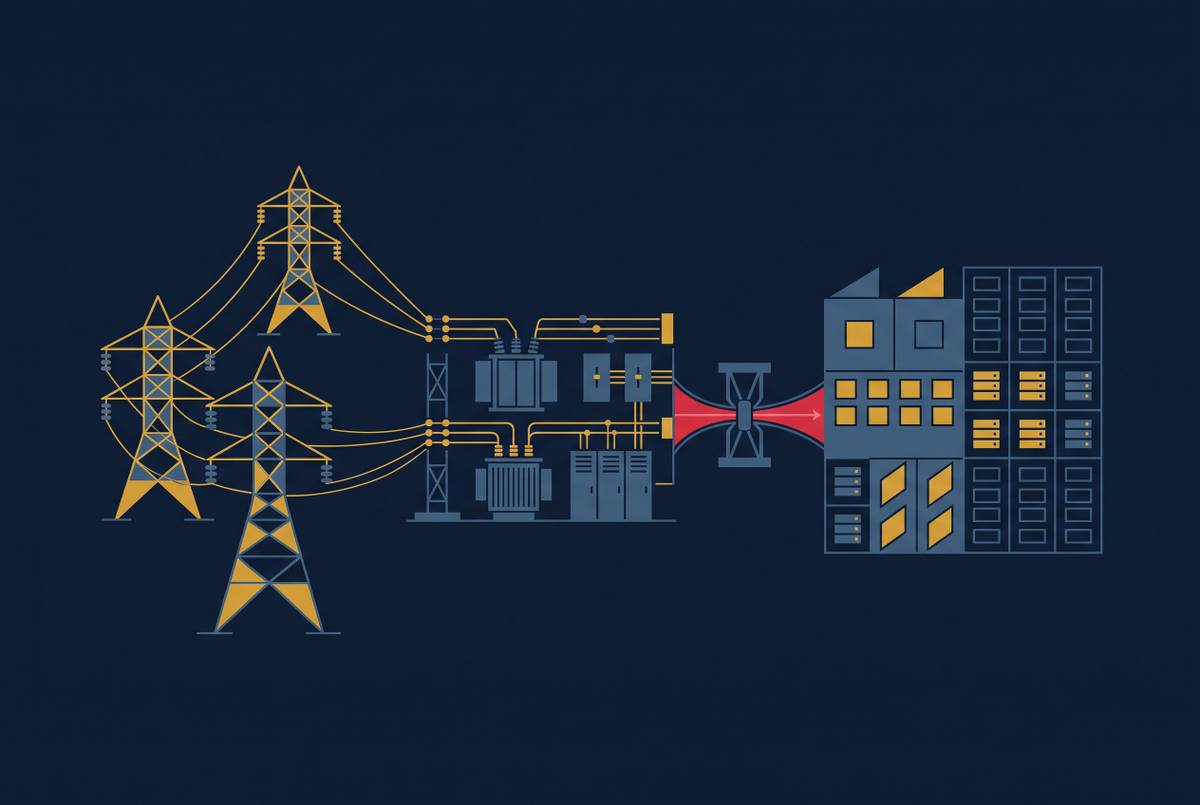
Compliance on the generation side has been sluggish too. FERC only partially accepted PJM's Order 2023 compliance filing in July 2025, sending it back for more revisions, and a second revised version got only partial approval in April 2026. The design target for cluster studies is around 315 days. PJM's actual average interconnection timeline, as of 2025, runs over eight years, nearly ten times the paper goal. The queue did shrink somewhat, from roughly 2,600 gigawatts in 2023 to 2,300 gigawatts in 2024, but most of the projects that left the queue had filed before Order 2023 took effect. That drop reflects withdrawals and pruning, not the reform working as intended.
PJM's December 2025 capacity auction made the load-side gap impossible to ignore. Forecast peak load for the 2027/2028 delivery year came in 5,250 MW higher than the previous year's forecast, with nearly 5,100 MW of that jump, an entire new power plant's worth of demand, traced directly to data center demand. That is not a rounding error. That is an entire new power plant's worth of demand appearing in a single forecast revision, driven by data center load growth, with no interconnection framework built to handle it.
The December 2025 PJM colocation ruling
One day after that capacity auction shortfall became public, on December 18, 2025, FERC issued a unanimous order finding PJM's tariff for co-located loads "unjust and unreasonable." The specific defect: PJM had no proper rates, terms, or conditions for a generator serving a load that sits physically on the generator side of the interconnection point, the classic setup for a data center built next to a power plant. Without clear rules, PJM's footprint covering 13 states and D.C., which serves 67 million people, ended up treating similar colocation arrangements in inconsistent ways depending on which utility or region handled the filing.
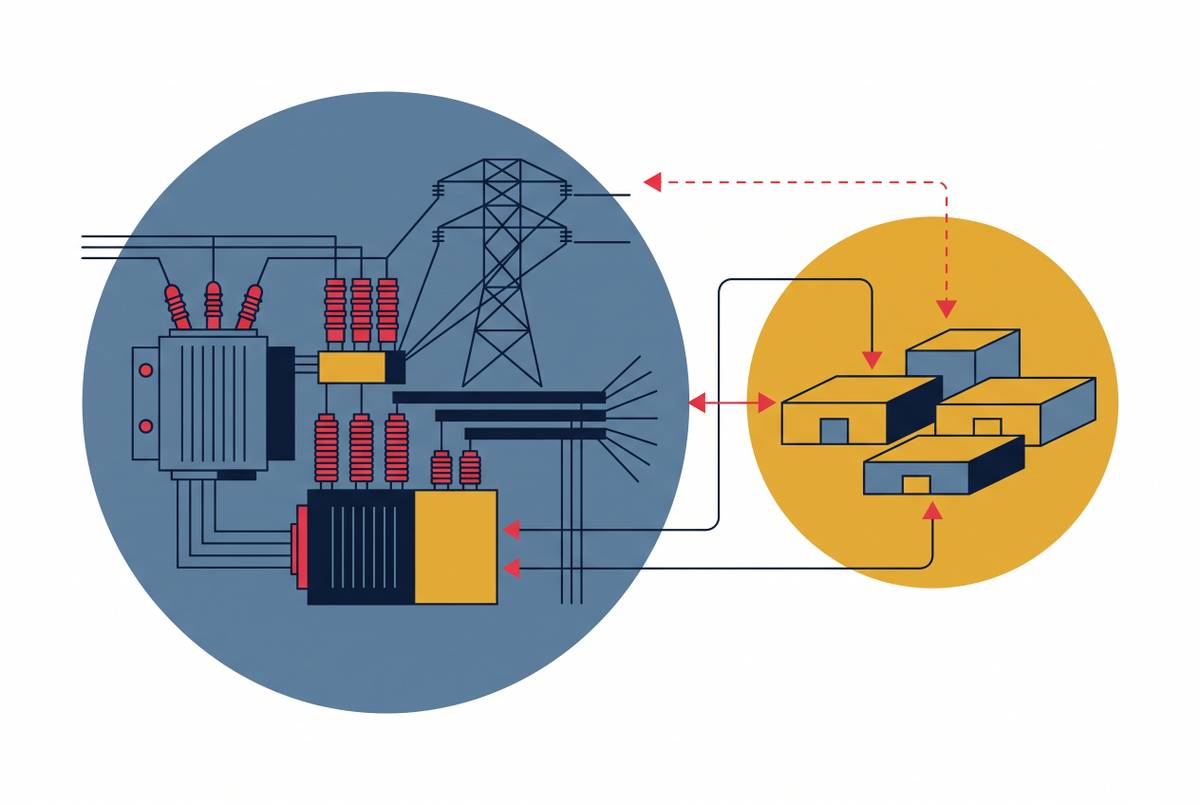
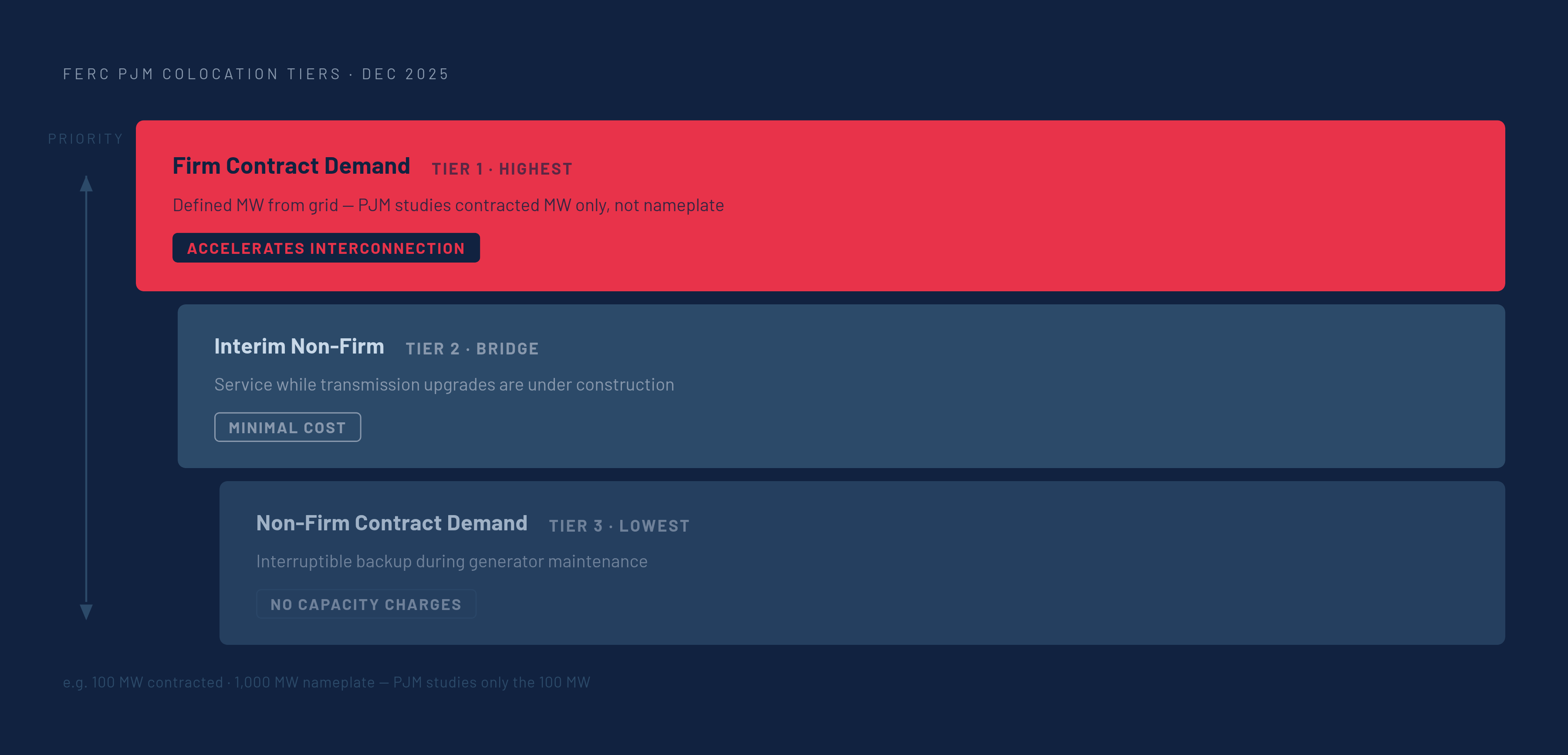
FERC's fix was to create three distinct transmission services, each with its own priority and price. Firm Contract Demand sits at the top: a data center contracts for a defined MW quantity from the grid, and PJM studies and plans for only that contracted amount, not the facility's full nameplate load. A 1,000 MW facility co-located with a generator could elect just 100 MW of Firm Contract Demand, and PJM's study obligation shrinks to match, only those 100 MW get evaluated for grid impact. Non-Firm Contract Demand sits below it: interruptible service meant for emergency backup during generator maintenance, with no capacity charges attached. Interim Non-Firm fills the gap in between, a bridge service that covers a facility while transmission upgrades are still under construction, again at minimal cost.
FERC also tore into PJM's rules for Behind-the-Meter Generation, calling them "outdated and potentially unfair" once applied to loads the size of a modern data center campus. PJM now has to propose updated rules for how much load can be netted against on-site generation, rather than continuing to apply BTM rules that were designed for smaller, older arrangements. Current BTM customers get a three-year transition window, expiring December 18, 2028, and certain existing contracts are grandfathered in. The order didn't just add a service tier. It forced PJM to draw lines around a practice that had grown well past the scale anyone originally designed it for.
The June 2026 show-cause orders: FERC extends the framework to all six RTOs
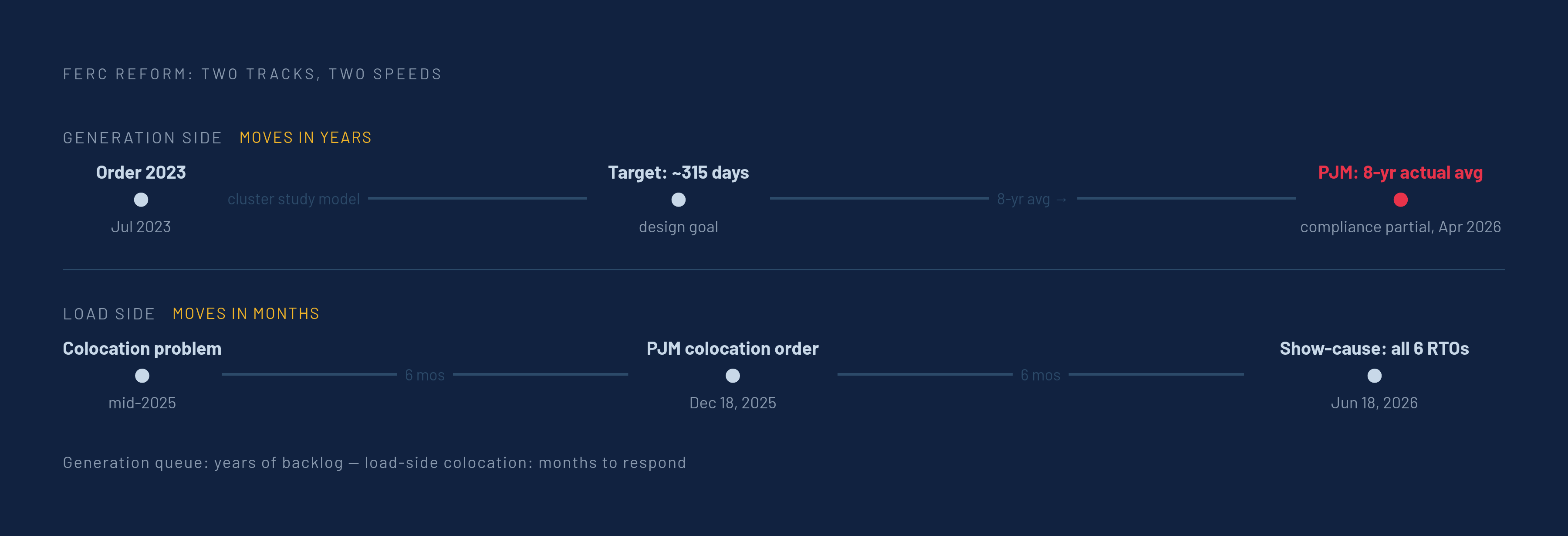
Six months later, on June 18, 2026, FERC widened the lens. It issued six separate show-cause orders under Section 206 of the Federal Power Act, one apiece to PJM, MISO, SPP, CAISO, ISO New England, and NYISO. The preliminary finding in each: existing tariffs may be unjust and unreasonable because they fail to properly address how large loads and co-located loads, including data centers, manufacturing plants, and other big power users, get integrated into the grid.
FERC drew a specific line for what counts as a "large load" under these orders: peak demand above 50 MW, interconnecting to transmission lines rated above 69 kV. That threshold sweeps in most hyperscale campuses and a good chunk of industrial facilities too.
The choice to issue six customized orders instead of one nationwide rulemaking wasn't incidental. Each order addresses the specific tariff language of its RTO, reflecting the fact that PJM, CAISO, and NYISO all run genuinely different market structures.
Two reform tracks running simultaneously
By mid-2026, FERC is effectively running two interconnection reform projects at once, on two very different clocks. The generation-side track, Order 2023's cluster study model, is still being implemented unevenly across the RTOs and moves in years. PJM's own compliance saga, stretching from July 2025 into April 2026 and still not fully resolved, is proof of how slow that gear turns. The load-side track, the December 2025 PJM order and the June 2026 show-cause orders, moves in months.
That mismatch creates real friction. FERC has to protect open, non-discriminatory access for generators, the entire premise Order 2023 was built on, while also speeding up load-side access for data centers that increasingly want to sit right next to a power plant. FERC's framework requires that transmission providers maintain open, non-discriminatory access regardless of resource type or end-use load. Holding both of those commitments at once is not simple, and the agency's own mandatory reliability reports, reveal that load growth may be outrunning new generation, producing a resource adequacy risk that shows up in reserve margin warnings and capacity price spikes. That is not a queue management inconvenience. That resource adequacy risk appears in reserve margin warnings and capacity price spikes, not just as a longer wait time.
For a developer, the practical upshot cuts both ways. Colocation and flexible large-load service can move a project onto the grid faster than the old model allowed. But the generation asset that arrangement depends on, if it doesn't exist yet, still has to clear the multi-year Order 2023 queue on its own separate track. Speeding up one half of the transaction doesn't speed up the other.
The new framework for securing grid access for data center projects
The old playbook ran in sequence: pick a site, then go apply for interconnection. Grid access was a downstream administrative step, handled after the real decisions were made. That sequence doesn't work anymore. Wait times in major data center markets can run well beyond five years for a new grid connection, and similar bottlenecks occur in Dallas, Phoenix, and Columbus. Site selection and interconnection strategy now have to happen at the same time, because the queue position a site offers can add years of delay that neither a lower land price nor good fiber access can offset.
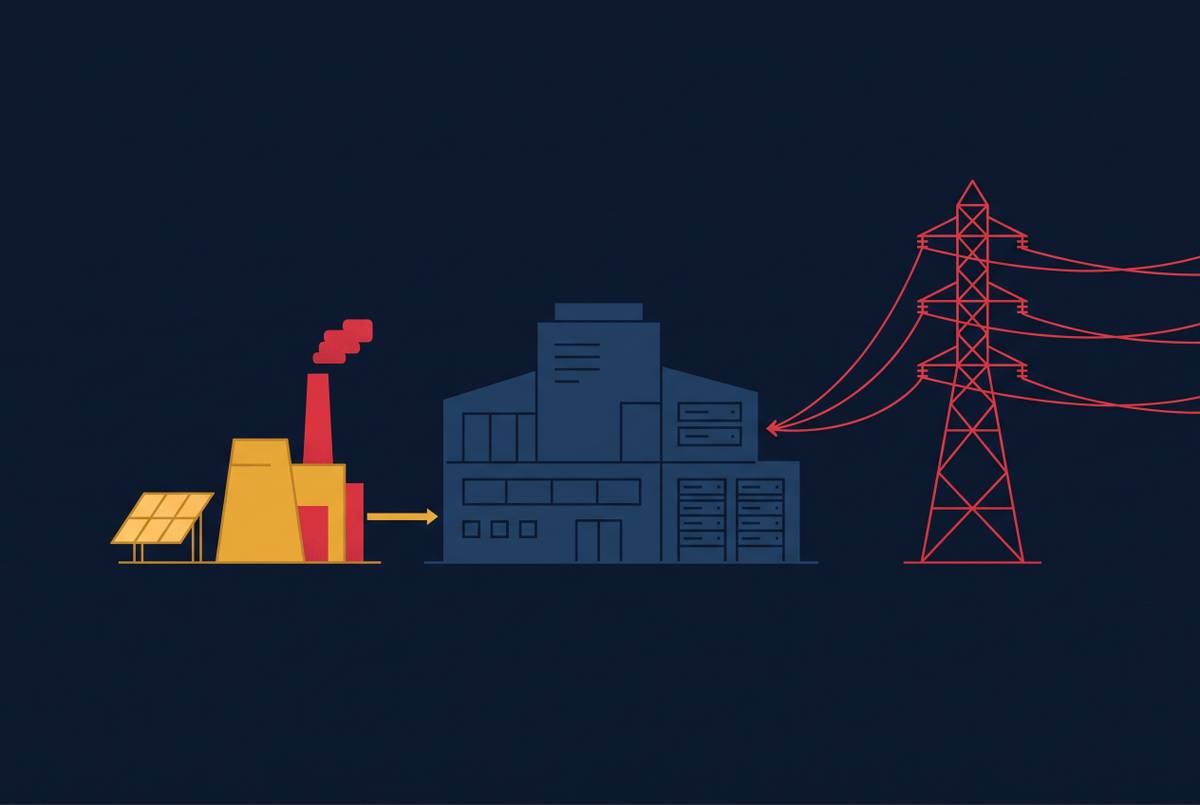
Colocation, thanks to the December 2025 order, is now a real federal pathway rather than a workaround negotiated deal by deal. Firm Contract Demand lets a facility size its grid obligation down to a fraction of its total load, say, 100 MW out of 1,000 MW, and that smaller number is what actually gets studied, which can meaningfully shrink the time and complexity of the interconnection process for that portion of the load. The June 2026 orders also signal that FERC is open to "bring your own generation" arrangements, where a data center brings its own power source to the table rather than relying entirely on the grid. That openness comes with strings attached: cost responsibility and reliability obligations still need careful structuring, and getting that wrong turns a fast-track project into a stalled one.
Interconnection timelines and their effect on the design and delivery schedule
Grid interconnection now sets the master schedule for a data center project, even when the actual construction is routine. The time from interconnection request to commercial operation can span many years. The project clock starts ticking at the queue application, not at the building permit.
That timing reshapes engineering decisions in ways that used to happen much later. Power infrastructure sizing has to be locked in before the mechanical design that depends on it, because rack density, cooling strategy, and electrical architecture are tied together and can't wait for a construction-document phase to sort out. Under Firm Contract Demand service, the exact MW figure a facility contracts for becomes part of the interconnection filing itself, so a design team's early load assumptions turn into a regulatory commitment. Changing that load profile after the filing goes in puts the project at risk of a restudy, which can add months to a schedule that was already running on a multi-year clock. Design flexibility, once nearly free, now carries a real cost measured in queue position and lost time.