Operational Readiness Gates That Force BIM Handoff to Meet DCIM Intake Standards
Pre-project data contracts enforce standards that BIM alone cannot deliver to DCIM.

A DCIM-ready BIM handoff from design models to operations requires a data contract agreed at project kickoff, then enforced through design, construction, and commissioning gates. That contract defines shared asset identifiers, field mappings, deployment states, and acceptance evidence. Software can automate the transfer, but it cannot repair requirements that were never agreed before the work began.
Why BIM-to-DCIM handoff fails without a pre-defined data contract
BIM is built to satisfy architect and contractor deliverable obligations, while DCIM is configured to run a live facility. Those purposes produce different data requirements. Without an early agreement, the design team can meet its obligations and still deliver a model that operations cannot use. The failure is contractual and chronological. By the time construction is underway, the mismatch is embedded in the way equipment and its attributes have been recorded.
Anchor Defense's federal DCIM guide states that handoff requires explicit schema alignment and a shared asset identifier strategy before construction begins. The identifier is the link between project phases. Without one that persists through design, construction, and commissioning, each handoff reconciliation becomes a manual exercise in matching records to equipment. Transferring files late in the project cannot restore that link between phases.
Assigning DCIM administration to the construction contractor does not resolve the problem. The contractor also needs standards that define the operational record. Otherwise, DCIM may be configured around construction logistics. When the contractor demobilizes, the operations team inherits that configuration and the work of untangling it. The earlier negotiation must therefore settle both the required data and the responsibilities for maintaining it.
What does DCIM actually need at intake, and why does BIM rarely deliver it?
DCIM intake requires structured records. Each asset needs a persistent identity, defined fields, and a deployment status that describes its actual condition. Equipment objects in BIM can supply weight, dimensional, and power attributes, but their export must be specified. Only some BIM attributes are useful to operations, and some DCIM fields require sources outside BIM. The target specification must distinguish the two.
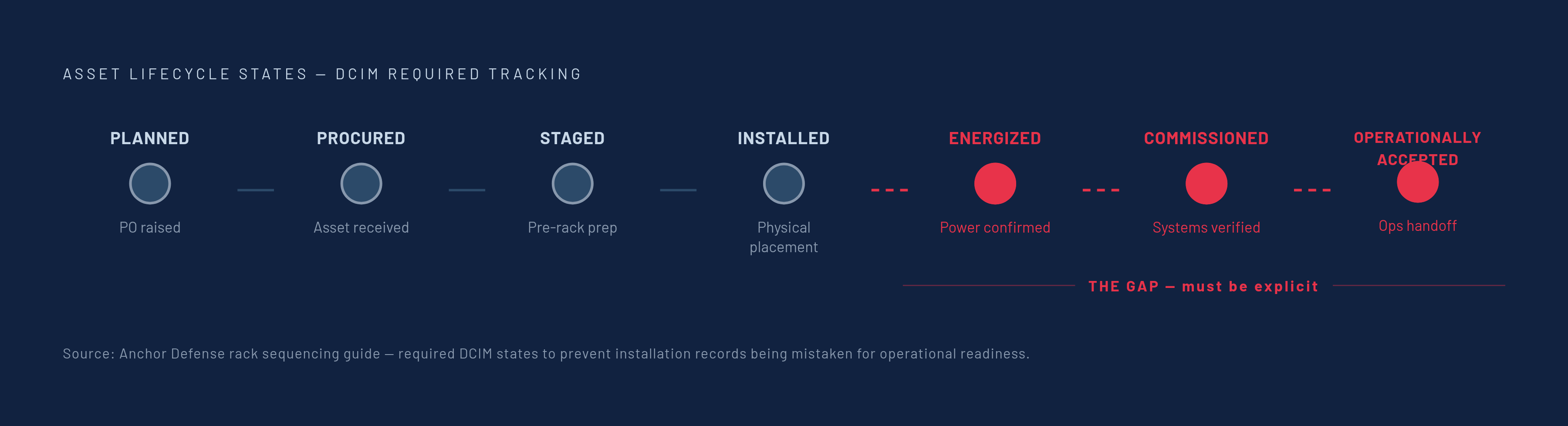
Status is a required part of that specification. Anchor Defense's rack sequencing guide identifies the minimum asset states as planned, procured, staged, installed, energized, commissioned, and operationally accepted. These states keep a record of installation from being taken as proof that an asset is ready for use. DCIM also needs evidence linked to the right asset or connection. For fiber and telecom, OTDR and insertion-loss results have limited operational value unless they can be queried against specific strands or termination points.
The authoritative record also needs a clear home. The federal guide recommends a hybrid architecture in which DCIM holds physical assets, spatial relationships, power topology, and environmental monitoring, while BIM retains links for geometric and spatial context. BIM is not continuously updated after handover under this approach. That division makes the intake requirement precise. Operations needs a usable asset model.
What a negotiated data contract looks like and when it must be written
The data contract is a concrete project deliverable agreed by design, construction, and operations at kickoff. It defines the shared asset identifier strategy, the BIM-to-DCIM field mapping, and the acceptance criteria for each gate. It must be settled before design documentation is issued for construction. This is when changes are cheapest. Leaving the agreement until commissioning turns a planned transfer into a search for missing information.
Each destination field needs an agreed source. The contract must specify which BIM exports populate which DCIM fields, which fields require manual entry, and which depend on commissioning test data. That distinction prevents an empty field from becoming a surprise at handoff. It also keeps automation claims honest, because some operational information does not exist in the design model.
The contract also fixes when the operational system must be available. The federal guide warns that waiting until occupancy to configure DCIM loses the opportunity to capture as-built conditions incrementally. DCIM provisioning and some of its configuration must therefore take place during design, before construction is complete. The acceptance criteria for telecom rooms should be set in DCIM before construction begins. Tying acceptance to record completeness makes data quality part of installation quality.
The white space state model: why gates need more than a binary ready/not-ready status
A room can be construction-complete without being ready for equipment. The rack sequencing guide distinguishes construction complete, infrastructure ready, and operationally released at the space level. Construction complete means the work on the raised floor, containment, and structure is done. Infrastructure ready means power circuits are certified, cooling is balanced and validated, and network pathways are confirmed. Operationally released means all acceptance criteria have passed and the space is cleared for rack population.
Collapsing these conditions removes the dependencies that gates must enforce. A finished floor does not prove that power is certified. Likewise, infrastructure readiness alone does not prove that every acceptance condition for rack population has been met. Treating the states as interchangeable allows physical progress to stand in for operational evidence. This leads to premature installation, even when the status record appears complete.
Asset states need the same discipline, with defined entry criteria for every transition. An installed asset that has not been functionally tested, configured, or validated against the design baseline is not ready for operational use. Default DCIM values such as available, occupied, reserved, and decommissioned describe steady-state operations but do not cover all the states needed during a build. A rack position may be allocated on paper while physically empty, awaiting power certification, and blocked by a punch list item.
Gate one: design-phase data alignment before construction documents are issued
The design gate checks whether the project is set up to meet the agreed contract before construction documents are issued. The shared asset identifier strategy must be confirmed, and operations must agree to the documented field mapping. DCIM must also be provisioned with the zone structure and deployment status model that will govern the build. Telecom room acceptance criteria must already be defined there. Without this setup, the written agreement cannot yet be enforced.
Equipment attributes belong in this gate as well. BIM equipment objects should already have the weight, dimensional, and power attributes that will be exported. If those attributes are absent, the handoff will require manual entry. The gate asks whether the model contains the agreed inputs for the operational record.
Passing the gate establishes how later design changes must be handled. When RFIs affect equipment specifications, power topology, or cable routing, DCIM must be updated too, and the gate criteria should make that duty clear. Otherwise, the original mapping may remain correct while the information moving through it becomes wrong. Skipping this gate leaves both the initial data requirements and the treatment of subsequent changes unresolved when construction begins.
Gate two: infrastructure-ready reconciliation at construction milestones
Field substitutions and scope changes test whether the data contract survives construction. The rack sequencing guide identifies changes that bypass DCIM updates as the primary source of as-built discrepancies in federal data centers. It calls for build-phase move/add/change control with the same rigor as steady-state processes. A substitution is not just a field decision. It also changes the record that operations will inherit.
At the infrastructure-ready gate, DCIM zone status must be reconciled against the construction punch list. Certified power circuits, balanced and validated cooling, and confirmed network pathways are dependencies that must resolve before an installation work order is released. Power certification, network port assignment, and cooling zone validation must be confirmed in DCIM before a rack position advances to operationally released. Without structured states and workflow integration, spreadsheet and verbal coordination allow planned configurations to drift from installed ones.
RFIs belong in this reconciliation because unresolved questions can mean unresolved asset configurations. Each RFI affecting power topology, equipment specifications, or cable routing should be scored for commissioning impact and downstream DCIM coordination risk. Cost alone is a poor proxy for that risk. A low-dollar clarification can block electrical energization or integrated systems testing. Until the answer is resolved and reflected in DCIM, the record represents an assumption.
Gate three: commissioning evidence as the validation mechanism for operational acceptance
Commissioning checks the agreed model against what has been installed. The federal guide identifies sensor and telemetry validation as the mechanism that turns a static model into a live digital twin. The model needs that validation before it can be used to make operational decisions. Design intent alone is not sufficient evidence. If reconciliation is skipped, the operational dataset starts with discrepancies already in it.
At operational acceptance, commissioned assets must be reconciled against commissioning test records and the CMDB. Every accepted asset needs a corresponding configuration item with accurate attributes. The rack sequencing guide treats this as a gate criterion. Fiber and telecom acceptance also requires OTDR and insertion-loss results linked in DCIM to specific strands and termination points. Standalone PDFs do not meet that standard because they cannot be queried against the specific connection being accepted.
The federal guide calls for formal design-to-as-built reconciliation with defined acceptance criteria. Ownership of model accuracy must then transfer explicitly from the contractor to operations. Written responsibilities and a sustainment plan must cover how change control will be handled over time. The transfer needs a durable record in DCIM. That record identifies who accepted the handoff, what was accepted, and which exceptions were documented at that moment.
What deterministic rules enforce and where AI supports the gate workflow
Deterministic rules enforce conditions whose outcomes must be unambiguous. Phase balance, clearance requirements, redundancy architecture, and power circuit certification status belong in this category. They must compute continuously as the layout is assembled. Smart components can encode clearance, weight distribution, cable length, airflow, and phase-balancing checks. A violation must be flagged before the relevant state transition is approved.
AI supports the work surrounding those decisions. During design and construction, it can extract RFI metadata, detect duplicate questions, identify aging unanswered items, and summarize long technical threads. Cross-referencing drawings and specifications can help expose unresolved coordination issues. Exposure reports can then flag items that block a gate before they put the schedule at risk. These tasks help reviewers find evidence, but they do not replace a certification or establish that an engineering constraint has passed.
Physics-informed machine learning models for thermodynamics can depend on geometry, so new IT equipment or altered containment can make them obsolete and lead to sub-optimal control. Deterministic rules are therefore the safer foundation where gate precision and compliance are non-negotiable. Sunkara's DCIM 3.0 framework describes a more unified architecture, using ontology-driven resource reasoning to put telemetry and configuration in context. Its autonomous orchestration links design, deployment, monitoring, and continuous optimization, illustrating a mature enforcement layer rather than a reason to remove explicit gate criteria.
How ArchiLabs Studio structures the data contract and enforces it across gate transitions
ArchiLabs Studio Mode connects layouts, critical-systems engineering, cable routing, documentation, RFIs, and operations-ready handoff in a single workflow. In that structure, the data contract is a live set of rules and field mappings. This addresses the fragmentation behind missed updates. The design gate has defined attributes to test, while later gates remain connected to the changes that affect them. Enforcement does not depend solely on coordination across models, spreadsheets, and PDFs.
Equipment information taken from manufacturer PDFs goes straight into models, schedules, and validation rules. That gives BIM objects the weight, dimensional, and power attributes needed at DCIM intake without anyone having to enter them again by hand. Changes then propagate through connected automation. When a rack moves, the change cascades across power, cooling, cable, and sheets, becoming a validated state transition that updates the DCIM record without manual entry. The same change in a fragmented workflow would require rework across four systems.
The RFI workflow preserves the connection between decisions and their supporting information. Every answer and design decision is traceable, so commissioning and DCIM records reflect resolved design intent. Structured handoff to DCIM, EPMS, and BMS is the finish line. Studio is designed to deliver the operational model developed through the project. Its role is to enforce the early agreement through each transition, while the commissioning gate still requires evidence from the installed facility.